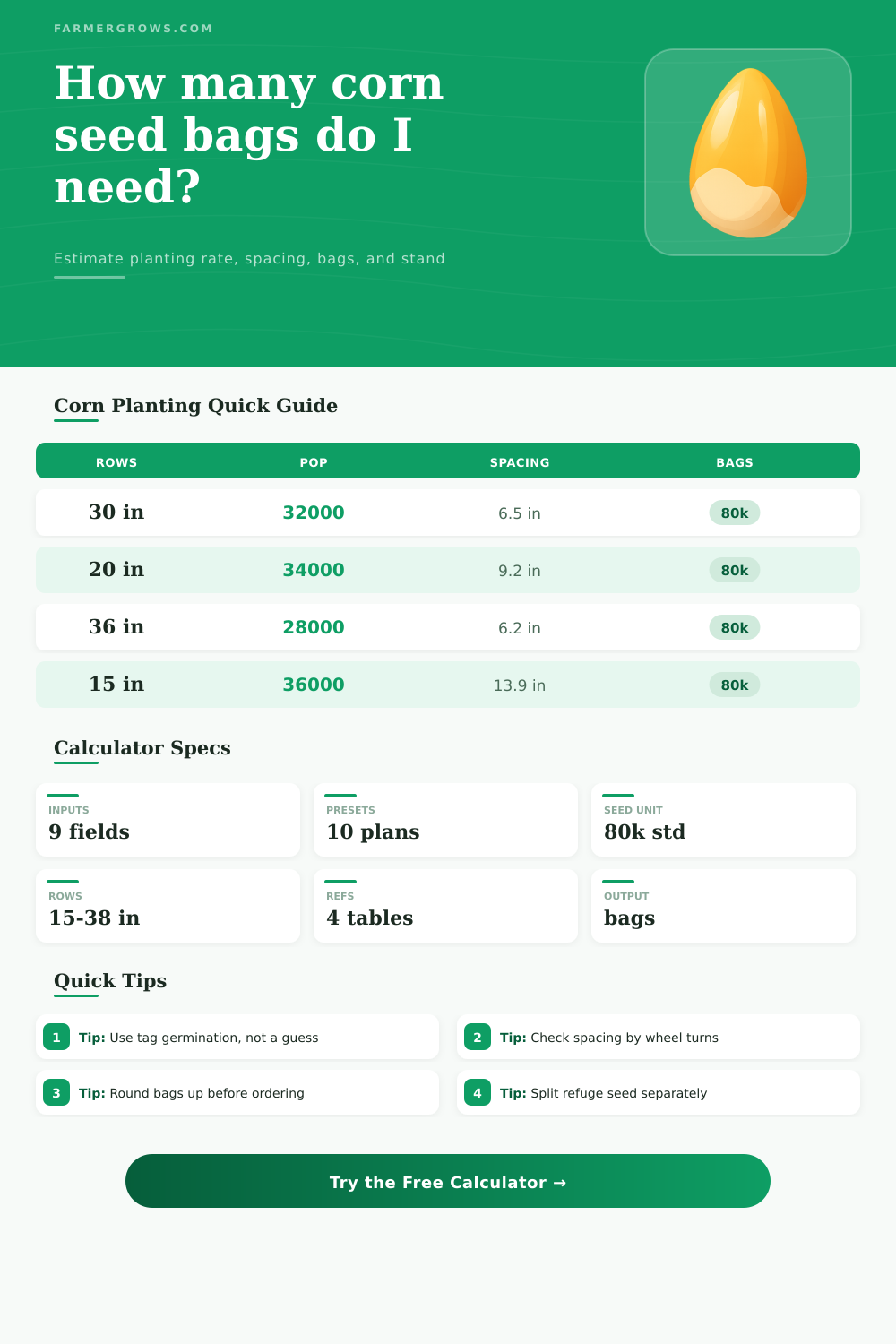
Corn Seed Calculator
Estimate planting rate, seed spacing, corn seed bags, refuge split, and final stand from acres, target population, row width, seed quality, and planter loss.
Use tag germination and your own emergence history when possible. This estimator treats target population as desired final stand and then backs into seed drop using germination, emergence, and planter loss.
Corn Seed Plan
Enter your field and seed values, then calculate.
| Row spacing | Row feet per acre | Spacing at 30,000 seeds/ac | Spacing at 34,000 seeds/ac |
|---|---|---|---|
| 15 in rows | 34,848 ft/ac | 13.9 in | 12.3 in |
| 20 in rows | 26,136 ft/ac | 10.5 in | 9.2 in |
| 22 in rows | 23,760 ft/ac | 9.5 in | 8.4 in |
| 30 in rows | 17,424 ft/ac | 7.0 in | 6.1 in |
| 36 in rows | 14,520 ft/ac | 5.8 in | 5.1 in |
| 38 in rows | 13,756 ft/ac | 5.5 in | 4.9 in |
| Scenario | Common final stand | Management fit | Watch point |
|---|---|---|---|
| Low rainfall dryland | 20,000-26,000 plants/ac | Flex-ear hybrids, limited water | Moisture reserve |
| Moderate grain corn | 28,000-32,000 plants/ac | Balanced fertility and yield goal | Uniform emergence |
| High-yield irrigated | 34,000-38,000 plants/ac | Strong fertility, water, and residue control | Lodging risk |
| Corn silage | 32,000-38,000 plants/ac | Canopy closure and forage tonnage | Hybrid rating |
| Fresh market sweet corn | 18,000-26,000 plants/ac | Ear size and hand harvest quality | Market specs |
| Seed unit | Seeds per unit | Acres at 32,000 seeds/ac | Best use |
|---|---|---|---|
| Standard corn bag | 80,000 seeds | 2.50 acres | Most field corn orders |
| Small trial unit | 40,000 seeds | 1.25 acres | Plots and test strips |
| Half pallet example | 800,000 seeds | 25.0 acres | Grouped hybrid planning |
| Pro box example | 2,500,000 seeds | 78.1 acres | Bulk seed handling |
| Refuge split | User entered | Varies by refuge percent | Separate non-traited seed |
| Field condition | Germination | Emergence | Planter loss |
|---|---|---|---|
| Excellent warm seedbed | 95-98% | 93-96% | 1-2% |
| Good normal planting | 92-96% | 88-93% | 2-4% |
| Cold early planting | 90-95% | 82-88% | 3-5% |
| Crusting or heavy residue | 88-94% | 75-85% | 4-7% |
| Replant risk window | Varies | Below 75% | Field count needed |
Calibrate with distance: After setting the planter, count seeds dropped over a measured row length and compare it with the calculated in-row spacing.
Separate order math: If refuge seed is a separate hybrid, use the main and refuge bag counts in the breakdown instead of buying one blended total.
Determining a proper rate of seed to plant into your field is a process that require you to find the proper rate of seed for your specific field. There are many variable that play a role in the determination of the rate of seed that should be planted into the fields. For instance, variables like the weather, the soil type within the field, the type of corn hybrid that will be planted into the field, and the condition of the planter will all play a role in the proper rate of seed that should be planted into each field.
Each of these variables has the potential to influence each of the other variables, so it is essential that you use a planning tool to adjust each of these variables at the same time. A planning tool will allow you to translate your observations of the fields into a seed order, and will prevent you from having to guess at the number of bags of seed that you will need to purchase for your field. In order to determine the proper rate at which to plant the seeds into the fields, you first must make a decision regarding the target stand of corn that you would like to establish within each field.
How to Decide How Much Seed to Plant in Your Field
Your target stand is the most important figure in establishing a proper rate of drop for the seeds, and using that stand will help to prevent any mistake that you may make during the planning of your fields. Variables like row spacing will impact the population of corn that is planted into the field. Corn that is planted into narrower rows will have less space within the row to germinate, and may lead to issues like lodging within the fields.
However, narrow rows may help with canopy closure and moisture retention within the soil. Wider rows will allow for each corn plant to recieve more resource from the soil, but will allow more soil to remain bare within the fields. The quality of the seed bags isnt the only factor in the calculation of the proper rate of seed to be planted into the fields.
The quality ratings for the bag of seed are measured under ideal condition in the seed bag, but emergence rates within the fields may be lower than the rating for the bags of seed. Additionally, the planter may skip some seeds or plant some seeds into the same location twice, which will also reduce the number of planted seeds that emerge from the fields. These factor will need to be entered into the calculator to determine the proper rate at which to plant the bags of seed.
Any change to the survival rate of the corn seeds will impact the number of bags of seed that are calculated for each field. Thus, planning software will allow you to determine whether you will run out of seed within your fields, or whether you will have extra bags of seed left over after planting within those field. In addition to calculating the proper rate at which to plant the bags of seed within the fields, you will also need to calculate the proper rate at which to plant the refuge field of corn within your farm.
The rules regarding the amount of non-traited corn that must be planted within your fields will require you to calculate the number of bags of each type of seed. Using the planning calculator will prevent you from guessing at how much seed the refuge fields will require, and will allow you to properly order each type of seed for your farm. If you fail to calculate the refuge fields of corn that are required by the insect resistance management plan, you may either buy too much refuge seed (leading to extra bags of seed that you will not use), or you may purchase too little refuge seed (leading to insufficient refuge crop within the fields).
Reference tables will tell you the various spacings for different row widths, and provide information regarding the population that should be planted within the fields according to your management and planting goals. These tables are not a replacement for your experience and knowledge of your fields and soil, but they can help you to understand the recommendations of other farmers regarding the best population rates and spacing within their field. For instance, if you have fields with light soil that does not hold water well, you should use a lower rate within the dryland corn range.
Fields with irrigation and high fertility will allow for higher rate of planted corn within the field. For each bag of corn seed that you purchase and plant within the fields during each growing season, you should utilize the same set of assumption and calculations. For instance, if you encounter a particularly cold and wet spring this year, you may choose to adjust the percentage of emerged corn within your assumption for this year’s planting, but otherwise each corn hybrid that you plan to plant within your fields during the season should use the same set of assumptions.
This will allow the corn hybrid calculations to be honest and true to the corn population within each field. The calculator will eliminate the need for manual calculation, and will allow you to focus on the overall planning of your fields and whether or not they make sense.