🐄 Cattle EPD Calculator
Compare up to 4 bulls — rank by Terminal, Maternal, or Balanced selection index
✅ EPD Ranking Results
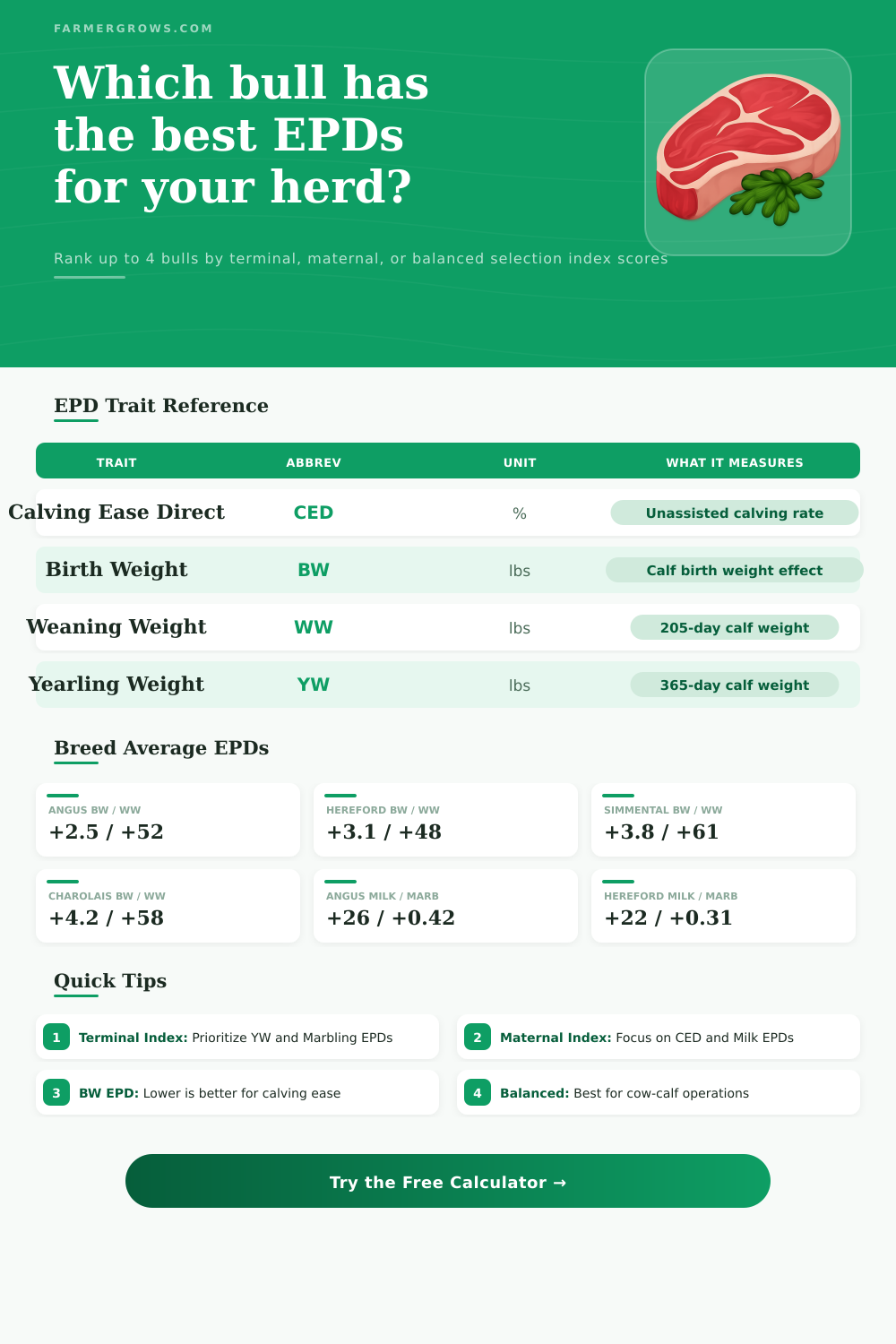
EPD Trait Definitions
| Trait | Abbreviation | Unit | What It Measures |
|---|---|---|---|
| Calving Ease Direct | CED | % | Unassisted calving rate as sire |
| Birth Weight | BW | lbs | Effect on calf birth weight |
| Weaning Weight | WW | lbs | 205-day adjusted calf weight |
| Yearling Weight | YW | lbs | 365-day adjusted calf weight |
| Milk | Milk | lbs | Milk contribution to calf weaning weight |
| Marbling | Marb | score | Intramuscular fat / carcass quality |
| Ribeye Area | REA | sq in | Muscle area, yield grade indicator |
| Fat Thickness | Fat | in | Subcutaneous fat at 12th rib |
Breed Average EPDs
| Breed | BW | WW | YW | Milk | Marbling |
|---|---|---|---|---|---|
| Angus | +2.5 | +52 | +88 | +26 | +0.42 |
| Hereford | +3.1 | +48 | +82 | +22 | +0.31 |
| Simmental | +3.8 | +61 | +105 | +28 | +0.18 |
| Charolais | +4.2 | +58 | +110 | +18 | +0.12 |
| Limousin | +2.1 | +55 | +95 | +15 | +0.05 |
| Gelbvieh | +3.0 | +54 | +92 | +30 | +0.20 |
Selection Index Weights
| Goal | WW Weight | YW Weight | Milk Weight | Marbling Weight |
|---|---|---|---|---|
| Terminal | 0.25 | 0.35 | 0 | 80 |
| Maternal | 0.15 | 0 | 2.5 | 0 |
| Balanced | 0.20 | 0.25 | 2.0 | 60 |
| Show | 0.15 | 0.20 | 1.0 | 50 |
Expected Progeny Differences, or EPDs, give the fastest way to improve the genetics of beef cattle. This tool helps ranchers compare traits between animals of same breed. During the sale season for bulls, ranchers commonly tour websites and catalogs to find the next herd sire and EPDs matter a lot in that choice
EPDs predict how the future progeny of animal perform compared to progeny of other animals in same database. They are shown by units of the trait, with plus or minus. Exactly, EPDs show the genetic transmitting skill of parent.
What Are EPDs and Why They Matter
It estimates the change in performance for given trait, that you expect of the progeny compared to breed average.
EPDs express the genetic part of animal phenotype, that passes to the next generation. Studies show that using EPDs are seven to nine times more effective than choosing according to visible phenotpyes. Only because of that they deserve attention.
If DNA data is available, the accuracy of EPDs improves. You call them Genomic-enhanced EPDs or GE-EPDs. EPD traits correspond with high, medium or low values, positively or negatively.
Negative correlation between two traits means that average the value of the second sinks when the first grows. Accuracy ranges from almost 0.99 (time proved) to under 0.40 (almost only a guess).
Commonly EPDs arrive with percent number, that shows the percentile in the breed. For instance, 10% puts the animal between the top 10% for that trait.
Some EPD traits matter for everyday ranching. Calving ease maternal shows the percentage of unassisted births at first-calving daughters of sire. Higher value is good.
It helps ranchers, because it predicts daughters that calve alone as heifers. Birth weight also goes with this EPD.
Weaning Weight EPD, in pounds, projects the growth skill of sire for progeny in weaning, compared to other sires. Yearling Weight EPD does same for yearling weight. REA EPDs show differences in ribeye area after 365 days, according to carcass measurements.
Sires with high REA EPD produce more muscle progeny for slaughter.
The Milk EPD does not measure directly the milk production of cow. Some with low EPD milk well. Advanced mathematical methods and more strong computation meant the National Cattle Evaluation, that compares animals inside breed exactly.
All major breed associations use such programs. EPDs already for decades help the beef industry, and they caused intended genetic changes in many traits. Good supplier of seedstock livestock, that chooses according to your operation, will use that selectivepressure.