
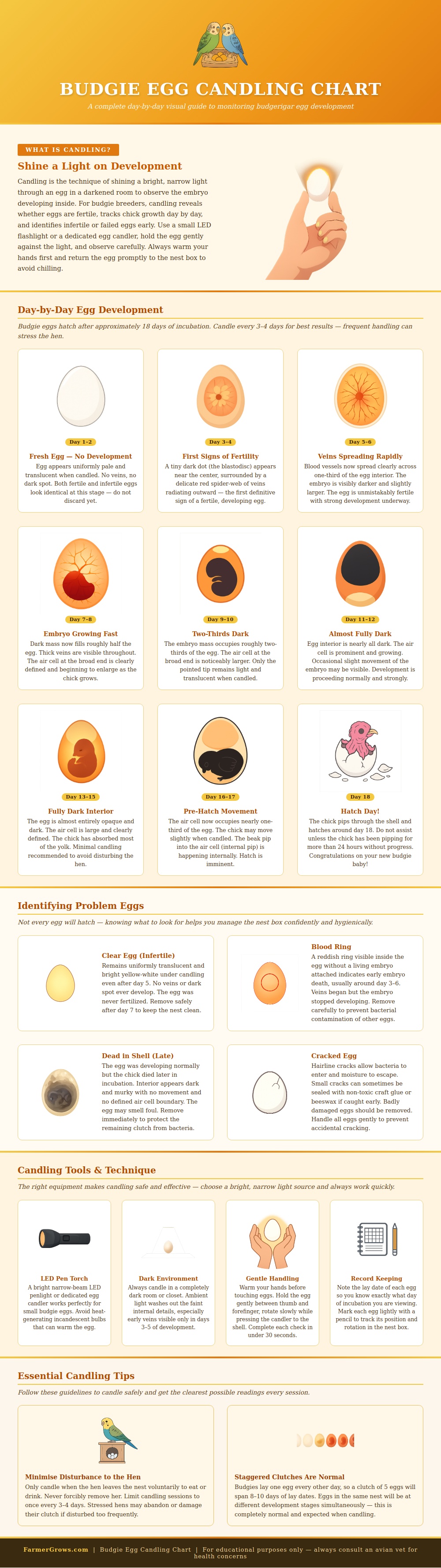
Candling is a method of examining the interior of a budgie egg to determine if an embryo is developing inside of the egg. Candling is a method that allow a person to determine if an egg is fertile or if it is infertile. To candy an egg, a person uses a light source in a dark room to shine the light through the eggshell to examine the content of the shell.
When candling, the embryo and the blood vessels of that embryo will obscure the light in a different manner than the contents of an infertile egg. Within a fertile egg, a person will see a small dot indicating the embryo, as well as red lines indicating blood vessel that supply nutrient to the embryo. As the embryo develops, the embryo will become larger and more darker relative to the rest of the egg.
How to Check Budgie Eggs with a Light
In addition, the air cell will become more visible within the egg… The air cell is the pocket of air that the chick will use to breathe. These changes in the contents of the egg can be monitored through candling.
Candling is useful in recognizing which eggs are not developing correctly. Within a fertile egg that do not develop properly, the embryo may be visible but there may be no development of the embryo. In these instances, there is potential for the embryo’s blood to take the form of a red ring, or the egg to become dark and murky.
By recognizing these abnormality in the eggs, the breeder can remove the eggs to prevent potential issues related to the spread of bacteria from those dead eggs to the healthy eggs. Candling should not be performed too frequentely. Too frequent candling may lead to the eggs becoming too cool and the hen to become stressed.
Most breeder only candy there eggs every three to four days. In order to candy the eggs, the breeder must remove the hen from the nest to eat or drink water. In addition, the breeder should warm their hand prior to candling the eggs, using an LED penlight help to ensure that the eggs dont become too hot.
Candling should take place within thirty seconds of removing the hen from the nest. Because each hen may lay her egg at a different time, some of the eggs may be at a different stage of development than the others. For example, some of the eggs may have blood vessel visible within the shell while other egg may be clear.
Furthermore, because each clutch of eggs was laid on different days, the health of the entire clutch cannot be determined from inspecting a single egg. It is helpful to use a light pencil to mark each eggshell. Additionally, it is important to record the date on which each egg was laid.
These two step ensure that each breeder can easily track the development of each egg. In the final days prior to hatching, the air cell will take up the majority of the eggshell. Within the egg, it is also possible to see the chick move within the egg.
The chick will first pip into the air cell followed by the chick working its way around the shell. Most chicks will hatch on their own within twenty-four hour of pipping into the air cell. Intervening to assist the chick in the hatching process should only of been done if it does not make any progress after a full day.
While candling does not ensure that each egg will hatch, the process does allow the breeder to identify each embryo and whether or not that embryo is still developing.