
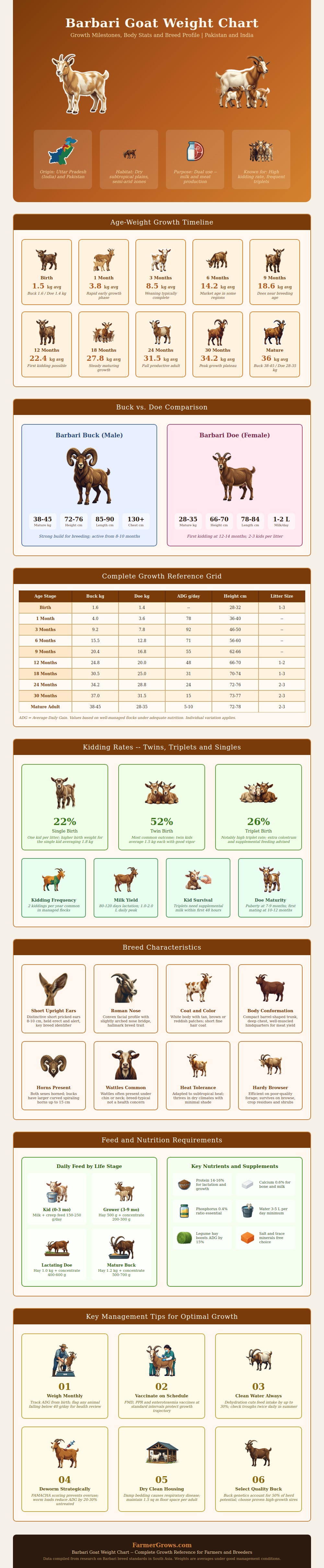
Whether you have goats for meat, for milk, or both, this is important to know so that you can understand their changing weight and better manage your herd. I find the Barbari goat grow quickly at first and then levels off in adulthood. For small farm, that’s good. Those landmarks are clear on chart above. There is no complicated calculations or numbers to memorize. You just look at the chart and visually see where your animals fall.
You don’t need to weigh every animal every day, but watching for growth patterns is critical in the first few months. That’s when they gains the most weight per day and any issues show up fast. If a kid gets behind by a month, chances are he’ll be behind forever if you don’t get him caught back up. Check him for health issues. Offer supplemental feed. Whatever it takes. This is where it shows on timeline. For that reason, many producer have a printed copy posted by their pen. You don’t have to weigh each animal everyday but seeing a stall lagging early will save you months of playing catch-up.
Why Watching Goat Weight is Important
Does and bucks grow at different rates, which explains why it’s important. Why? Check out the comparison section. Bucks are heavier and have more muscle mass. Does remains lighter while still needing sufficient condition to nurse multiple offspring. Feed them equally and you’re wasting feed on the does. What about the bucks? You may be shortchanging them when they want to save up reserves to breed. The chart shows the point. So what do you do? Just adjust rations to match, so you don’t have to think too hard.
With Barbari goats, twin kids or triplets is not uncommon. This affect your plans for housing and for feed. A doe nursing three kids will burn through her reserves more quickely than a doe with just one kid. And that additional demand shows itself in milk output and weight loss. The graphic breaks it down by percentages so you can see the odds going into kidding season. If you expect bigger litters, be prepared. Have creep feed available. Also have a back-up plan for the littlest one if she’s in a set of triplets. Prepare yourself, and keep them all on track.
They’re suited to modest feed supply and dry climate. Part of their charm as a smallholder animal. You’ll know them by their short upright ears, and also by that Roman nose. But their best feature is how efficiently they convert crop residues and browse into milk and meat. No need for lush pasture. And they still respond well to better nutrition if you can provide it.
This explains why they are managed different; these are animals that act like different animals. Nutrition requires different food at every stage of their lives. From creep feed and milk during their first few months to increased protein help for the lactating doe. The focus should of feeding according to need versus providing the same mix throughout the year. A dry doe doesn’t require the energy that a mature buck does.
When they don’t have access to either water or needed minerals, however, both animals will loses body condition. Regular checking of salt blocks and troughs can stop this decline before it’s too late. By then it may show itself as stalled weight gains. Feed is only part of it; housing and routine are as well. Environmental factors like damp conditions or a poorly ventilated pen causes respiratory stress. That reduces feed intake, but you don’t even notice because it’s quiet. Internal parasites steal nutrition by causing illness. Deworming regularly prevents this loss. Protect your growth curve with basic management. This includes the basics (see management tips).
Nothing about these steps is hard to do. But not doing any of them hurts the growth curve … if you go long enough. And you’ll see it on the scale. But the most helpful thing is to watch the overall pattern instead of getting hung up on one number. In the first year, if your animals stays close to the curve you expect, you’re likely doing the important stuff correctly. Wherever they fall outside that curve, that’s where the chart provides a reference point for you: Was it feed? Health? Something else? Knowing that makes weight tracking a useful tool. A good tool that helps each and every season of farming.