Auger RPM Calculator
Estimate target flow, required RPM, tip speed, and hold-up weight for grain, feed, fertilizer, and other bulk materials. Test presets, then fine tune the auger.
Pick a real farm setup first. Each preset sets diameter, pitch, target flow, length, incline, fill, and service margin for a common auger job.
This calculator is tuned for farm augers, so it prioritizes flow target, RPM, density, incline, and hold-up weight instead of cost or purchase guidance.
Auger RPM Output
Estimated RPM, flow, volume per rev, and tip speed from the settings above.
| Diameter | Pitch ratio | Fill band | Use |
|---|---|---|---|
| 6 in | 50% | 20-30% | Light duty |
| 8 in | 75% | 25-35% | Small line |
| 10 in | 100% | 30-40% | Common farm |
| 12 in | 125% | 35-45% | High flow |
| Diameter | Pitch | Fill | Use |
|---|---|---|---|
| 6 in | 50% | 20-30% | Seed line |
| 8 in | 75% | 25-35% | Bin unload |
| 10 in | 100% | 30-40% | Feed mill |
| 12 in | 125% | 35-45% | Bulk yard |
| Size | Start RPM | Flow | Use |
|---|---|---|---|
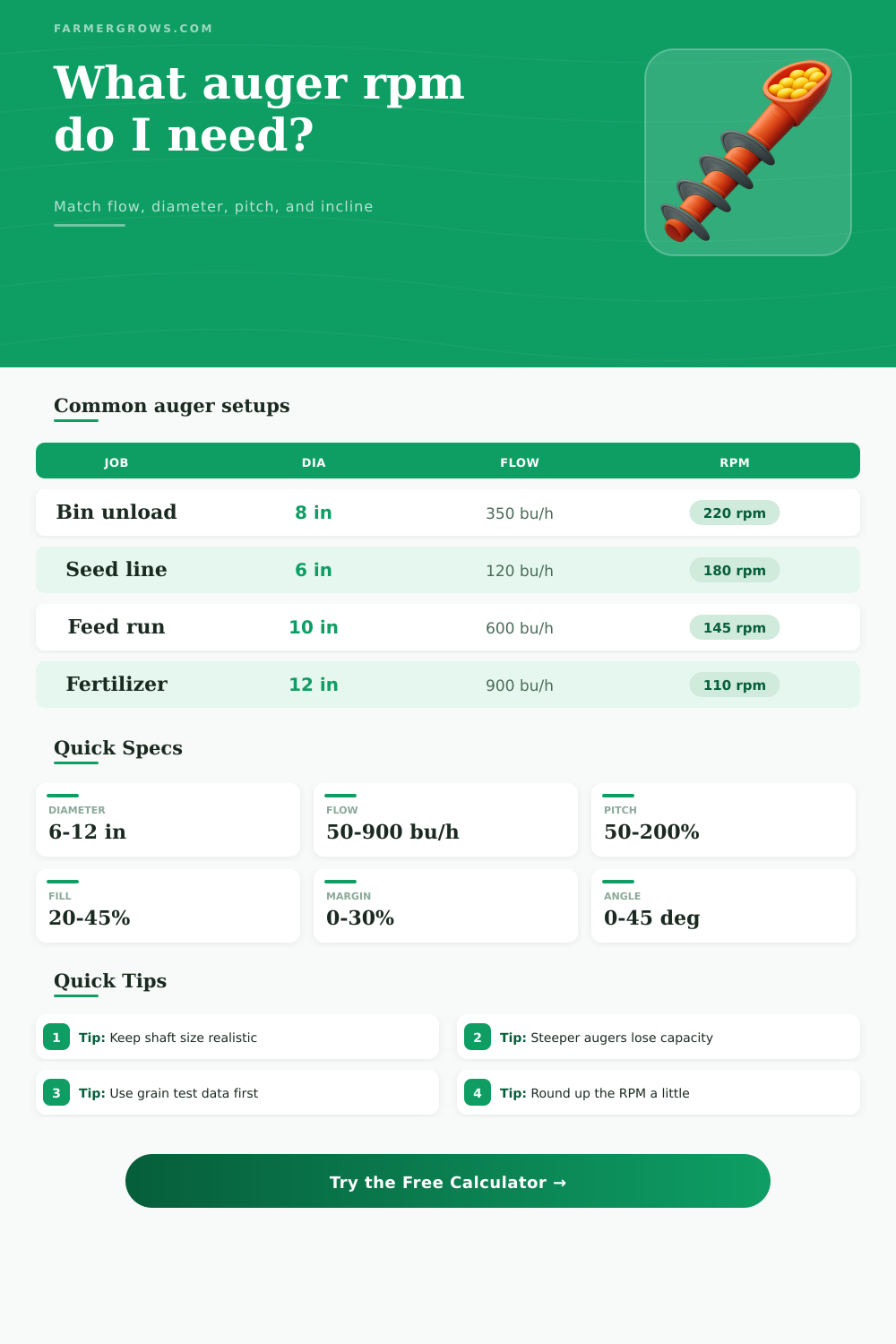
| 6 in | 180 rpm | 120 bu/h | Seed line |
| 8 in | 150 rpm | 300 bu/h | Bin unload |
| 10 in | 130 rpm | 550 bu/h | Feed run |
| 12 in | 110 rpm | 850 bu/h | Bulk flow |
An auger move the material within the tube by using a helical flight to trap the material within a pocket and push it forward. The pitch of the auger is the distance that the spiral travels for each single rotation of the auger shaft. An auger with a short pitch will move less material with each rotation of the auger shaft, but will slip less when the auger shaft is on an incline.
Conversely, a long pitch will move more material with each rotation of the auger shaft, but the auger may floods if there is too much material in the auger (fill level too high). The fill percentage is the portion of the pocket within the auger shaft that is filled with material; too high of a percentage will create friction within the auger, while too low of a percentage mean the auger is simply moving air. The incline of the auger tube will impact how the auger moves the material due to the effect of gravity on the material.
How an auger moves material
An incline will require higher RPMs to move the material forward due to the gravitational pull on the material within the auger shaft. The RPM can be calculated by considering the diameter of the auger shaft, the pitch ratio of the auger, the fill band of the auger, the bulk density of the material to be moved, and the losses due to the incline. The RPM of the auger can help to calculate the tip speed of the auger.
The tip speed of the auger is the velocity of the auger flights. Too high of a tip speed may lead to the erosion of the auger flights, while too low of a tip speed will cause the auger to behave sluggishly. Additionally, calculating the hold-up weight will help to prevent overloading of the motor that is to be used to power the auger and the auger shaft itselff.
The pitch of the auger should match the use of that auger. A 100% pitch means that the diameter of the auger shaft is matched with the pitch of the auger. A 100% pitch is the standard for flat (horizontal) runs of augers.
A 125% pitch can be used if it is desired to move more material with each rotation. The 125% pitch will lead to an increase in the amount of material that is moved with each revolution of the auger. Using the wrong pitch in conjunction with the RPM that is set for the auger may lead to RPMs that are too high for the auger, which will prematurely wear out the bearings of the auger, or RPMs that are too low, which will lead to starvation of the material to be moved by the auger.
The incline of the auger will reduce the capacity of that auger. For every degree of incline, the auger’s capacity reduces by 0.65%. Therefore, if the auger has a 7-degree incline, the auger will have to increase its RPM by 10% to 15% to move the same amount of bushels of material per hour as it would be able to push if it were moving on a flat (horizontal) auger.
For inclines that are steeper than 20 degrees, due to the physics of gravity, the auger will become difficult to move the material forward, so shortening the incline or adding a booster to the system would of been considered. The type of material that the auger is to move will impact how the auger functions. Different materials has different bulk densities.
Corn is a material that will flow more easily than wheat, and wheat will pack more densely than corn. Fertilizer is a gritty material that is heavy, so the settings for the auger will have to be different than those used for corn or wheat. Sawdust is a light material that will fill the pockets within the auger loosely.
Additionally, the trough or tube of the auger can be either open or enclosed. Enclosed auger tubes are more efficient at moving material, but are also more prone to packing. The volumetric efficiency of an auger is usually between 85% and 92%, but a 10% to 20% safety margin should be included into that calculation to account for any unexpected changes in the material that is to be moved by the auger.
The size of the auger shaft may seem to be an ignored factor in the determination of the settings for the auger; however, the size of the auger shaft is important. Using a large size for the auger shaft will reduce the area available for the material, the annulus, within the auger. Using too large of a shaft will increase the risk of the augers tip speeds increasing to 400 feet per minute or more, which can lead to the tossing of the grain within the auger and the erosion of the auger flights.
Additionally, it is important to test the bulk density of the grain that the auger is to move. Using the bulk densities from the general charts can result in inaccurate calculations of the RPM, tip speed, and the hold-up weight of the material. Finally, the motor for the auger should be matched to the torque that the auger shaft and auger material will require.
This is especially true for long runs of augers, where the motor has to contend with the weight of the grain that is being held within the auger shaft.