🌿 Grass Seed Overseeding Calculator
Find out exactly how much grass seed you need for overseeding your lawn
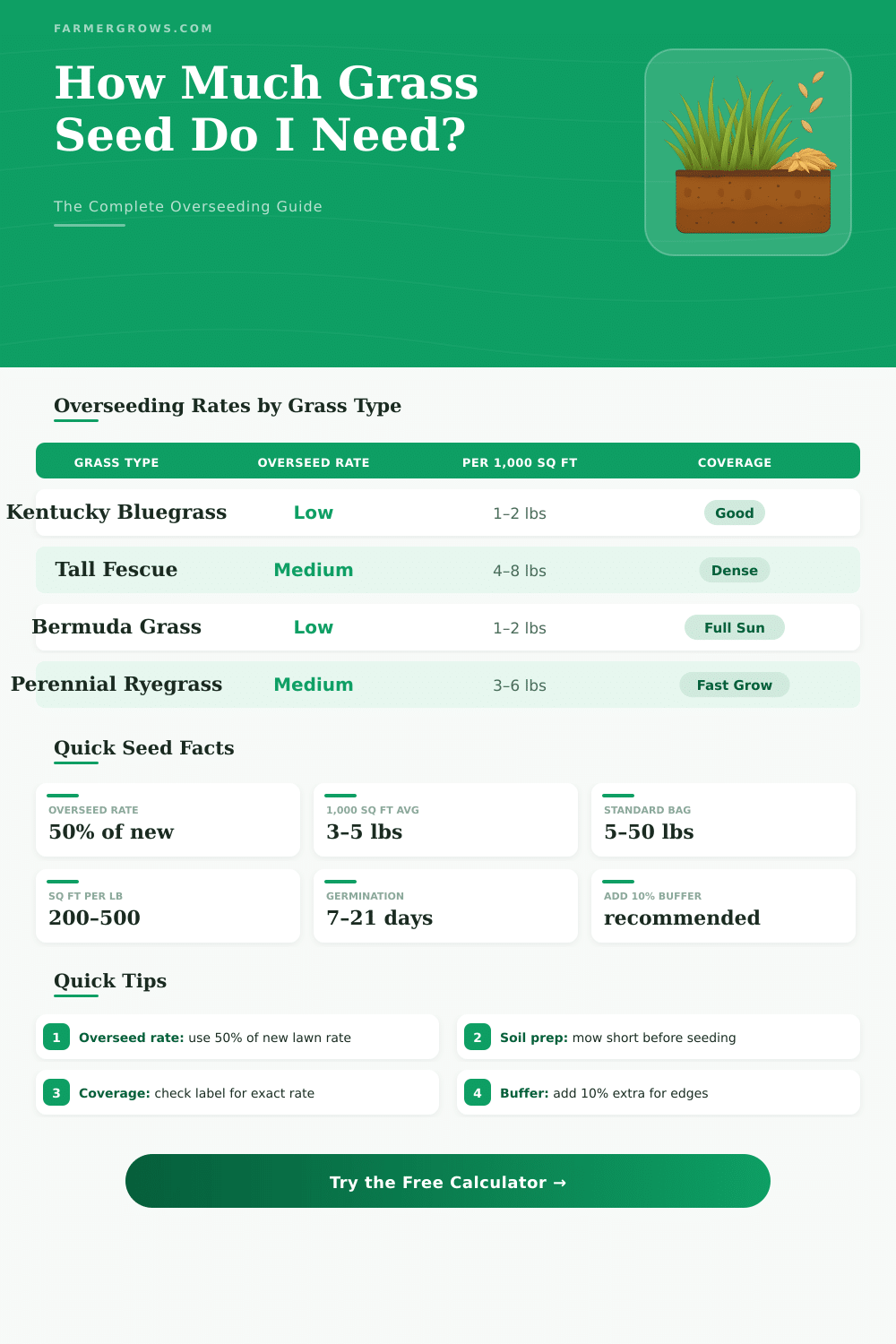
| Grass Type | Overseed Rate (lbs/1,000 sq ft) | New Lawn Rate (lbs/1,000 sq ft) | Seeds per lb (approx) | Germination (days) |
|---|---|---|---|---|
| Kentucky Bluegrass | 1–2 lbs | 2–3 lbs | 1,400,000–2,200,000 | 14–30 |
| Tall Fescue | 4–8 lbs | 6–10 lbs | 225,000–250,000 | 7–14 |
| Fine Fescue | 2–4 lbs | 3–5 lbs | 450,000–600,000 | 7–21 |
| Perennial Ryegrass | 3–6 lbs | 5–9 lbs | 240,000–260,000 | 5–10 |
| Bermuda Grass | 1–2 lbs | 2–4 lbs | 1,800,000–2,000,000 | 10–21 |
| Zoysia Grass | 1–3 lbs | 2–4 lbs | 1,000,000–1,400,000 | 14–21 |
| St. Augustine | N/A (plugs) | N/A (sod) | N/A | N/A |
| Centipede Grass | 0.25–0.5 lbs | 0.25–0.5 lbs | 400,000–430,000 | 14–28 |
| Bag Size | Tall Fescue Coverage | KY Bluegrass Coverage | Ryegrass Coverage | Bermuda Coverage |
|---|---|---|---|---|
| 5 lb bag | 625–1,250 sq ft | 2,500–5,000 sq ft | 833–1,666 sq ft | 2,500–5,000 sq ft |
| 10 lb bag | 1,250–2,500 sq ft | 5,000–10,000 sq ft | 1,666–3,333 sq ft | 5,000–10,000 sq ft |
| 20 lb bag | 2,500–5,000 sq ft | 10,000–20,000 sq ft | 3,333–6,666 sq ft | 10,000–20,000 sq ft |
| 25 lb bag | 3,125–6,250 sq ft | 12,500–25,000 sq ft | 4,166–8,333 sq ft | 12,500–25,000 sq ft |
| 50 lb bag | 6,250–12,500 sq ft | 25,000–50,000 sq ft | 8,333–16,666 sq ft | 25,000–50,000 sq ft |
| Project | Area (sq ft) | Area (m²) | Tall Fescue (lbs) | KY Bluegrass (lbs) | Ryegrass (lbs) |
|---|---|---|---|---|---|
| Small Patch | 200 | 18.6 | 0.8–1.6 | 0.2–0.4 | 0.6–1.2 |
| Small Yard | 500 | 46.5 | 2–4 | 0.5–1 | 1.5–3 |
| Medium Yard | 1,000 | 92.9 | 4–8 | 1–2 | 3–6 |
| Average Lawn | 2,500 | 232.3 | 10–20 | 2.5–5 | 7.5–15 |
| Large Lawn | 5,000 | 464.5 | 20–40 | 5–10 | 15–30 |
| Half Acre | 21,780 | 2,023 | 87–174 | 21.8–43.6 | 65–130 |
| Full Acre | 43,560 | 4,047 | 174–348 | 43.6–87 | 130–261 |
grass seed does not work for every situation the same way. The best kind of seed depends on the nature of your garden and on the needs of the lawn. In places with lots of open space and enough light, warm season grasses can grow during the warm and wet times of the year.
In gardens with trees and parts in the shade, cold season grasses, like tall fescue, usually prove to be the best choice.
How to Choose and Plant Grass Seed
Many kinds of grass seed are available, among them fescue, bermuda and zoysia. Some grasses handle both cold and warm conditions in the middle part of the land. Special mixes are made for places with light or shade, which gives bigger freedom for gardens with both elements.
Quality matters a lot when choosing grass seed. Mixes of seeds for lawns from reliable brands are made by local experts, who know the science for good lawn care. The best seed is tested for cleaning and ability to sprout, and it does not hold fillers, pellets or changed organisms.
Seed straight from the farm usually has a higher rate of sprouting than that in big packed stores. Any good grass seed should have types with less than 0.01 % of seeds of unwanted grasses by weight. Cheap options can work, but they usually carry fillers and biggre risk for unwanted grasses.
The time of planting is important for grass seed. The spring works for overseeding of the lawn or to fix bare parts. Summer deserves to be skipped, because the ground becomes too warm and dry, which needs much water and the seeds hardly sprout.
In the region of the Great Lakes, the end from August until the end from September is usually the ideal time. For the northwest Pacific area, new lawns should be planted between the middle of August and middle of September, so that they settle before the winter. Overseeding and repair works best from the end of February until April, or from middle of August until middle of October, where the autumn stays the best.
When spreading seeds, every kind has its own rate for sowing, so read the directions on the package. Using a spreader for coatings with the advised settings helps too reach even coverage. The best way is to spread half in one direction and the rest at right angles.
grass seed can start sprouting on the soil, but the result depends on the type of seed, on the touch with the ground, on the moisture and on the care. Straw can protect the soil against washing away, while the grasses begin to grow, and it helps to keep the moisture. It matters less on flat ground, but it is slightly useful.
The seeds must not dry, or they will not sprout. A rake with good teeth can scratch the ground to bury the seeds, then cover them in the other direction. Better structure of thesoil is among the main steps for a good lawn.