🪨 Gravel Driveway Calculator
Find exactly how much gravel you need — cubic yards, bags, and weight in seconds
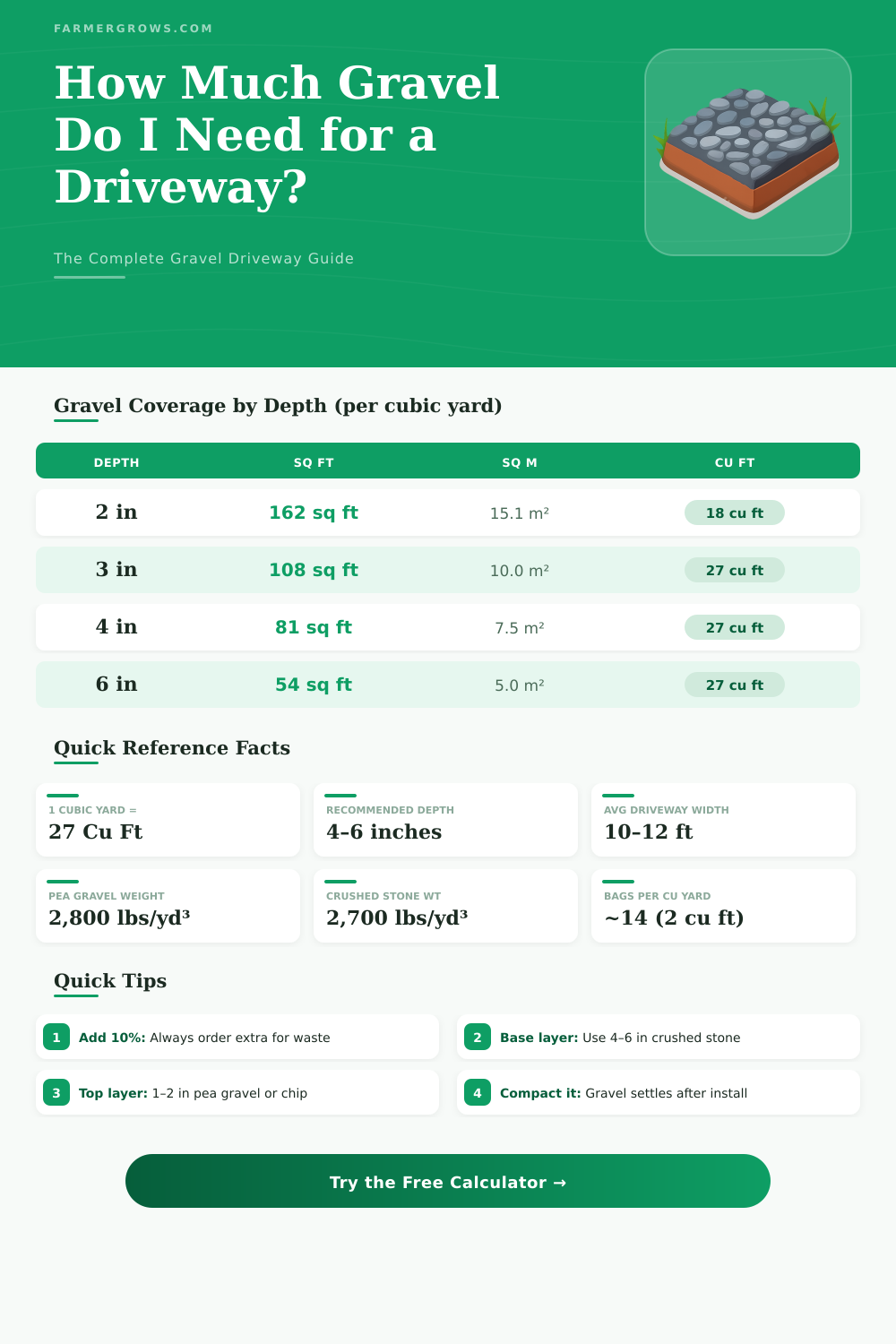
| Depth | Coverage (sq ft) | Coverage (m²) | Cubic Feet | Best Use |
|---|---|---|---|---|
| 1 inch | 324 sq ft | 30.1 m² | 27 cu ft | Light top dressing |
| 2 inches | 162 sq ft | 15.1 m² | 27 cu ft | Walkways, paths |
| 3 inches | 108 sq ft | 10.0 m² | 27 cu ft | Light traffic areas |
| 4 inches | 81 sq ft | 7.5 m² | 27 cu ft | Standard driveways |
| 6 inches | 54 sq ft | 5.0 m² | 27 cu ft | Heavy traffic / base layer |
| 8 inches | 40.5 sq ft | 3.8 m² | 27 cu ft | Deep base layer |
| Bag Size | Volume (cu ft) | Bags per Cu Yd | Coverage @ 3 in | Coverage @ 4 in |
|---|---|---|---|---|
| 0.5 cu ft bag | 0.5 cu ft | 54 bags | 2 sq ft | 1.5 sq ft |
| 1 cu ft bag | 1 cu ft | 27 bags | 4 sq ft | 3 sq ft |
| 2 cu ft bag | 2 cu ft | 13.5 bags | 8 sq ft | 6 sq ft |
| 3 cu ft bag | 3 cu ft | 9 bags | 12 sq ft | 9 sq ft |
| 0.5 ton bulk | ~9 cu ft | ~3 bags equiv. | 36 sq ft | 27 sq ft |
| 1 ton bulk | ~18 cu ft | ~6 bags equiv. | 72 sq ft | 54 sq ft |
| Project | Dimensions | Area (sq ft) | Cu Yds @ 4 in | Bags @ 2 cu ft |
|---|---|---|---|---|
| Single-Car Driveway | 20 x 10 ft | 200 sq ft | 2.47 yd³ | 34 bags |
| Standard Driveway | 40 x 12 ft | 480 sq ft | 5.93 yd³ | 80 bags |
| Double-Wide Driveway | 40 x 20 ft | 800 sq ft | 9.88 yd³ | 133 bags |
| Long Driveway | 80 x 14 ft | 1,120 sq ft | 13.83 yd³ | 187 bags |
| Parking Pad | 20 x 20 ft | 400 sq ft | 4.94 yd³ | 67 bags |
| Rural Driveway | 200 x 14 ft | 2,800 sq ft | 34.57 yd³ | 467 bags |
Getting the right amount of gravel for a driveway is not hard when you already know the basic math. For start, you simply multiply the length by width and depth… Everything in yards…
To reach the number of cubic yards that you need. Would you like to work with feet? Then multiply only those three dimensions together and share the result by 27, and you again will have cubic yards.
How to Figure Out Gravel Needed for a Driveway
For instance, for a 20-foot long and 10-foot wide way at half foot of depth, put those values in the formula and you will find your whole amount.
The width matters a lot when you plan the needs of materials. Many folks aim for around 12 feet, because that works well. Depth of gravel is also important: it at least must have 4 inches.
If it is lower, the stones can not settle down and lock together as they would need to for a good way. One ton of gravel usually covers almost 100 feet, when you lay it 4 inches thikc above a 10-foot width.
For gravel driveways the “57-stone” is the most commonly chosen option, and you usually lay it between 4 and 6 inches thick. Some wholesale suppliers advise to use 6 inches of base material, later covering it with at least one inch of crushed 3/4-inch gravel or road mix. According too the type of soil below, where you work, at least six inches of rock alone can work for a rugged driveway.
Big stones go in the bottom, acting as a base for the rest. That bottom layer stops the finer gravel from sinking in the mud below. Do not use loose or raw stone.
It simply will not hold together, no matter how much depth you give it. It works well to lay some processed layers and end everything with around one inch of 1/2- or 3/4-inch stone on top.
The cost is clearly part of the equation. A new gravel driveway commonly costs from 500 to 1,000 dollars only for the materials. Mind that gravel costs about 10 to 50 dollars each ton, and for 100 square feet you need around 2.5 tons at 6 inches of depth.
A full truck load could cost 450 to 500 dollars, with the delivery fee alone reaching around 150 dollars or more. Standard work ends at almost 1,500 dollars, although it usually sits between 600 and 1,800 dollars. What really affects the price is the setup of the place and the real size of your driveway.
For driveways that already suffered wear with ruts and holes, adding 3 inches of new gravel is a smart move. You will fill the low parts, while you cover the areas that are still good. In places where the soil becomes soft or wet according to seasons, fabric below keeps the gravel from sinking into the dirt and helps the surface stay more flat for longer.
Such methods save time, because they reduce how often you must add fresh material. The most manygravel driveways need refreshing about every 5 years or so.