🥒 Zucchini Plant Spacing Calculator
Find exactly how many zucchini plants fit your garden bed — with spacing recommendations by growing method
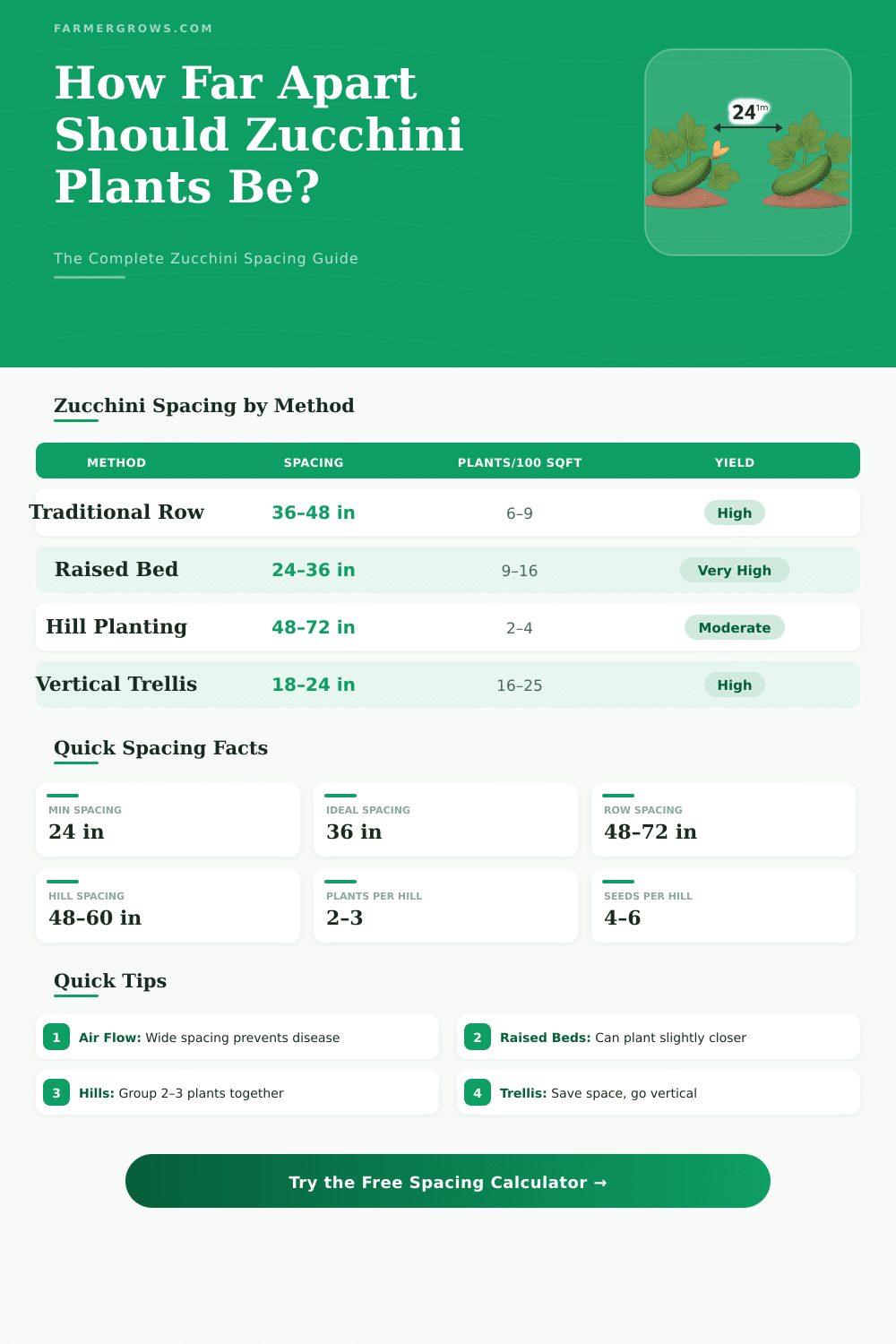
| Plant Spacing | Metric Equiv. | Plants/100 sq ft | Plants/10 m² | Recommended For |
|---|---|---|---|---|
| 18 in | 46 cm | ~25 | ~27 | Compact / Trellis |
| 24 in | 61 cm | ~16 | ~17 | Raised Bed / Trellis |
| 30 in | 76 cm | ~10 | ~11 | Raised Bed |
| 36 in | 91 cm | ~7 | ~8 | Traditional Row |
| 42 in | 107 cm | ~5 | ~6 | Traditional Row |
| 48 in | 122 cm | ~4 | ~4 | Hill / Standard |
| 60 in | 152 cm | ~3 | ~3 | Large Varieties |
| 72 in | 183 cm | ~2 | ~2 | Very Large / Hill |
| Method | Plant Spacing | Row Spacing | Plants per Row (10 ft) | Rows per 10 ft Width |
|---|---|---|---|---|
| Traditional | 36–48 in | 60–72 in | 3–4 | 1–2 |
| Raised Bed | 24–36 in | 36–48 in | 4–5 | 2–3 |
| Hill Planting | 48–72 in | 48–72 in | 2–3 | 1–2 |
| Vertical Trellis | 18–24 in | 24–36 in | 5–7 | 3–5 |
| Compact Variety | 18–24 in | 24–36 in | 5–7 | 3–5 |
| Garden Size | Area (sq ft) | Traditional (36 in) | Raised Bed (24 in) | Trellis (18 in) |
|---|---|---|---|---|
| 4 × 4 ft | 16 sq ft | 1–2 | 2–3 | 3–4 |
| 4 × 8 ft | 32 sq ft | 2–3 | 4–5 | 6–9 |
| 8 × 8 ft | 64 sq ft | 4–5 | 7–10 | 12–18 |
| 10 × 10 ft | 100 sq ft | 6–8 | 10–16 | 18–25 |
| 10 × 20 ft | 200 sq ft | 12–16 | 20–32 | 36–50 |
| 20 × 20 ft | 400 sq ft | 24–33 | 40–65 | 72–100 |
| Garden Size | Hill Spacing | Number of Hills | Seeds to Plant | Final Plants (thinned) |
|---|---|---|---|---|
| 10 × 10 ft | 48 in | 3–4 | 12–24 | 6–12 |
| 10 × 20 ft | 48 in | 6–8 | 24–48 | 12–24 |
| 20 × 20 ft | 60 in | 9–12 | 36–72 | 18–36 |
| 30 × 30 ft | 72 in | 12–16 | 48–96 | 24–48 |
Note: This article is based on actual experience in gardening and practical advice for growing.
Zucchini plants reach really big sizes in good conditions. They spread their leaves during growth hence give them enough space. The right spacing depends on the state of the crop and if the species is a bush or vine type.
How far apart to plant Zucchini
Common advice is to lay one Zucchini plant for every two to three feet of space. At least, plants should stand two feet or sixty centimetres from each other. Some gardeners lay them 18 to 24 inches from each other with rows six feet apart.
Others plant them one foot from each other with rows 1,5 feet apart, but only if one does heavy pruning. Laying them only one foot apart without pruning does not work, because the plants become huge.
When one plants from seeds, place them one inch deep. Put two or three seeds in every hole and space the holes three feet from each other. Instructions on seed packets commonly say plant every hill with four to five seeds, later thin to three plants when they reach three inches tall.
After thinning, remove at least one plant per hill and leave only one or two of the strongest. If plants are too dense, they will compete for water and food.
Growing Zucchini vertically helps to save space. Even so, Zucchini plants do not climb naturally. They do not have tendrils like cucumbers.
Because most Zucchini are bush plants, one can grow them in big round tomato cages, guiding the leaves upward in the cage so that they stay held off the soil. Tomato cages work well for this, surely better then walking on the leaves always to reach the fruits. During vertical growth, one plant needs only two squares in a square foot garden.
Normal bush Zucchini need nine squares.
In a 4×4 raised bed, every plant takes around nine square feet. So one can lay two plants in a box, or maybe three in a bigger bed. For vertical growth in raised beds, one can narrow the spacing to 12 to 15 inches between plants.
Using smaller species is also useful. Growing tinier squash means harvesting fresh Zucchini almost daily. The amount of production will not be better with narrow spacing, because squash can carry several stems after rooting, but it works much better in small space.
In cool climates, spacing plants one metre from each other works for traditional growth. Mixing the rows a bit also allows one to fit some extra plants. When one hesitates, follow the directions onthe seed packet.