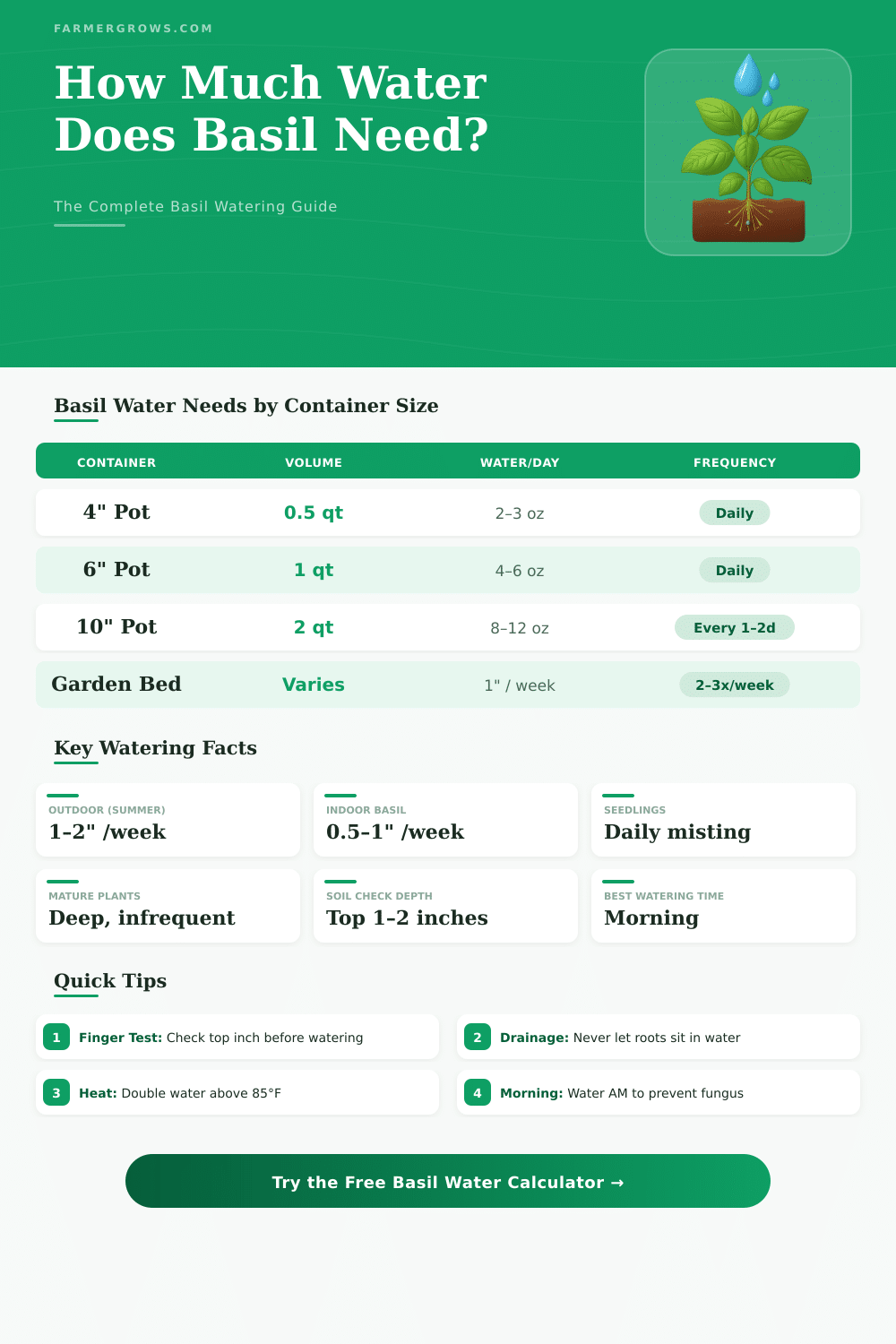
🌿 Basil Plant Water Calculator
Calculate exactly how much water your basil plants need based on size, environment & conditions
| Environment | Climate | Frequency | Water Per Session (per plant) |
|---|---|---|---|
| Indoor Container | Temperate | Every 2–3 days | 4–8 fl oz (120–240 ml) |
| Indoor Container | Hot / Dry | Daily | 6–10 fl oz (180–300 ml) |
| Outdoor Container | Temperate | Every 1–2 days | 8–16 fl oz (240–480 ml) |
| Outdoor Container | Hot (>85°F) | Daily | 12–20 fl oz (355–590 ml) |
| Garden Bed | Temperate | 2–3x per week | 1 inch per week total |
| Garden Bed | Hot | 3–4x per week | 1.5–2 inches per week |
| Seedling (any) | Any | Daily / mist | 2–4 fl oz (60–120 ml) |
| Pot Diameter | Approx Volume | Water Per Session (imperial) | Water Per Session (metric) |
|---|---|---|---|
| 3" pot | 0.3 qt | 2–3 fl oz | 60–90 ml |
| 4" pot | 0.5 qt | 3–5 fl oz | 90–150 ml |
| 6" pot | 1 qt | 5–8 fl oz | 150–240 ml |
| 8" pot | 1.5 qt | 8–12 fl oz | 240–355 ml |
| 10" pot | 2 qt | 12–16 fl oz | 355–475 ml |
| 12" pot | 3 qt | 16–24 fl oz | 475–710 ml |
| Climate | Temperature Range | Water Multiplier | Notes |
|---|---|---|---|
| Cool | <65°F / 18°C | 0.65x | Reduce watering, risk of root rot |
| Temperate | 65–80°F / 18–27°C | 1.0x (baseline) | Ideal growing range |
| Hot | 80–95°F / 27–35°C | 1.35x | Check soil daily |
| Very Hot | >95°F / 35°C | 1.7x | May need twice-daily watering |
Note: This article is based on practical advice about growth and experiences from gardening.
Basil likes moisture, but when Water builds up around its roots? That simply means disaster. Good drainage is just as important as neat moisture.
How to Water Basil
The goal is to keep the ground always quite a lot humid, but do not let it become too soaked. Too much Water is the main mistake that kills Basil, and if rot exists in the roots, the plant commonly no longer recovers.
The most many Basil plants benefit with around one to two inches of Water weekly, but that amount adjusts according to the setting. Heat, type of ground and amount of sunshine all affect the need. In very hot weather, Basil in distant ground maybe requires Water once, twice or even daily.
When the temperature drops, once weekly commonly suffices. Ground rich in compost holds humidity more long, so that one Waters less often. And if rain cares about everything, simply skip adding Water.
For control, push finger around two inches in the ground. If it feels dry at that depth, is time for Water. If the ground yet is wet some inches below, but the surface seems dry, leave it be.
The target is fresh, humid topsoil with a bit of humidity below.
Basil in jar requires more frequent Water than that planted in ground. Little jars dry more quickly than big, and without good drainage the roots choke. Ensure that jars have holes below.
Water that stays in the bottom plate, must one remove after some hours. For Basil in little jar, watering all too days can be usual.
Do not Water according to fixed timetable. Self control the humidity of the ground gives better results. Here the good aspect of Basil: itself signals, when it thirsts.
The leaves droop, the firmness disappears and the whole plant simply looks sad.
When Water, soak the ground up until that Water flows freely from the drainage holes. Deep Water helps roots grow more down in the ground. About the Water self, tap Water works very well.
Rain Water gathered in barrel or bucket is even better. Do not require any fancy or special tool.
Sunshine is just as key as Water. Basil wants six to eight hours daily, ideally more than six hours of strong, direct sun. If light lacks, the plant hardly grows.
It comes from Southeast Asia, where warm, wet and humid conditions rule. Copy those surroundings helps that Basil benefits. It likes heat and truly dislikes cold nights.
Swings in temperature can strain it a lot.
Bottom watering deserves a try. Many gardeners swear that Basil does more well, when one Waters from below instead of from up. Also, Basil truly requires more space than many folks think, andit will enjoy bigger jar than one first would guess.