🌱 Gardening Soil Calculator
Calculate exactly how much soil, compost, or topsoil you need for any garden bed or project
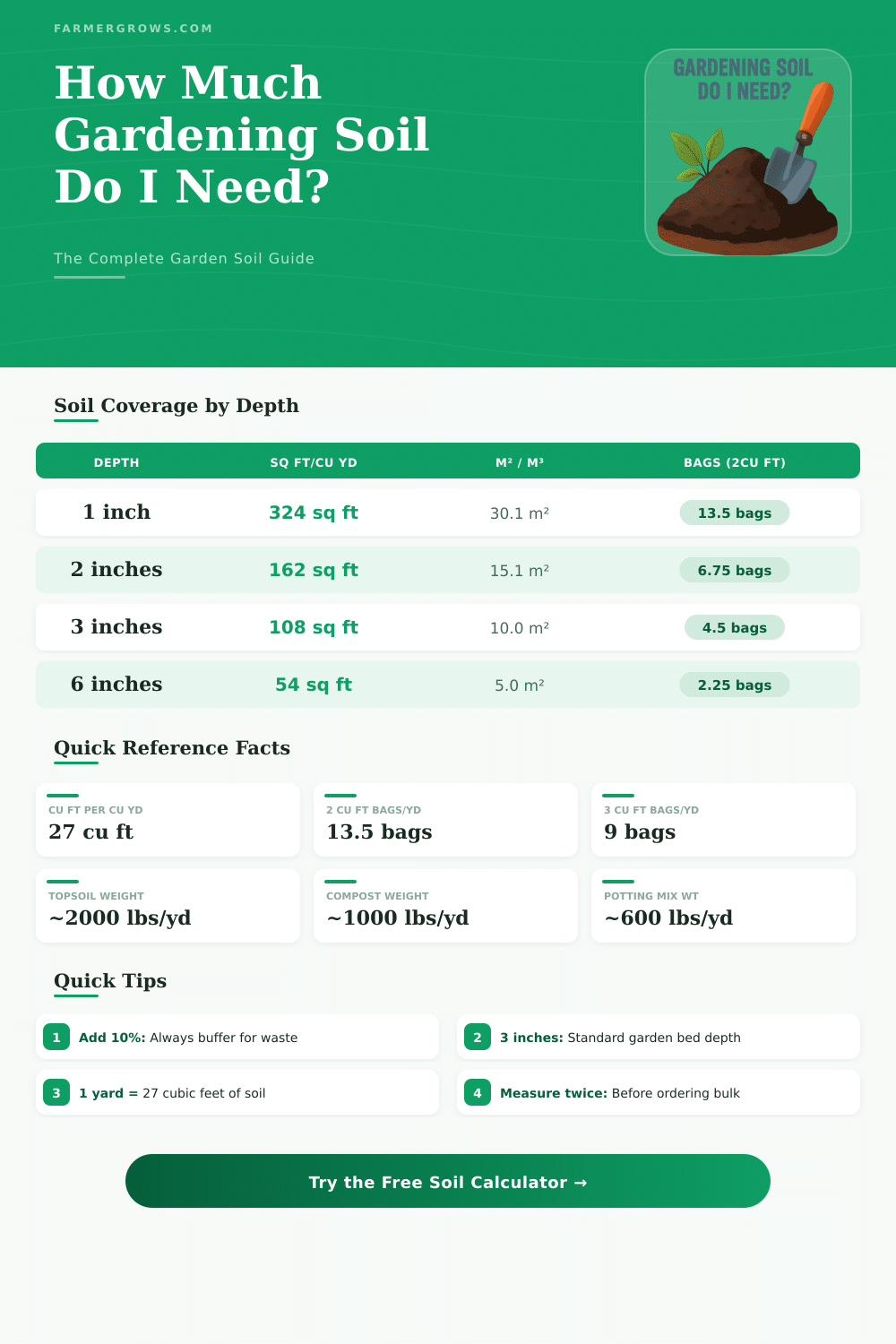
| Depth | Sq Ft Coverage | M² Coverage | 2 Cu Ft Bags Needed | 3 Cu Ft Bags Needed |
|---|---|---|---|---|
| 1 inch (2.5 cm) | 324 sq ft | 30.1 m² | 13.5 bags | 9 bags |
| 2 inches (5 cm) | 162 sq ft | 15.1 m² | 13.5 bags | 9 bags |
| 3 inches (7.5 cm) | 108 sq ft | 10.0 m² | 13.5 bags | 9 bags |
| 4 inches (10 cm) | 81 sq ft | 7.5 m² | 13.5 bags | 9 bags |
| 6 inches (15 cm) | 54 sq ft | 5.0 m² | 13.5 bags | 9 bags |
| Bag Size | Volume per Bag | Bags per Cu Yard | Coverage at 3in | Coverage at 2in |
|---|---|---|---|---|
| Small bag | 1 cu ft | 27 bags | 4 sq ft | 6 sq ft |
| Standard bag | 2 cu ft | 13.5 bags | 8 sq ft | 12 sq ft |
| Large bag | 3 cu ft | 9 bags | 12 sq ft | 18 sq ft |
| Half yard | 13.5 cu ft | — | 54 sq ft | 81 sq ft |
| Bulk yard | 27 cu ft | — | 108 sq ft | 162 sq ft |
| Project | Approx Area | Cu Yds at 3in | 2 Cu Ft Bags |
|---|---|---|---|
| Window box | 4 sq ft | 0.04 yd³ | 1–2 bags |
| Small flower bed | 40 sq ft | 0.44 yd³ | 6–7 bags |
| Veggie garden 10×20 | 200 sq ft | 2.2 yd³ | 30 bags |
| Raised bed 4×8 | 32 sq ft | 0.59 yd³ (6in) | 8 bags |
| Tree ring (6ft dia) | 28 sq ft | 0.31 yd³ | 4–5 bags |
| Lawn renovation 50×50 | 2,500 sq ft | 9.3 yd³ | 125 bags |
| Playground 15×15 | 225 sq ft | 2.5 yd³ | 34 bags |
If you need more than 2 cubic yards, ordering bulk soil from a landscape supplier is usually more economical and practical than hauling many bags. For smaller projects under 1 yard, bagged soil from a garden center is the most convenient option.
For irregular garden shapes, break the area into rectangles and circles, calculate each separately, then add the totals. Always add a 10% buffer to your final figure to account for settling, spillage, and slight measurement errors.
Everything starts from the soil under the roots of your plants. Good soil separates a successful garden from one that fails you, it gives the food that plants need, controls the water so that roots do not rot or dry out, and creates the right setting for good growth. Ignoring the quality of soil simply ensures that you will have empty beds instead of healthy vegetables and nice flowers.
soil does not work the same everywhere. One finds most commonly clay, sand, and loamy soil, and that last one really is the best. It offers the right mix between good drainage and control of moisture, which makes gardening easier than an endless struggle.
How to Make Your Garden Soil Better
Most plants do best in rich soil with good structure, that keeps water without becoming too wet or too dense.
The most basic way to help? Add organic materials. During the spring, compost can turn heavy or sandy soil into something more like loamy soil.
At the end of autumn, dug leaves do almost the same. Covering the beds with mulch is also useful, bits of stick help, when you do not have many options. Kitchen scraps like coffee grounds and crushed egg shells improve the health, when you put them around certain plants, though they do not fix everything on there own.
Here is another way, if you want to skip the process of fixing soil: build raised beds and fill them with a special mix. That method for square feet in gardening uses equal parts of peat moss, vermiculite, and finished compost, each a third. Garden soil sits a bit between heavy topsoil and light mix for jars, which gives you control of moisture without losing drainage.
Mind the pH level. Too alkaline soil locks out tiny nutrients that plants really need, and that shows itself through yellowing leaves and low growth. Test a few different places in your yard to sea whether you have zones with sour or alkaline soil that need adjusting.
A good soil test gives clear info about what changes really would be useful.
Bought soil costs a lot, when you cover several beds. Buying in bulk from local landscapers beats the high price of big stores. That is one of those steps that really saves money, when one works with anything quite big.
Working compost into dense soil opens everything up. More air can pass through, water soaks in better, and nutrients become available again. Worm castings give a strong nutrient boost, when you need fast help.
Cover beds or plant cover crops to keep the topsoil in place, while naturally holding back weeds. Good soil means that you do not need to use chemicals each week just to stop death. Sometimes the simplest way is just to grow what does well in the soil that you already have, consider plants that resist dryness, if yoursoil is sandy.