🌱 Aloe Plant Water Calculator
Calculate exactly how much water your aloe plants need based on pot size, season, and growth stage.
Less water needed
Reference amount
Drains fast
Very fast drain
Retains moisture
Excellent drainage
Evaporates faster
Retains moisture
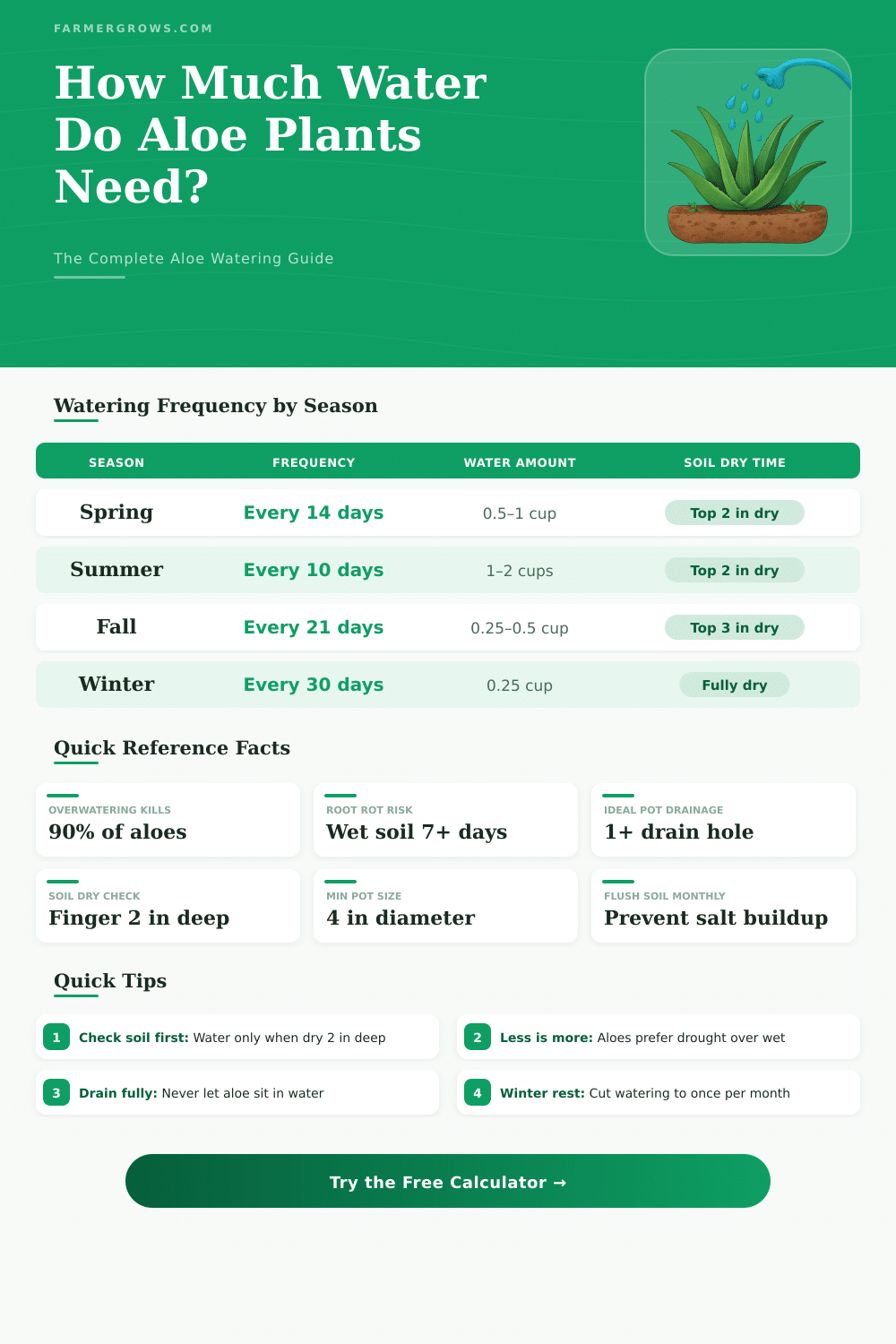
| Season | Frequency (days) | Soil Check Depth | Notes |
|---|---|---|---|
| Spring | Every 14 days | Top 2 in (5 cm) dry | Growth resumes, increase slowly |
| Summer | Every 10–14 days | Top 2 in (5 cm) dry | Peak growth, water more if very hot |
| Fall | Every 21 days | Top 3 in (7.5 cm) dry | Growth slows, reduce watering |
| Winter | Every 30–45 days | Soil fully dry | Dormant period — minimal water |
| Pot Diameter | Pot Volume (approx) | Water per Session (fl oz) | Water per Session (ml) |
|---|---|---|---|
| 4 in (10 cm) | ~0.25 qt | 1–2 fl oz | 30–60 ml |
| 6 in (15 cm) | ~0.75 qt | 2–4 fl oz | 60–120 ml |
| 8 in (20 cm) | ~1.5 qt | 4–6 fl oz | 120–180 ml |
| 10 in (25 cm) | ~2.5 qt | 6–10 fl oz | 180–300 ml |
| 12 in (30 cm) | ~4 qt | 10–14 fl oz | 300–420 ml |
| 16 in (41 cm) | ~7 qt | 14–20 fl oz | 420–600 ml |
| Container | Volume | Water Fill Rate | Recommended Fill % |
|---|---|---|---|
| Small watering can | 0.5 gal (1.9 L) | ~32 fl oz / pour | Fill 25–50% |
| Standard watering can | 1 gal (3.8 L) | ~128 fl oz | Fill 10–25% |
| Measuring cup | 8 fl oz (240 ml) | 1 cup = 8 fl oz | Use for small pots |
| Medicine cup | 1 fl oz (30 ml) | Precise measure | Seedlings only |
| Spray bottle | 16 fl oz (475 ml) | ~0.5 ml per spray | Not for mature aloes |
| Setup | Plant Count | Water per Session | Monthly Total (summer) |
|---|---|---|---|
| Windowsill seedlings (4 in pots) | 4 | 4–8 fl oz | 8–16 fl oz |
| Indoor desktop (6 in pot) | 1 | 2–4 fl oz | 4–8 fl oz |
| Medium patio collection | 3 | 12–24 fl oz | 24–48 fl oz |
| Outdoor garden bed aloes | 6 | 36–72 fl oz | 72–144 fl oz |
| Large patio feature plant | 1 | 14–20 fl oz | 28–40 fl oz |
Aloe are a group made up of more than 650 species of flowering succulents. The most famous of them is Aloe real, commonly called “real aloe“. Among others liked types are Aloe arborescens and Aloe aristata that occasionally one calls sublime aloe.
Every species has its own look regarding the form, colour and size of the leaves. Identifying separate species can be really hard. Plants commonly arrive without labels, and even if labels are here, they occasionally describe them wrong.
How to Grow and Care for Aloe Plants
Aloe plants grow fairly slowly and reach very different sizes. Some stay little, only two inches broad, while others grow into high branching trees up until thirty feet. They can form as single plants, high stacks of leaves or dense clumps.
There are even climbing types. Among the five main growth forms are tree aloes and clmup aloes, among others.
As succulents, aloes own thick, fleshy leaves designed to preserve Water. Thick skins and waxy membrane protects the leaves. In close looking, that waxy membrane shows patterns on itself.
Healthy aloe have that waxed membrane, that appears when one touches the leaves. The big internal space regarding the outer surface of the leaves helps too reduce the loss of Water. For instance, Aloe nobilis bears yellow spiny and pink leaves.
In strong light it tends to produce red-orange flower spikes.
Aloe real does best outside, where the winter temperatures stay gentle. It lasts until around 25 degrees Fahrenheit. It handles dryness after it established, but it likes deep watering.
During the summer, twice monthly watering works well, and once monthly during winter. In deserts, weekly summer watering is better. Between waterings the soil should dry, and rough, well draining soil is needed.
Clay jars with drainage holes work best. Aloe plants like it simple. They last dryness, love heat and do not need rich ground.
Aloe real comes from the Mediterranean and Africa. One believes that it comes from Arabia and has typical traits of desert plants. It belongs to the family Asphodelaceae.
In cold regions one can grow it in jars outside and bring inside for the winter. When comes the spring, it usually grows quickly and produces many baby plants. Full sun until filtered shade works, but afternoon sun deserves to escape.
More light helps them makchildren.
The gel from leaves of Aloe real helps to cool minor burns and sunburns. For long time one uses it to heal and soften the skin. Having one in the kitchen allows to quickly remove a leaf for burns.
Aloe real works as a house plant, patio pot plant or in medical gardens. It really likes to be left alone.