🫐 Blueberry Plant Water Calculator
Calculate exactly how much water your blueberry garden needs per week based on plant count, size, and growth stage.
per plant/week
per plant/week
per plant/week
per plant/week
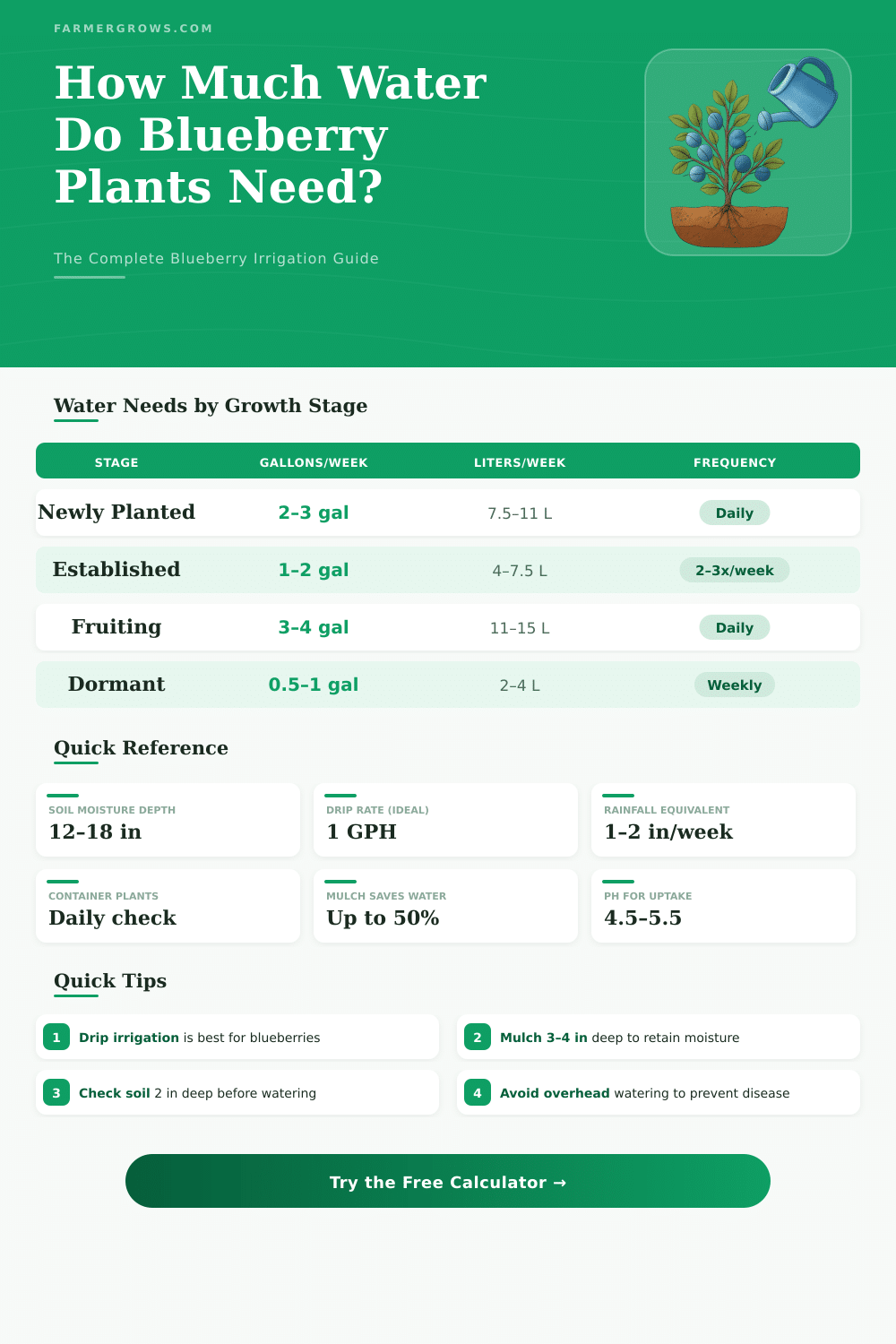
| Growth Stage | Gal / Plant / Week | Liters / Plant / Week | Watering Frequency | Soil Moisture Depth |
|---|---|---|---|---|
| Newly Planted (Yr 1) | 1–3 gal | 4–11 L | Daily or every 2 days | 12–15 in (30–38 cm) |
| Established (Yr 2+) | 1–2 gal | 4–7.5 L | 2–3 times/week | 12–18 in (30–45 cm) |
| Fruiting / Peak | 2–4 gal | 7.5–15 L | Daily during fruit set | 12–18 in (30–45 cm) |
| Dormant / Winter | 0.5–1 gal | 2–4 L | Once per week | 6–10 in (15–25 cm) |
| Container / Pot | 0.5–1 gal | 2–4 L | Check daily; water as needed | Full pot depth |
| Method | Efficiency | Water Adjustment | Best For |
|---|---|---|---|
| Drip Irrigation | 90–95% | Baseline (no adjustment) | Rows, established plantings |
| Soaker Hose | 80–90% | +10–15% more water | Row plantings |
| Subsurface Drip | 95%+ | –5% less water | Large plantings, low evap |
| Hand Watering | 60–75% | +25–35% more water | Small gardens, containers |
| Sprinkler | 65–75% | +25–35% more water | Large areas; avoid foliage wet |
| Flood / Basin | 50–65% | +40–50% more water | Sandy soils, infrequent deep |
| Mulch Depth | Water Savings | Evaporation Reduction | Recommended Mulch Type |
|---|---|---|---|
| No Mulch | 0% | Baseline | — |
| 2 in (5 cm) | ~20–25% | Moderate reduction | Pine bark, pine needles |
| 3 in (7.5 cm) | ~30–40% | Good reduction | Sawdust, wood chips |
| 4 in (10 cm) | ~40–50% | Excellent reduction | Pine bark (ideal for blueberries) |
| Plant Count | Stage | Gal/Week (Total) | Liters/Week |
|---|---|---|---|
| 1 plant | Established | 1–2 gal | 4–8 L |
| 2 plants | Established | 2–4 gal | 8–15 L |
| 4 plants | Fruiting | 8–16 gal | 30–60 L |
| 6 plants | Established | 6–12 gal | 23–45 L |
| 10 plants | Fruiting | 20–40 gal | 75–151 L |
| 20 plants | Established | 20–40 gal | 75–151 L |
Blueberry bushes work well for newcomers as well as for expert gardeners. Those tiny to medium plants add beauty and use to any garden. During spring they give little white bell-shaped flowers that attract pollinators.
Bushes those grow well in jars, so they perfectly suit for terraces or balconies and care about them require only a bit of work.
How to Grow and Care for Blueberry Bushes
Bushes usually rise to four to six feet and create nice views. In little areas we can use dwarf forms in tins. Some species in wild areas even reach eight feet high.
Blueberry bushes are deciduous, so they drop leaves in winter. Then also they seem interesting because of reddish stems and half peeled barks. The foliage year-round surprise; high Blueberry bushes turn to deep red, while low ones become bright oraneg.
Setting up of soil is important. Blueberry plants like sour ground, best with pH between 4.5 and 5.5. They do not tolerate wet roots, so good drainage is needed.
When drainage is difficult, one can raise the beds, what works very well. Projects mix almost equal from peat moss and pine bark chips. Peat moss in the long term stays and have little food, what Blueberry plants like.
They require a lot of organic matter, but not too much food, so compost materials do not work. Ammonium sulphate is commonly used during growth and feeding. When leaves lose color, that usually shows an acid problem.
Add gardening sulphur to the ground help to correct it, although it can take several months.
Full light is the best. Blueberry plants require six to eight hours of sun daily. Also they require steady Water, because their roots are shallow, usually no more then one to one and half feet.
One should plant at least two different species to increase the product by cross pollination. Blueberry plants pollinate themselves, but cross pollination give bigger fruits and rich harvests. Best plant two to three types with same bloom time.
Bees very help in pollination. In the landscape include local species to attract natural pollinators quite a lot.
Bushes do not give much fruit during the first two to three years. After five years the harvests grow more, and plants reach full size in eight to ten years. Among popular species is Chandler with his big berries, together with Patriot, Legacy, Pink Lemonade and Top Hat.
Mix late and mid-season forms ensure Blueberry fruit during two months. Low Blueberry plants grow in dry, sour, rocky or sandy grounds with low nutrients, where manyother plants do not succeed. Strong species even last drought and salt Water.