🌱 Garden Myths Soil Calculator
Calculate exactly how much soil, compost, or amendment your garden really needs — no guesswork, no myths.
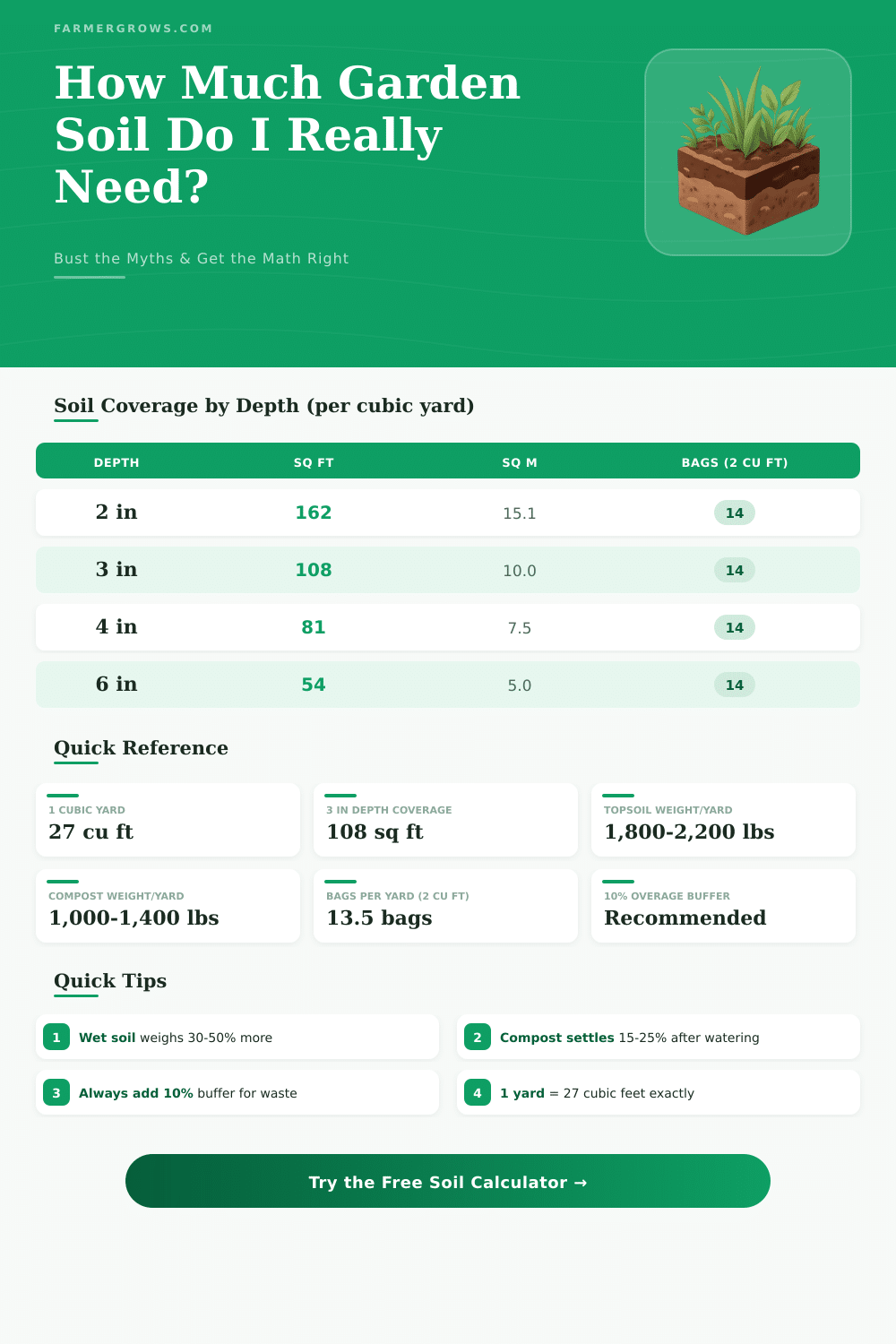
| Depth | Sq Ft / Yard | Sq M / Yard | Depth (cm) |
|---|---|---|---|
| 1 in | 324 | 30.1 | 2.54 |
| 2 in | 162 | 15.1 | 5.08 |
| 3 in | 108 | 10.0 | 7.62 |
| 4 in | 81 | 7.5 | 10.16 |
| 6 in | 54 | 5.0 | 15.24 |
| 8 in | 40.5 | 3.8 | 20.32 |
| 12 in | 27 | 2.5 | 30.48 |
| Bag Size | Volume per Bag | Bags per Yard | Coverage at 3 in |
|---|---|---|---|
| Small Bag | 1 cu ft (0.028 m³) | 27 bags | 4 sq ft |
| Standard Bag | 2 cu ft (0.057 m³) | 13.5 bags | 8 sq ft |
| Large Bag | 3 cu ft (0.085 m³) | 9 bags | 12 sq ft |
| Super Sack | 1 cu yd (0.765 m³) | 1 bag | 108 sq ft |
| Project | Area | Cubic Yards | Bags (2 cu ft) |
|---|---|---|---|
| Window Box | 10 sq ft (0.9 m²) | 0.09 | 2 |
| Small Flower Bed | 50 sq ft (4.6 m²) | 0.46 | 7 |
| Raised Bed 4×8 | 32 sq ft (3.0 m²) | 0.30 | 5 |
| Garden Plot 10×20 | 200 sq ft (18.6 m²) | 1.85 | 25 |
| Side Yard Border | 100 sq ft (9.3 m²) | 0.93 | 13 |
| Large Bed 20×30 | 600 sq ft (55.7 m²) | 5.56 | 75 |
| Full Lawn 50×50 | 2,500 sq ft (232 m²) | 23.15 | 313 |
Good soil forms the base for any healthy garden, simple, but it really works. A calculator for soil helps to quickly guess how much soil you need for beds in your garden, pots, plants and all other things that you plan in your gardening. Of course, it does not answer for food.
Really it is useful for care about the soil itself in gardening.
How to calculate how much soil you need and choose the right mix
Using such a calculator, you exactly know how much soil needs each of your pots, whether it is raised beds, gardens in soil, flowery pots, window boxes or whatever else. The tool guesses the whole volume of your garden bed, so you well know what to buy… Soil, dirt, compost, mix for plants or whatever.
Also, it even points out a rough price to fill the place. Like this you avoid guessing and spending too much on materials.
The math itself is fully easy. It takes the length in feet, times by width in feet, later by depth in feet, and gives the cubic feet. Because soil commonly sells by cubic yards, simply divide the number by twenty-seven.
Many gardeners do not have depth more than one foot, so convert inches to feet before you simplfy everything. For instance, if you have sixteen inches, ten inches and five inches (convert them to feet first), multiply and you find around 0.46 cubic feet.
Those calculators well handle big purchases and bagged soil amounts. They give results in imperial and metric units, without need of hand. Having the write amount of soil or plant mix really matters for good growth of plants, whether you grow vegetables or flowers.
When you well guess those cubic feet, your plants get the spaces that they need to spread roots and grow.
What about the soil itself? Any mix for soil is simply a blend of silt, clay, sand and organic stuff. Some add extras like perlite or sphagnum moss.
The main parts to think about are clay, silt, sand, grit and that organic stuff. Usually, use something better than what already sits in your yard, leads to better results.
Raised beds, garden soil or ground does not really help; they too heavy and dense. You want something that drains well, but also holds enough moisture. One good option that does not cost a lot is Sunny mixes.
Right mix means around sixty percent of garden soil mixed with thirty percent of compost and the rest plant soil. Plant soil is simply another name for a marked bag with that, and it usually is made up of compost, peat moss and a bit of natural dung added.
There is also the mix of Mel for square foot gardening… It mixes peat moss, compost and regular vermiculite. Helpful guides here show how much of this mix you need for different sizes of beds, and carefully share how many five-gallon buckets of every part to take.
Health of soil does not mean to simply toss mix in a bed and stop. Knowing what soil really does helps to see that it backs plants, holds water, gives food, allows air flow and good drainage. Test the pH of your soil too.
Here the thing about pH scale (it is logarithmic), so a move of one spot makes the change ten times more strong. That sourness or alkalinity directly affects how much food your plants can really use. A simple pH meter goes directly in the soil, but color test kits with tubes give more reliable results.
Taking small samples from different spots around your garden helps to build the whole picture.
Adding organic stuff to hard, pressed soil opens it, more air, better water flow, more food flowing through. Cover your topsoil with mulch or cover crops is a really clear idea. Rotate what you plant, and avoid chemicals except when absolutelynecessary, helps to keep everything in good shape.
See earthworms and their tunnels in your soil? That is really good luck. Soil is much more than simply dirt.