🌿 Topsoil Calculator — Litres, m³ & Bags
Calculate exactly how many litres of topsoil you need for any garden project
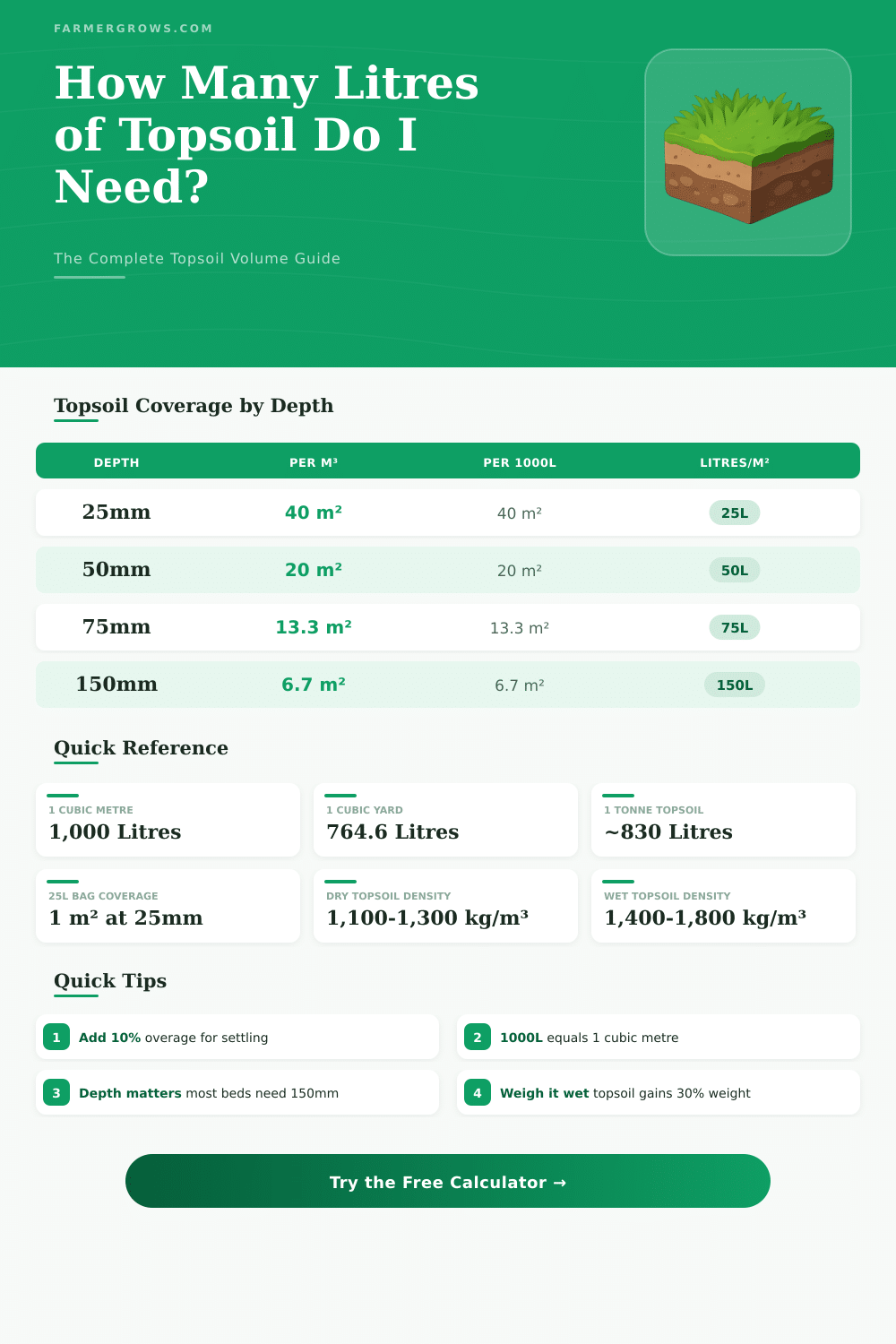
| Depth | Coverage (m²) | Coverage (ft²) | Litres per m² |
|---|---|---|---|
| 25 mm (1 in) | 40.0 m² | 430.6 ft² | 25 L |
| 50 mm (2 in) | 20.0 m² | 215.3 ft² | 50 L |
| 75 mm (3 in) | 13.3 m² | 143.5 ft² | 75 L |
| 100 mm (4 in) | 10.0 m² | 107.6 ft² | 100 L |
| 150 mm (6 in) | 6.7 m² | 71.8 ft² | 150 L |
| 200 mm (8 in) | 5.0 m² | 53.8 ft² | 200 L |
| 300 mm (12 in) | 3.3 m² | 35.9 ft² | 300 L |
| Bag Size | Volume (Litres) | Bags per m³ | Coverage at 150mm |
|---|---|---|---|
| Small Bag | 25 L | 40 bags | 0.17 m² |
| Medium Bag | 40 L | 25 bags | 0.27 m² |
| Large Bag | 50 L | 20 bags | 0.33 m² |
| Jumbo Bag | 75 L | 14 bags | 0.50 m² |
| Bulk Bag (small) | 500 L (0.5 m³) | 2 bags | 3.33 m² |
| Bulk Bag (tonne) | ~830 L (0.83 m³) | 1.2 bags | 5.53 m² |
| Project | Area | Volume (Litres) | 25L Bags Needed |
|---|---|---|---|
| Window Box 1×0.3m | 0.3 m² | 45 L | 2 bags |
| Small Bed 2×1m | 2 m² | 300 L | 12 bags |
| Garden Bed 5×2m | 10 m² | 1,500 L | 60 bags |
| Raised Bed 2.4×1.2m | 2.88 m² | 432 L | 18 bags |
| Veggie Patch 6×4m | 24 m² | 3,600 L | 144 bags |
| Lawn Repair 10×5m | 50 m² | 7,500 L | 300 bags |
| Full Garden 15×10m | 150 m² | 22,500 L | 900 bags |
At the surface of the ground, we find a thin but important layer that folks walk on without thinking, the topsoil. It forms the upper part of the soil, and here happens almost every natural process. What makes it unique is it is full of organic material and full of tiny life forms.
In it mix mineral bits with rotting plant remains, everything working to support life. The thickness normally reaches around 13 to 25 centimetres but it adjusts according to conditions. Under any meadow in your back garden, this topsoil does its task, it backs everything, from natural meadows to dense woods.
Topsoil: What It Is and Why It Is Important
That is one of those natural treasures, that always keep the ecosystems of the world running.
Forming topsoil requires patience. It starts by means of rocks, that split because of weather, wearing and the slow pressures of plant roots, that push in. When the plants exist, their roots loosen the upper layer and enter organic matter in the mix.
In the end one receives rotting substances, minerals and a whole livnig community of bacteria, fungus and other tiny life forms, that work constantly. Farmers well know that layer; when they dig, they overturn it for air flow.
The word “topsoil” commonly one uses without big attention, sometimes without clear sense. It can point to almost everything, clay, sand or mix between them. The make-up can be a bit rocky or based on clay, and commonly it lacks enough organic content.
Moreover exists the problem of unwanted grasses; some gardeners introduce dangerous seeds of weeds. The local topsoil, occasionally called “loam“, truly is special: it is made up of sand, silt and clay in write proportions. Such kind always carries nutrients and holds water quite well.
If you require a big amount of topsoil, the strained kind is the best choice. It has sense for big leveling works or filling of holes. It well works for raising low parts of farm.
The advantage is also the option to mix it with compost or peat, to increase the soil health before sowing. Whether you level ground, start beds or prepare vegetables, strained soil does the target.
Whether bagged topsoil? Here everything becomes complex. Not every bag marked “topsoil” truly carries it.
Some packages consist mainly from old wooden bits instead of real topsoil. Good topsoil should combine loam, silt and clay. The problem with many store bags is, that they stress organic matter, that breaks down too quickly.
Others go to the opposite extreme with too much clay. Wholesale topsoil usually is a double mix (sand and compost) or triple (loam, sand and compost).
The base of a good garden bed is firm mineral soil. Naturally, organic additions help, but they vanish surprisingly quickly. Mix topsoil with compost to improve the beds, although it is not always needed.
Skip good topsoil, and the ground loses its skill to filter water, store carbon and feed crops. Plants growing in tired soil have fewer nutrients. Erosion always removes that, what we have, the situation not much changed from the 1940s. Only the corn regions losebillions of dollars each year because of soil exhaustion.