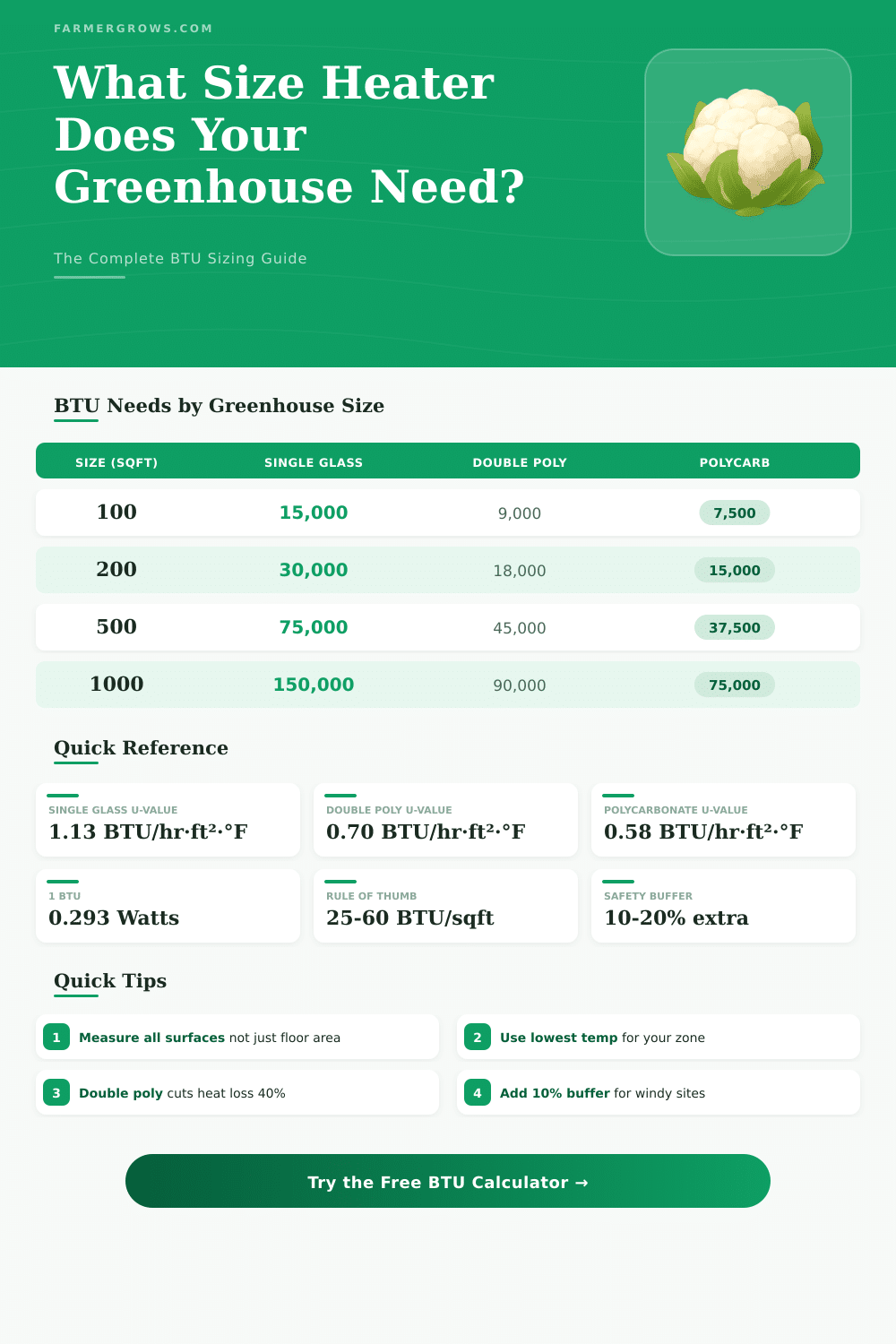
🌿 Greenhouse Heater Size Calculator
Calculate the exact BTU rating needed to keep your greenhouse at the right temperature
BTU/hr·ft²·°F
BTU/hr·ft²·°F
BTU/hr·ft²·°F
BTU/hr·ft²·°F
BTU/hr·ft²·°F
BTU/hr·ft²·°F
BTU/hr·ft²·°F
BTU/hr·ft²·°F
| Greenhouse Size | Single Glass | Double Poly | Twin-Wall Polycarb | Triple-Wall Polycarb |
|---|---|---|---|---|
| 6×8 ft (48 sq ft) | 10,800 BTU | 6,700 BTU | 5,600 BTU | 3,500 BTU |
| 8×10 ft (80 sq ft) | 16,300 BTU | 10,100 BTU | 8,400 BTU | 5,200 BTU |
| 10×12 ft (120 sq ft) | 22,600 BTU | 14,000 BTU | 11,600 BTU | 7,200 BTU |
| 12×16 ft (192 sq ft) | 33,200 BTU | 20,600 BTU | 17,000 BTU | 10,600 BTU |
| 14×20 ft (280 sq ft) | 45,200 BTU | 28,000 BTU | 23,200 BTU | 14,400 BTU |
| 20×30 ft (600 sq ft) | 81,400 BTU | 50,400 BTU | 41,800 BTU | 25,900 BTU |
| 24×36 ft (864 sq ft) | 110,600 BTU | 68,500 BTU | 56,800 BTU | 35,200 BTU |
| 30×48 ft (1,440 sq ft) | 171,400 BTU | 106,200 BTU | 88,000 BTU | 54,600 BTU |
| Greenhouse Style | Wall + Roof Multiplier | Example: 10×20 ft Floor | Total Exposed Surface |
|---|---|---|---|
| Quonset / Hoop House | 2.5× floor area | 200 sq ft floor | 500 sq ft |
| Even-Span Gable | 2.7× floor area | 200 sq ft floor | 540 sq ft |
| Gothic Arch | 2.6× floor area | 200 sq ft floor | 520 sq ft |
| Lean-To (attached) | 1.8× floor area | 200 sq ft floor | 360 sq ft |
| Geodesic Dome | 2.2× floor area | 200 sq ft floor | 440 sq ft |
| Heater Type | BTU Range | Best For | Efficiency |
|---|---|---|---|
| Electric Fan Heater | 5,000 – 17,000 | Small hobby greenhouses | ~100% (electric) |
| Electric Infrared | 3,000 – 10,000 | Spot heating / benches | ~100% (electric) |
| Propane Forced Air | 25,000 – 400,000 | Medium to large structures | 80–95% |
| Natural Gas Unit Heater | 30,000 – 400,000 | Permanent commercial | 80–95% |
| Hot Water Boiler System | 50,000 – 1,000,000+ | Large commercial operations | 85–95% |
| Wood / Biomass Stove | 20,000 – 150,000 | Off-grid / rural | 60–80% |
| Oil-Filled Radiator | 3,000 – 5,100 | Very small spaces | ~100% (electric) |
| Heat Pump (Mini-Split) | 9,000 – 36,000 | Year-round climate control | 200–300% COP |
| USDA Zone | Avg Min Temp °F (°C) | ΔT to 50°F | ΔT to 60°F |
|---|---|---|---|
| Zone 3 | -40 to -30 (-40 to -34) | 80–90°F | 90–100°F |
| Zone 4 | -30 to -20 (-34 to -29) | 70–80°F | 80–90°F |
| Zone 5 | -20 to -10 (-29 to -23) | 60–70°F | 70–80°F |
| Zone 6 | -10 to 0 (-23 to -18) | 50–60°F | 60–70°F |
| Zone 7 | 0 to 10 (-18 to -12) | 40–50°F | 50–60°F |
| Zone 8 | 10 to 20 (-12 to -7) | 30–40°F | 40–50°F |
| Zone 9 | 20 to 30 (-7 to -1) | 20–30°F | 30–40°F |
| Zone 10 | 30 to 40 (-1 to 4) | 10–20°F | 20–30°F |
The information in this article does not come from computer or automatic translator. It is based on actual users’ memories, posts in forums and gathered experiences of the community, that one finds everywhere on the net.
A greenhouse heater is a device that helps to keep the greenhouse warmer, when the outside temperature drops too much for the plants. Heating matters for the growth of plants and it depends on various factors, as the size of the greenhouse, its insulation, the local climate and the efficiency of the heating system. Without a proper heater cold nights can quickly destroy tender plants.
How to Heat Your Greenhouse
For instance, in one case two nights with temperature in the low 20th degrees caused, that the heater could not quite warm enough, and resulted in loss of several precious plants.
There are various kinds of greenhouse heaters to choose, between them electrical, natural gas or propane. Some websites offer filters, that allow customers to narrow their searches according to type of heater, fuel or mode of delivery. Choice of heating system and fuel depends on what is available locally, on the needs to warm the plants, on the price and on personal taste.
A calculator for size of greenhouse heater can help estimate exactly, what size of electrical, natural gas or propane heater is needed for a particular greenhouse.
Electrical space heaters form a safe and efficient option for warming a small greenhouse. One considers a portable small electrical heater among the best modes to add extra heat. Such heaters occasionally carry water, but more commonly oil, what gives some benefits.
Hanging space heaters also enjoy popularity, because they are small and use a fan to spread the heat. On the other hand, baseplate heaters depend on natural convection, stand very low, easily damage themselves and can have there mode turned off because of pollutants.
Propane heaters form another reliable option. Propane gives off a bit of carbon dioxide, what well feeds the plant. Brands as @Mr. Buddy, Dyna-Glo and Professional-Com commonly use in greenhouses.
Dyna-Glo and Professional-Com offer thermostat control for their units of 10 000 BTU, and all three brands maybe produce in the same plant. Vesta portable tent heater works as a non-electrical option, tests show, that the thermostat pointed 58 degrees inside, while outside were around 34 degrees with wind.
For big greenhouses electrical heaters do not work well. Running a big electrical heater for wholesale activity would require 480-volt three-phase commercial electricity. A ductless heat pump fits to warm the space with less energy and less costs to run, reaching around 100 000 BTU while it uses only around 5 kW of energy.
Warm mats present another cheap solution. For a standard 6×8 Harbor Freight greenhouse six mats are enough to protect tropical plants as coconut trees and Malay apples during the winter. Warm cables buried under grow beds also work well, and the kind sold for roof edges of houses to stop ice forming is the same wire, only longer and much cheaper than special greenhouse cables.
One brand called Father, produced in Finland, plugs into 110-volt home electricity and uses a fan to blow past a coil. It spends around five dollars per day during cold. Biogreen greenhouse heater with ACA Infinity 69 professional 4-channel WiFi control lets growers control everything from afar with a phone app.
Another heater with app control allows to control temperature from anywhere using a phone. Modine propane heater is described as easy to install and a big advantage compared with 1500-watt heaters on timers, because it runs only when needed.
In United Kingdom greenhouse heating can start in January and last until the end of May. Bubble wrap insulation and applied heat are common modes here. Small paraffin or kerosene heaters are used in England for tiny greenhouses and cold frames, although they hardly deliver to United States.
A ceramic heater laid one and a half foot from the wall in a corner of a Harbor Freight portable greenhouse added almost twenty dollars to the monthly electric bill.
For anyone who tries to keep a small greenhouse active through winter without spending a fortune, the right heater makes every difference. A tank type home waterheater, running on natural gas or propane in 30 000 to 40 000 BTU per hour, can give root zone heat for 3000 to 6000 square feet of growing area.