🚜 Tractor Tyre Size Calculator
Convert between standard, metric & imperial tyre sizes. Calculate overall diameter, width, sidewall height & find equivalent sizes.
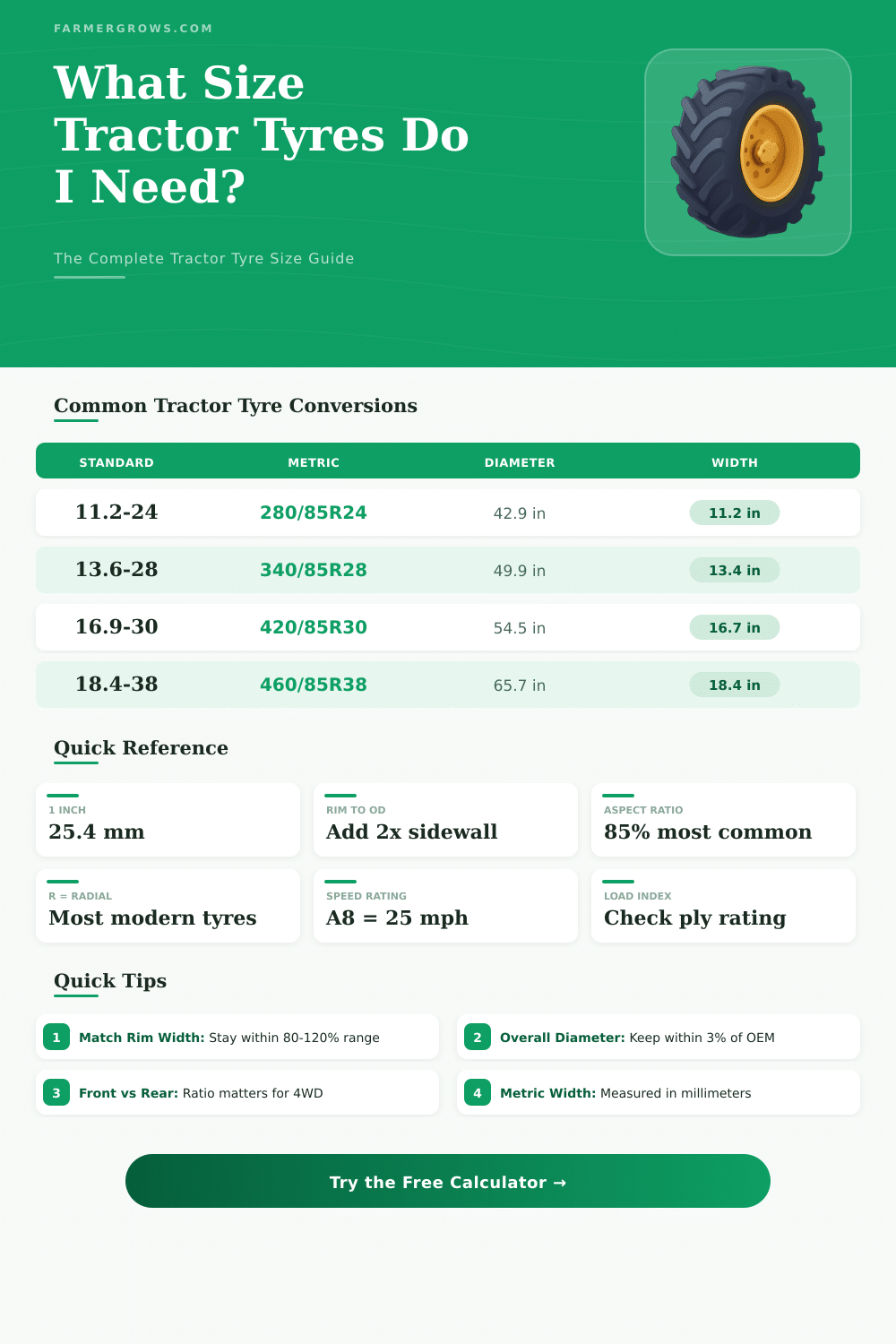
| Standard Size | Metric Equivalent | Overall Dia (in) | Overall Dia (mm) |
|---|---|---|---|
| 9.5-24 | 240/85R24 | 39.4 | 1001 |
| 11.2-24 | 280/85R24 | 42.9 | 1090 |
| 12.4-28 | 310/85R28 | 48.4 | 1229 |
| 13.6-28 | 340/85R28 | 49.9 | 1267 |
| 14.9-28 | 380/85R28 | 51.8 | 1316 |
| 16.9-30 | 420/85R30 | 54.5 | 1384 |
| 18.4-34 | 460/85R34 | 60.7 | 1542 |
| 18.4-38 | 460/85R38 | 65.7 | 1669 |
| 20.8-38 | 520/85R38 | 68.8 | 1748 |
| 24.5-32 | 620/85R32 | 66.8 | 1697 |
| Width (in / mm) | AR 70% Sidewall | AR 85% Sidewall | AR 100% Sidewall |
|---|---|---|---|
| 9.5 / 241 | 6.65 in / 169 mm | 8.08 in / 205 mm | 9.50 in / 241 mm |
| 11.2 / 284 | 7.84 in / 199 mm | 9.52 in / 242 mm | 11.20 in / 284 mm |
| 13.6 / 345 | 9.52 in / 242 mm | 11.56 in / 294 mm | 13.60 in / 345 mm |
| 16.9 / 429 | 11.83 in / 300 mm | 14.37 in / 365 mm | 16.90 in / 429 mm |
| 18.4 / 467 | 12.88 in / 327 mm | 15.64 in / 397 mm | 18.40 in / 467 mm |
| 20.8 / 528 | 14.56 in / 370 mm | 17.68 in / 449 mm | 20.80 in / 528 mm |
| Tyre Width | Min Rim Width | Recommended Rim | Max Rim Width |
|---|---|---|---|
| 9.5 in | 7 in | 8 in | 10 in |
| 11.2 in | 8 in | 10 in | 12 in |
| 13.6 in | 10 in | 12 in | 14 in |
| 16.9 in | 12 in | 14 in | 16 in |
| 18.4 in | 14 in | 16 in | 18 in |
| 20.8 in | 16 in | 18 in | 20 in |
| Tractor Type | Typical Rear Tyre | Typical Front Tyre | Overall Rear Dia |
|---|---|---|---|
| Sub-Compact (25 HP) | 9.5-16 | 6-12 | 31.4 in |
| Compact (40 HP) | 12.4-28 | 7.50-16 | 48.4 in |
| Utility (75 HP) | 16.9-30 | 11.2-24 | 54.5 in |
| Row Crop (120 HP) | 18.4-38 | 14.9-28 | 65.7 in |
| Large (200 HP) | 20.8-38 | 16.9-28 | 68.8 in |
| 4WD Articulated (400 HP) | 24.5-32 (all) | 24.5-32 (all) | 66.8 in |
Wow, you could not believe the huge size that I found when I examined those great 18.4-38 back Tyre for Tractor. They have whole diameter of almost 1 700 millimeters, around 65,7 inches! Until I saw one of them standing against the doorframe for comparison, I absolutely not imagined that they reach such height.
And about the sidewall itself, with 85-percent side ratio, it reaches around 15,6 inches. That eats a lot of space of the upper part, before you even reach the desired tread pattern. Good value to recall that, if you plan to change to bigger model from something more small as 16.9-30, that only has 54,5 inches of height.
How to Choose Tractor Rear Tyres
When deal about Tractor with MFWD (mechanical front wheel-drive), I learnt that the front-back circle ratio must stay between 1,03 and 1,05. A bit outside that range, and you risk problems with the driveline. For instance, front Tyre 13.6-28 matches with around 340/85R28 in metric system, that measures almost 49,9 inches whole.
The change of width can be tricky, simply take the inches, multiply by 25,4 for millimeters, and round to the nearest 20 for the metric name. Like this 11,2-inch Tyre becomes 284 mm, waht rounds to 280.
Tractor use both radial and diagonal (or bias) Tyre, every type with its own benefits. Usually you spot radial by the “R” on the sidewall. The standard size as “14.9-42” shows the width in inches and the rim diameter in inches.
Sometimes you find it written with “x” or stroke, for instance 11.2×24 or 11.2-24. The European ETRTO-group set many of those things, witch simplifies everything.
Do note that back Tyre always bear the biggest part of the Tractor weight, so they are usually bigger than the front. Even so that is not strict rule. Tractor with two-wheel drive has big backs and less big fronts, while models with broad lead use double front Tyre, that matches the back.
For four-wheel drive, best are use almost same sizes for Tyre, so that the driveline stay happy.
The transmissions of these machines are designed for certain rim sizes, so changing that can seriously affect the performance. You should stay at the tips of the maker, unless they allow to go bigger or less big. Use the wrong size can cause problems in traction, load skill and whole impact.
Talking about load skill, here enters the IF (increased flexibility) and VF (very high flexibility) Tyre, that gives real benefits. They allow to bear heavier tools, while one keep the pressure low, what is big help. Also the markings about speed and load on the sidewall deserve attention.
I noticed that some old Tyre reach maximum of around 4 800 kg. In 50 km./h, while new models can handle 5 300 kg. In 70 km./h; with less sidewall-bend, to boot.
When one chooses brands, I have good experiences with BKT. Their Tyre last well and wear quite cleverly, I saw eight-year BKT-Tyre that yet looks almost new, without any crack visible. Firestone Tyre, on the other hand, commonly crack over time.
Michelin Tyre hold well, but wear more quickly, if you do much road work. And the Alliance-brand offers reliable, cheaper option, that even so works surprisingly.
At the end of the day, the “good” Tractor Tyre depends on the certain task that you do; whether ploughing, farming, hauling or whatever. Michelin, Nokian and MRF produces Tyre fit for maximum pull, less ground packing or lasting hardground. It all deals about finding the right balance for your needs.
Many things play role, but with a bit of research, you certainly will find the ideal set of rubber for your Tractor.