🐄 Livestock Feed Ration Calculator
Calculate daily and periodic feed requirements for cattle, horses, sheep, goats, swine & poultry
| Feed Type | DM Content (%) | As-Fed Density (lb/ft³) | Density (kg/m³) |
|---|---|---|---|
| Grass Hay | 88% | 4.5 | 72 |
| Alfalfa Hay | 90% | 5.0 | 80 |
| Corn Silage | 35% | 40.0 | 641 |
| Corn Grain (Shelled) | 87% | 45.0 | 721 |
| Grain Mix | 88% | 40.0 | 641 |
| Complete Feed (Pelleted) | 90% | 38.0 | 609 |
| Poultry Layer Mash | 90% | 36.0 | 577 |
| Poultry Broiler Ration | 90% | 38.0 | 609 |
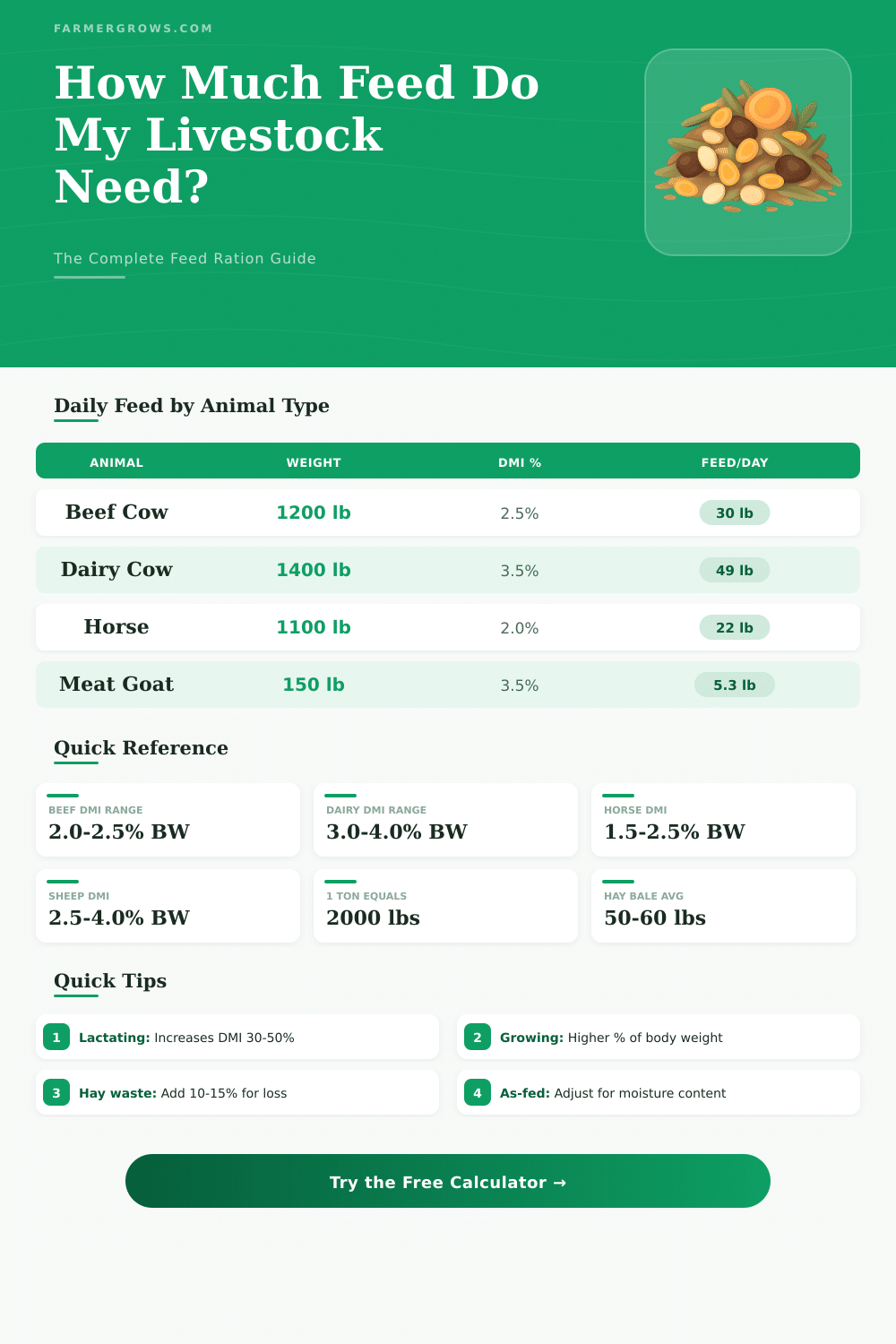
| Animal | Body Weight | DMI (%BW) | Daily DM (lbs) | Daily DM (kg) |
|---|---|---|---|---|
| Beef Cow (maintenance) | 1,200 lb / 544 kg | 2.0% | 24.0 | 10.9 |
| Beef Cow (lactating) | 1,200 lb / 544 kg | 2.5% | 30.0 | 13.6 |
| Dairy Cow | 1,400 lb / 635 kg | 3.5% | 49.0 | 22.2 |
| Horse (maintenance) | 1,100 lb / 499 kg | 2.0% | 22.0 | 10.0 |
| Horse (working) | 1,100 lb / 499 kg | 2.5% | 27.5 | 12.5 |
| Ewe (maintenance) | 175 lb / 79 kg | 2.5% | 4.4 | 2.0 |
| Ewe (lactating) | 175 lb / 79 kg | 4.0% | 7.0 | 3.2 |
| Meat Goat | 150 lb / 68 kg | 3.5% | 5.3 | 2.4 |
| Dairy Goat | 150 lb / 68 kg | 4.5% | 6.8 | 3.1 |
| Swine Finisher | 250 lb / 113 kg | 3.0% | 7.5 | 3.4 |
| Bale Type | Avg Weight (lbs) | Avg Weight (kg) | Approx. Bales per Ton |
|---|---|---|---|
| Small Square (2-string) | 50–60 | 23–27 | 33–40 |
| Small Square (3-string) | 100–130 | 45–59 | 15–20 |
| Large Round (4x5) | 800–1,000 | 363–454 | 2–2.5 |
| Large Round (5x6) | 1,200–1,500 | 544–680 | 1.3–1.7 |
| Large Square (3x3x8) | 1,000–1,400 | 454–635 | 1.4–2 |
| Large Square (4x4x8) | 1,800–2,200 | 816–998 | 0.9–1.1 |
| Scenario | Animals | Period | Total Feed (As-Fed, lbs) |
|---|---|---|---|
| 10 Beef Cows (maintenance) | 10 | 90 days | 24,545 |
| 1 Dairy Cow (high production) | 1 | 30 days | 1,633 |
| 2 Horses (light work) | 2 | 30 days | 1,500 |
| 20 Ewes (gestation) | 20 | 150 days | 15,000 |
| 50 Meat Goats | 50 | 30 days | 9,034 |
| 100 Layer Hens | 100 | 365 days | 10,139 |
| 500 Broilers (market) | 500 | 42 days | 4,667 |
| 50 Swine Finishers | 50 | 120 days | 51,136 |
Cow weighing 1 200 pounds, that receives basic diet for support usually consume around 24 pounds of dry matter daily… Everything that matches to about 2% of her whole body mass. During the period of high energy for milk product, the needs of feed grow to 2,5%, what means around 30 pounds of dry matter.
That does not seem a lot, but considering that hay carries only around 88% of dry matter, those 30 pounds must match to almost 34 pounds of real hay for one cow day. If one counts for more than 20 cows during 90 days, one arrives to around 24 500 pounds of hay. One half round ball, that disappears for a cow during one day, adds up very quickly.
How Much Feed Do Farm Animals Need
Selling cows raise the cause to an entirely new height. A cow weighing 1 400 pounds requires around 3,5% of her body mass in eating of dry matter daily, what results in a huge amount of 49 pounds. Thinking about that corn silage has only 35% of dry matter, each such cow takes somehting as 140 pounds of actual silage for one day.
Mad, right? Factors of waste play a big role also, cows, that eat from ground fed autumn grasses, can lose 25-30% of their feed, but using ring feeders one reduces the waste to 10-15%. Birds are a bit easier cause, but the amounts grow quickly; 100 chickens, that lay eggs, consume each 0,25 pound of feed each, what adds up to around 9 125 pounds of feed yearly, plus some changes because of moisture.
The information below does not come from a calculator or anything fancy. It is based on actual usage, looking back, discussions in forums and experiences of farming communities on the net.
feed for livestock is a wide category, that covers everything, what we give to hour domestic creatures, especially in operations of raising animals. There are two main kinds: feed and roughage. If folks simply say “feed”, they usually mean the feed.
Whole grain of corn is very liked for feed livestock and birds. It packs energy and carbohydrates, what helps to keep creatures in healthy weight and work at their best. One can give corn to livestock, horses, goats, whatever you want; alone or mixed in special pasture mixes.
The kind, that one uses for livestock, has a thicker shell than the sweet corn, that we eat, and around 90% of the corn grown in United States is that farm kind, not the eating one. Interesting cause is that livestock can use around 90% of the whole corn plant, while folks only really take the little grains.
Some ingredients of feed work well for many species of livestock. Oats, barley and corn cakes all work. No matter what creature you feed, it matters to understand the needs of fat, protein and carbohydrates for that particular type of livestock.
Mixing your own special feed at home can even save money over long time. Another category is extras for feed, those include added vitamins, minerals, amino acids or other nutrients, that are added to feed for livestock.
Livestock is made up of ruminant creatures, what means that they are able to break down low-quality proteins and turn them in better ones, that their bodies really can use. Actually, livestock can digest up to 60-80% of plant materials, that are totally not digestible for folks. So they can eat stuff as grasses, that single-stomach creatures as chickens and pigs simply can not touch.
On the other hand, ruminants as cows only need 0,6 kilo of protein from their feed to produce 1 kilo of protein in form of meat and milk.
Believe it or not, cooking grains for livestock is a real practice. Some people take corn, roast it in a pan, add water to fill the space and cook it at 350°F during 10-12 hours. When it cools, one gives it during the next feeding.
Soaking barley before giving it to cattle also helps with weight gain, according to saying. The general opinion is that cooked corn helps beef livestock gain weight more quickly.
There are several important companies for feed, that serve owners of livestock. Performance Livestock and Feed Company is one of them, and it works with the animal nutrition division of Land O’Lakes, called Purina. KENT Nutrition exists since 1927, when the founder created a product called KENT 34% Baby Beef, sold as feed without hulls.
Other big names are Cargill Nutrena, Hubbard and Blue Seal. When costs of feed keep growing, finding ways to cover or addto those expenses is key for all kinds of operations with livestock.