🌿 Liquid Fertilizer Application Rate Calculator
Calculate exact liquid fertilizer quantities, dilution volumes, and spray coverage for any area
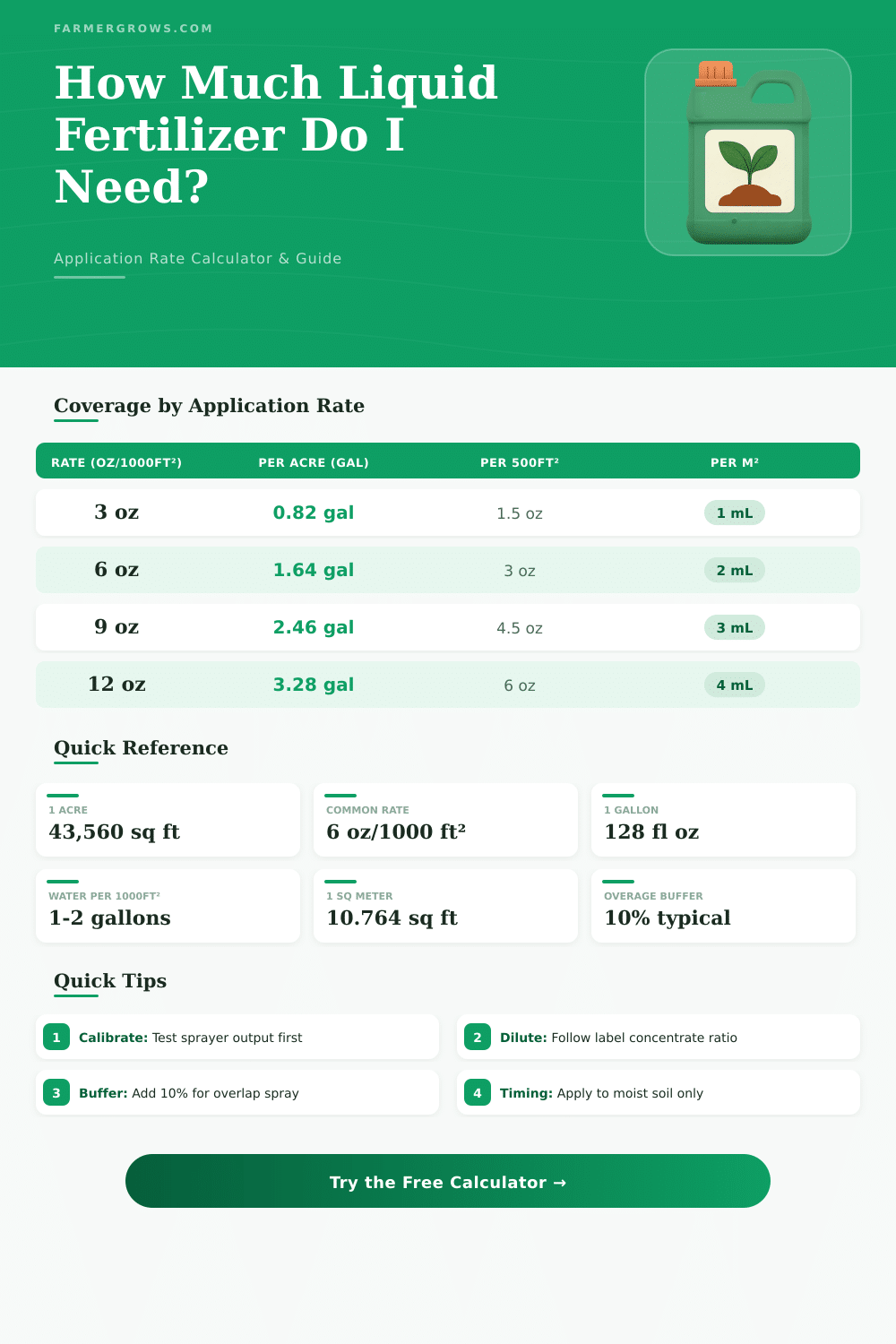
| Rate (oz/1,000 ft²) | Per Acre (gal) | Per 5,000 ft² (oz) | Per 93 m² (mL) |
|---|---|---|---|
| 2 oz | 0.68 gal | 10 oz | 59 mL |
| 3 oz | 1.02 gal | 15 oz | 89 mL |
| 4 oz | 1.36 gal | 20 oz | 118 mL |
| 6 oz | 2.04 gal | 30 oz | 177 mL |
| 8 oz | 2.72 gal | 40 oz | 237 mL |
| 9 oz | 3.06 gal | 45 oz | 266 mL |
| 12 oz | 4.08 gal | 60 oz | 355 mL |
| Container Size | Fluid Ounces | Coverage at 6 oz/1,000 ft² | Coverage (m²) |
|---|---|---|---|
| 1 Pint | 16 oz | 2,667 ft² | 248 m² |
| 1 Quart | 32 oz | 5,333 ft² | 495 m² |
| Half Gallon | 64 oz | 10,667 ft² | 991 m² |
| 1 Gallon | 128 oz | 21,333 ft² | 1,982 m² |
| 2.5 Gallon | 320 oz | 53,333 ft² | 4,954 m² |
| 5 Gallon (Bulk) | 640 oz | 106,667 ft² | 9,909 m² |
| Project | Area | Fertilizer at 6 oz/1,000 ft² | Water Needed (1 gal/1,000 ft²) |
|---|---|---|---|
| Small Flower Bed | 100 ft² | 0.6 oz | 0.1 gal |
| Raised Garden | 250 ft² | 1.5 oz | 0.25 gal |
| Side Yard | 500 ft² | 3 oz | 0.5 gal |
| Front Lawn | 1,000 ft² | 6 oz | 1 gal |
| Average Yard | 2,500 ft² | 15 oz | 2.5 gal |
| Large Property | 5,000 ft² | 30 oz | 5 gal |
| Half Acre Lot | 21,780 ft² | 130.7 oz (1.02 gal) | 21.8 gal |
| Full Acre | 43,560 ft² | 261.4 oz (2.04 gal) | 43.6 gal |
Well, we start with this theme. Here the first part:
When talking about liquid fertilizer I found that the right amount usually is around 6 ounces for 1 000 square feet. Everything comes to around 2 gallons of concentrate for acre, what really surprised me… I assumed that the dose will be a bit bigger.
How Much Liquid Fertilizer to Use and How to Use It
One quart bottle is enough to cover around 5 300 square feet, so it becomes a practical single solution for most home lawns. Exception is the fish mix, that requires a bit more, namely around 9 ounces for 1 000 square feet, so that quart covers only around 3 500 square feet.
For a yard of 2 500 square feet I used around 15 ounces of concentrate mixed with 2.5 gallons of water. If you scale up to 5 000 square feet, you need 30 ounces, almost a whole quart. The extra 10 percent reserve is built in, because I noticed that overlap of the sprinkler commonly wastes 8 to 12 percent of the covering, and that amount can rise to 15, 20 percent on slopes steeper than 3:1 grade.
One good thing about liquid fertilizer is their flexibility; they solve several problems during one application. Whether you struggle against transplant shock, yellowing leaves or simply want too give flowering plants a fast feeding boost, those focused mixes really help. And they are made for use both indoors and outside, during the whole year.
The liquid types include also many extras, for instance boosters for deeper roots, liquid aeration and liquid iron. You find balanced all-use mixes with basic N-P-K nutrients or more special recipes for separate targets, as the slow release 20-2-3 liquid for feeding in spring and early summer. The Tiger Flowers are liked for helping fruits, flowers and young shoots grow.
Now, liquid fertilizer does not always beat granular in results, especially in dry or wet conditions, the nutrient levels vary quite a lot. However the main benefit of liquids is, that plants receive nutrients right away, rather than the slower release from granules. Like this liquids work well for fast helps, while granules are better for general, long-lasting feeding.
Even so, with liquids you must be careful, because you can easily overdo it, especially with potted plants. If a plant looks a bit dry, better water it first and fertilize only the next day, otherwise you can burn the roots. For seedlings I advise to start with a quarter-strong solution, when the first real leaves appear; that is a good simple rule.
Leftover diluted mix you can save for next time, instead of dumping.
Of course, you can always make your own liquid fertilizer. Compost, egg shells, fish mix and seaweed extracts all make good home options. But homemade liquids bring some downsides, like maybe bigger problems with pests, diseases and weeds, so store bought is commonly the more reliable choice formost people.
All in all, liquid fertilizer gives a lot of flexibility and ease, whether for indoor plants, outdoor gardens or your lawn. Simply mind the amounts, the dilution and avoid over feeding, and you will get good results. Do not hesitate to try different ones.
The options are almost endless for those focused liquid plant nutrients.