Bahia Grass Seed Germination Calculator
Estimate bahia grass emergence from hulled or unhulled seed, soil temperature, scarification, planting depth, surface moisture, seedbed firmness, PLS, rainfall or irrigation, days since sowing, and soil pH.
Pick a bahia planting situation, then tune the seed tag and field conditions. These presets focus on emergence speed and stand risk, not seeding cost.
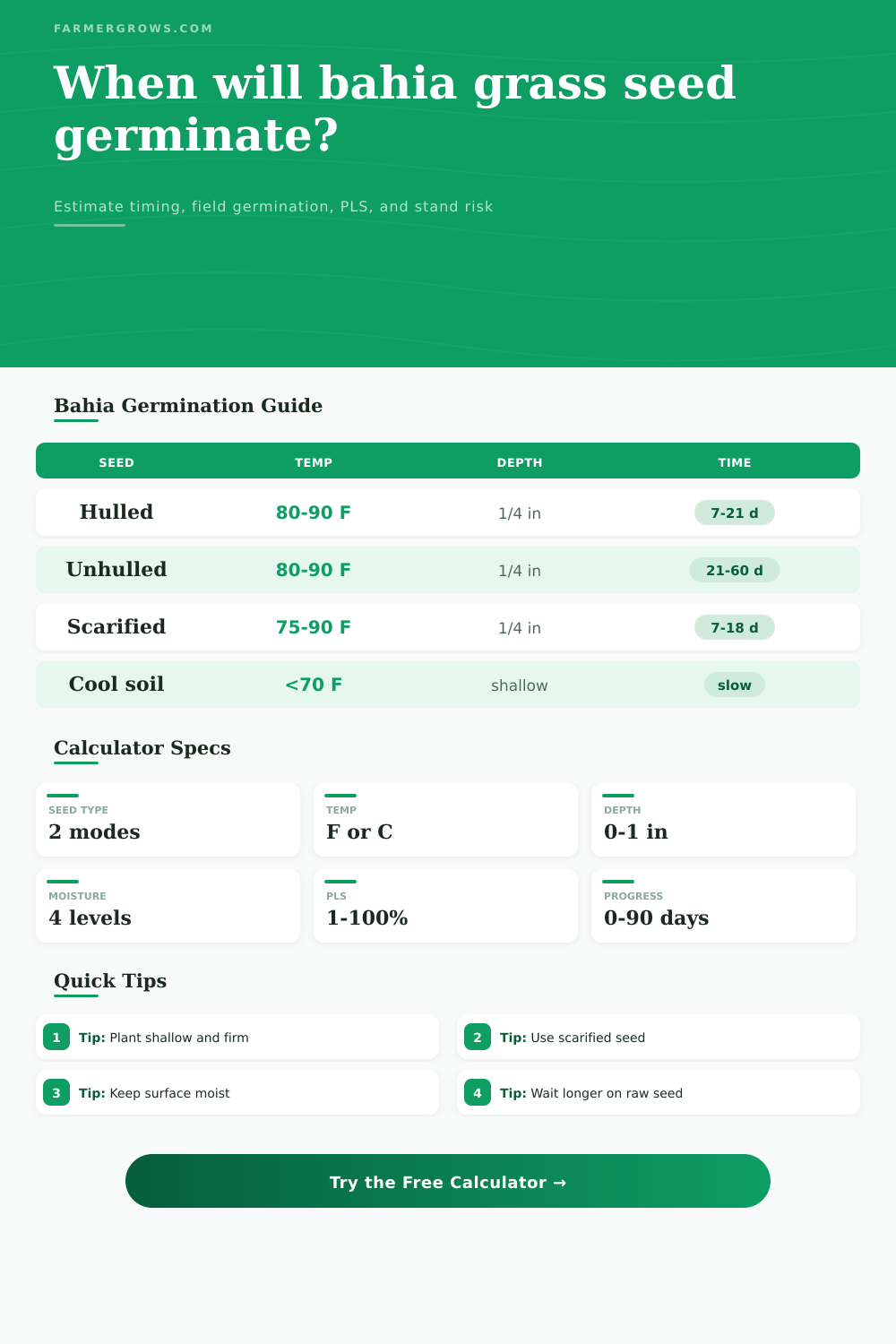
Hulls are removed, so water reaches the seed more easily. Good lots can show visible sprouts much sooner in warm, moist soil.
Raw seed is slower and less uniform. Some seed may wait for weathering, warmth, and repeated wetting before sprouting.
Scarification breaks dormancy pressure and shortens the expected emergence window when depth and moisture are right.
Older or mixed lots can behave unevenly. Use the PLS number and field conditions to control the estimate, not the bag name alone.
Bahia Germination Estimate
Your emergence estimate will appear here after calculation.
| Average soil temperature | Bahia response | Calculator factor | Expected field note |
|---|---|---|---|
| Below 65°F / 18°C | Very slow or stalled | Strong penalty | Seed may wait until the soil warms instead of emerging evenly. |
| 65-74°F / 18-23°C | Slow start | Moderate penalty | Early spring plantings can look inactive for extra days. |
| 75-90°F / 24-32°C | Best germination range | Full credit | Moist scarified seed can begin showing in one to three weeks. |
| 91-98°F / 33-37°C | Fast but moisture-sensitive | Small penalty | Hot seedbeds need steady light watering to avoid surface drying. |
| Above 98°F / 37°C | Heat stress risk | Moderate penalty | Seed may dry, crust, or lose vigor without careful moisture. |
| Field condition | Good target | Warning sign | Calculator effect |
|---|---|---|---|
| Planting depth | 1/8 to 1/2 inch | Buried deeper than 1/2 inch | Deep seed receives a strong emergence penalty. |
| Surface moisture | Evenly moist, not sealed | Dry cycles or standing water | Moist soil improves both speed and final percentage. |
| Seedbed firmness | Footprint about 1/4 inch | Fluffy soil or hard crust | Firm soil keeps shallow seed in the active moisture zone. |
| Water after sowing | About 0.5 to 2 inches useful water | No rain, washout, or crusting rain | Too little or too much water reduces the progress estimate. |
| Seed situation | Typical first visible seedlings | Typical judging window | Best use in calculator |
|---|---|---|---|
| Scarified hulled seed | 7 to 14 days | 21 to 30 days | Use for quick lawn or pasture establishment checks. |
| Hulled, not scarified | 10 to 21 days | 30 to 45 days | Use when the tag says hulled but treatment is not listed. |
| Unhulled or raw seed | 21 to 45 days | 45 to 90 days | Use for dormant-prone seed lots and slow pasture starts. |
| Weathered or stored seed | 14 to 30 days | 30 to 60 days | Use when aged seed has reduced dormancy but uncertain vigor. |
| Input range | Calculator reading | Stand implication | Adjustment idea |
|---|---|---|---|
| PLS below 55% | Weak seed lot | Fewer live seeds are available before field losses. | Expect a thinner stand unless seeding rate was increased. |
| PLS 70% to 85% | Usable seed lot | Field factors usually decide the final stand more than the tag alone. | Focus on depth, moisture, and firm seed-to-soil contact. |
| pH 5.5 to 6.5 | Good bahia range | Seedlings face less chemical stress during early root growth. | Keep fertility decisions tied to a current soil test. |
| pH below 5.0 or above 7.2 | Stress range | Emergence may happen, but seedling vigor can lag. | Correct soil limits before expecting full establishment. |
The calculator is an estimate for stand-check timing. Local variety, seed age, soil texture, pests, and weather after sowing can shift actual emergence.
Use the first 30 days wisely: For hulled or scarified bahia seed, warm soil plus light frequent moisture should produce visible seedlings before the stand is judged too harshly.
Give raw seed more time: Unhulled bahia can emerge in waves, so a bare-looking field at two or three weeks may still fill in after more warm, moist days.
Preparing the soil is one of the most frustrating parts of growing bahia grass for many homeowners because it takes time. They want to do something now and have a nice green carpet in a week. The seed goes down, you water it, but nothing happens. Is the seed dead? No. Usually what has happened is the seeds is simply waiting for the right environment.
Germinating bahia is not a race. It’s about understanding seed type, moisture, and temperature requirements to trick your soil into doing its job.
How to Help Bahia Grass Grow
The largest variable you control is the seed itself: unhulled bahia seeds (raw) look like small grains of rice encased inside a hard shell. While the hull keeps the embryo safe it also prevents moisture from entering the seed. When the hull rots or cracks, the seed emerge, which is why raw seed may require up to 45 days before full emergence. Once the hull is removed, what’s left is hulled seed. Water penetrates the seed at that point, right away. A step further is scarified seed, where the seed coat is mechanicaly “nicked,” to allow quicker water absorption. Bottom line: For instant results, use either hulled or scarified seed. Use raw seed (to save money) and you’ve bought yourself time, not just grass.
Once you know your soil conditions and seed type, plugging those variables into the calculator above do the math for you, saving you the guesswork about conversions and coefficients.
This entire process is driven by temperature. Because Bahia is a warm-season grass, it won’t germinate in cool soil. Below sixty-five degrees F., the seed simply sits there and wait for summer. It’s not rotting. But it’s also not growing. The sweet spot? Between eighty and ninety degrees. At those temperatures, hulled seed can sprouts within two weeks or less. Unhulled seed may take another month.
No one can control the weather, but you can select your planting window wisely. The biggest mistake people make when planting bahia is planting too early in spring. They look out at the yard and see some green stuff and say, “OK, time to sow.” Nope. Don’t do it. Wait till the soil warm up.
Heat is also important but so is depth. Because Bahia seed is small, it lacks the energy reserves to fight its way up through thick soil cover. To ensure death before it even begins, simply bury it deep. Just press the seeds into the uppermost layer of soil, barely covering it. Make your seedbed firm. Walking on it or rolling it create better seed-soil contact. Fluffy soil is worse because it allows seeds to sink too deeply between clumps. The simple ways of doing this improve germination rate far more different than any costly fertilizer ever could.
The last part of the equation is moisture. Keep the top half-inch of soil damp, but don’t soak it because then the seed rots. Keep the top inch or so moist (not wet) throughout germination. Water lightly and frequently. Never use a big gush, which can seals the surface with a crust that no tender little seedling pushes through.
Patience pays off here. Even if you start with raw seed, resist the urge to panic at the second week when things seem barren out there in the field. Looks like death? Not yet. Just slow. Keep the soil warm and moist for another few weeks and the seedlings will emerges…and they won’t be all at once. In waves.
Trust the process. Check your soil. Check the moisture and the soil temperature, and let nature take over. Soon enough, the grass will arrive when it’s good and ready.