Tomato Plants Per Container Calculator
Estimate how many tomato plants fit in a pot, grow bag, trough, or planter using container dimensions, gallons, tomato type, spacing, pruning, support, sun, water reserve, and disease pressure.
Start with a real tomato container setup, then adjust gallons, spacing, pruning, support, sun, water reserve, and disease pressure for your patio or greenhouse.
Your Tomato Container Plan
Recommended plant count, soil volume, spacing fit, and water-airflow rating will appear here.
Efficient root ball shape for one caged tomato. Diameter controls canopy spacing more than listed gallon size.
Good for two or more dwarf or determinate plants when length gives enough centers between stems.
Air-pruned roots help growth, but reserve water drops quickly in hot sun unless the bag is oversized.
Reservoir containers can carry dense patio tomatoes better, but airflow still limits humid plantings.
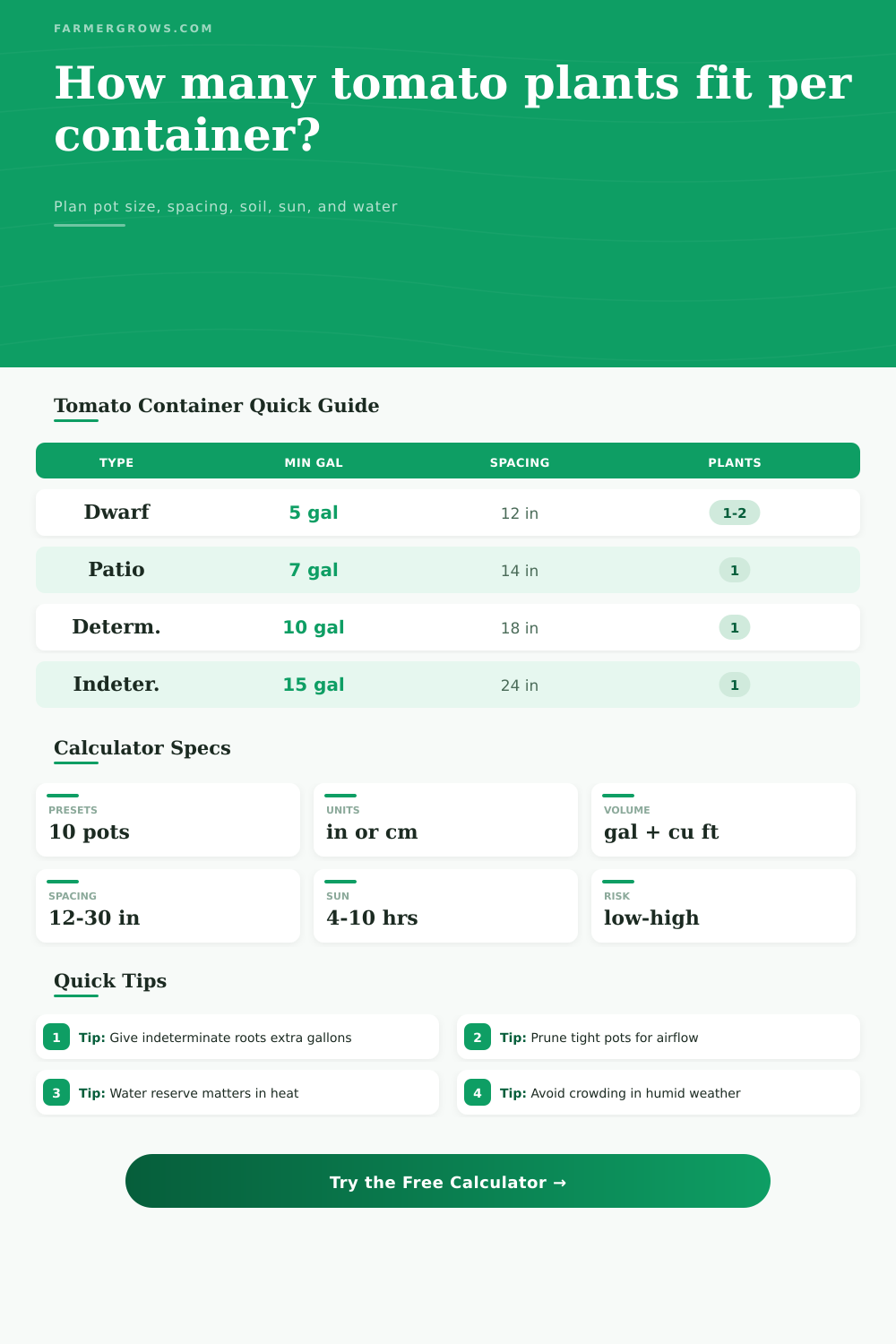
| Container size | Best tomato fit | Typical count | Notes |
|---|---|---|---|
| 3 to 5 gallons | Micro, dwarf, small cherry | 1 plant | Use compact support and avoid large slicers in this size. |
| 7 to 10 gallons | Patio determinate or dwarf | 1 plant | Enough for many bush tomatoes if watering is consistent. |
| 15 to 20 gallons | Indeterminate cherry or slicer | 1 plant | Best all-around size for tall container tomatoes. |
| 25 to 30 gallons | Two dwarf plants or one vigorous vine | 1 to 2 plants | Spacing, airflow, and support decide whether two is sensible. |
| 40 gallons or more | Planter row or stock tub | 2 to 4 plants | Use a long footprint, not just extra depth, for multiple plants. |
| Training style | Spacing target | Soil target | Container note |
|---|---|---|---|
| Minimal pruning, wide cage | 24 to 30 inches | Highest | Best for one plant in a large round pot or barrel. |
| Standard cage or stake | 18 to 24 inches | Normal | Reliable for most patio determinate and cherry tomatoes. |
| Single-stem trellis | 12 to 18 inches | Moderate | Useful in long troughs, but needs frequent pruning. |
| Compact cage or basket | 10 to 14 inches | Lower | Use for dwarf, micro, or hanging tomato cultivars only. |
| Condition | Good range | Calculator effect | Practical meaning |
|---|---|---|---|
| Direct sun | 6 to 10 hours | Raises readiness | Less than 6 hours can support foliage but reduces fruiting strength. |
| Water reserve | Medium to high | Protects dense pots | Small hot containers may wilt before roots can use all nutrients. |
| Disease pressure | Low to medium | Lowers safe count | Humid patios need more airflow between tomato leaves. |
| Usable depth | 12 inches or more | Supports root volume | Shallow planters dry quickly even when the gallon number looks fair. |
| Preset | Size used | Tomato type | Likely count |
|---|---|---|---|
| 5 gallon cherry bucket | 12 x 12 x 14 in | Dwarf cherry | 1 tight plant |
| 10 gallon patio pot | 16 x 16 x 15 in | Patio determinate | 1 plant |
| Sub-irrigated box | 29 x 14 x 12 in | Determinate | 2 careful plants |
| 48 inch trough | 48 x 18 x 16 in | Single-stem cherry | 2 to 3 plants |
| Half barrel | 24 x 24 x 18 in | Determinate | 1 to 2 plants |
Root room: If the calculator says the plant count fits by spacing but not by gallons, choose the lower count. Tomato roots and moisture reserve usually become the limiting factor first in containers.
Airflow: In humid gardens, treat high disease pressure as a real capacity limit. One healthy, well-supported container tomato usually beats two crowded plants that stay wet overnight.
The seedling’s in the pot, A good one; the tomato’s starting out strong. But come July it droops; too many leaf for its space, or maybe its roots is outgrowing the container. Why? Most of us think about the tomato itself (its variety), instead of thinking about physical limits of both the plant and the pot.
To ensure airflow and enough room for the roots to grow, the calculator matches your pot size with its volume. It also considers space, sun, watering reserves, and disease pressure for container-grown tomatoes. Before any soil go in, it converts guessing into planning.
Why This Tomato Calculator Is Useful
Not only does the tool ask for size (the number on the side of the pot), it also asks about the volume (which is not just the labeled size, but includes the usable soil depth). Ten gallons of soil may fit into a wide, shallow planter. However, with no more than four inches of soil depth, there is nowhere for roots to anchor. The mix will also dry out fast in hot weather.
The tool accounts for settled soil (you don’t fill your pots right to the top) by asking for the fill percentage. It also accounts for the fact that vigorous indeterminate slicers requires vertical space for their roots to reach nutrients. Without this space, the plant stress and its fruit comes out poor. The tool accounts for this reality in the math, so you don’t overestimate what any particular tub can handle.
Soil volume isn’t all; there’s also the matter of spacing. Two determinate plants may fit comfortabley in a ten-gallon pot, but then their foliage will get close together and hold moisture. Moisture between the leaves are an invitation to mildew and blight, which can destroy a crop in short order. To provide a realistic number of plant, the calculator takes into account pruning style and disease pressure, too.
In a moist climate, or where air doesn’t circulate well, it recommends fewer plants different than might be possible in a dry, breezy one. That adjustment could of saved your harvest. Wide cages need more space; so does single-stem pruning on a trellis (since the side shoots are removed, freeing up light). The tool reflects those tradeoffs.
Another key consideration is the water reserve. A big pot will hold more, and therefore buy you more time before watering again. On the other hand, a smallish grow bag may demand two-waterings-a-day in high summer. To rate how ready a container will be, the tool takes into account both its water reserve and also the level of sun exposure.
Medium? high?) and also the level of sun exposure (five hours? 10?). So if you only have a five gallon pot and it’s on a spot where there are ten hours of direct sun…that brings down the readiness score. This happens not just because the plant won’t do well, but because you won’t be able to keep up with maintenance.
You can make up for a little less size by watering a lot more. But you can’t pretend to provide sun or air circulation. The numbers help you create a set-up that matches your climate, and your schedule.
Big tomatoes aren’t like small ones. Dwarf and micro tomatoes behave differently than their larger cousins; micros are a type of compact tomato that has been selected for its size… And will do better in smaller areas with less soil. That’s why the chart indicates, for example, that a micro tomato might be happy in a container as little as three gallons, but a beefsteak slicer would require at least fifteen, or more.
You can fertilize all day long; it just won’t work out if you try to grow a full-size vine in a miniature-sized pot. To see this in action, the calculator defaults to common scenarios, ranging from a simple five gallon bucket up to a large sub-irrigated box.
What is the key to successful container growing? The key is balance. It is not just about having the right-sized pot, but finding the right match between what the plant needs and what you can offer it. The inputs in the tool make you think through the entire system: whether you’re starting with a humid backyard or a sunny balcony.
What happens to root development when there isn’t much soil volume? How does closer spacing impact the risk of disease? Why does water reserve matter during a hot summer day? By forcing you to run the numbers first, you avoid the typical pitfalls of underwatering and overcrowding.
And you set your tomato up for success, less wilt in July, more fresh slices on your table. The idea is simple, but the execution demands attention to detail. The right plan can keep your container garden both manageable and productive all season long.