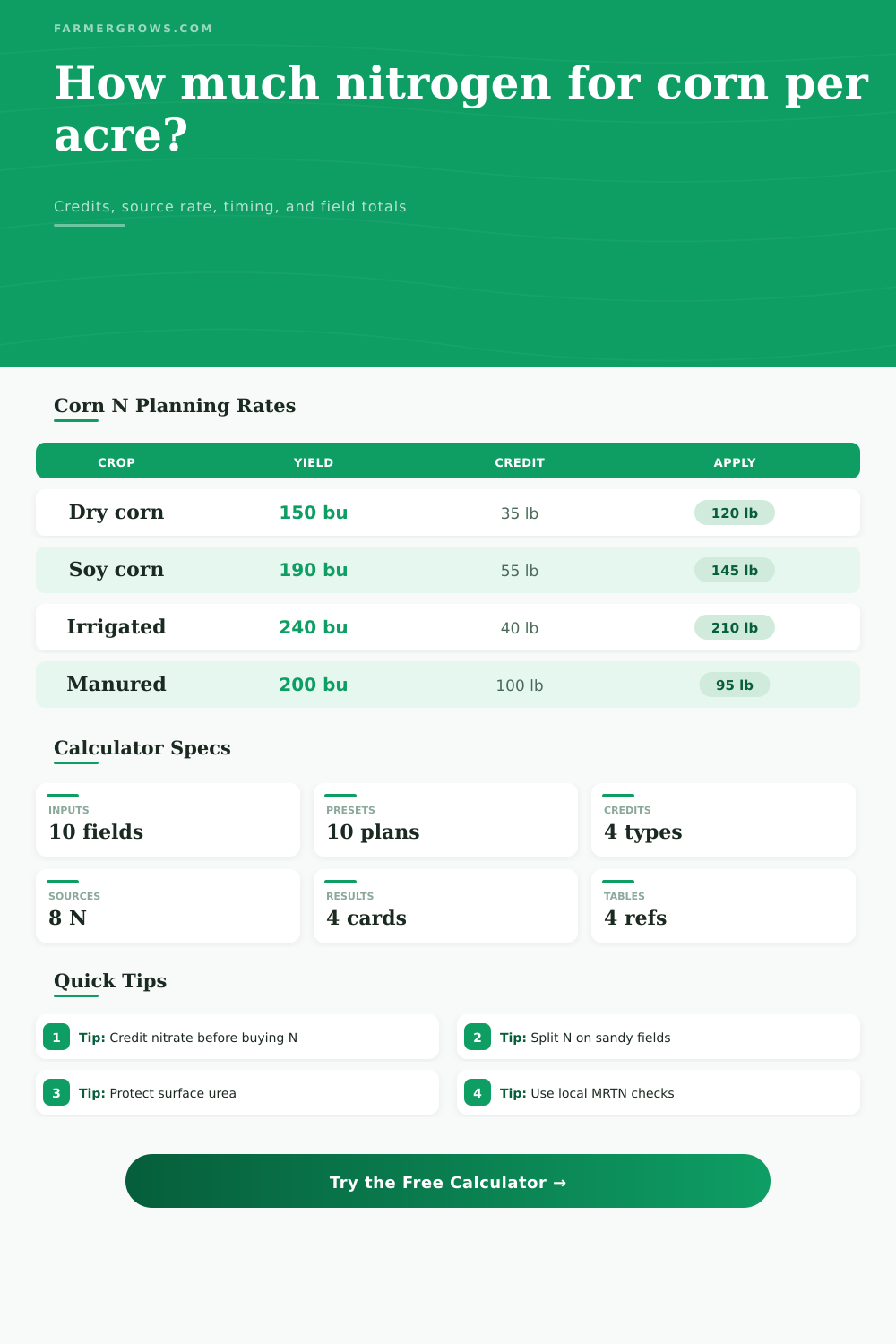
Nitrogen For Corn Per Acre Calculator
Estimate corn nitrogen per acre from acres, yield goal, soil nitrate credit, previous crop credit, manure credit, organic matter, source N percentage, split timing, loss risk, and irrigation or rainfall pattern.
Choose a corn nitrogen starting point, then adjust the field credits, organic matter, source percentage, split timing, and water-risk setting for your actual field plan.
Liquid programs fit starter, dribble, injected, or sidedress timing and can be adjusted after early-season weather.
High analysis keeps pounds low, but surface applications need timely rainfall, incorporation, or a stabilizer.
Injected ammonia has a high N percentage and often works best as a sealed preplant or sidedress band.
Heavy sidedress or rescue timing protects against early loss but depends on equipment access and crop stage.
Corn Nitrogen Results
Calculated nitrogen program.
| Yield goal | Gross N at 1.05 lb/bu | Example credits | Net N before risk | Planning fit |
|---|---|---|---|---|
| 140 bu/ac | 147 lb N/ac | 35 lb/ac | 112 lb/ac | Moderate dryland corn |
| 180 bu/ac | 189 lb N/ac | 55 lb/ac | 134 lb/ac | Corn after soybeans |
| 220 bu/ac | 231 lb N/ac | 50 lb/ac | 181 lb/ac | Strong rainfed field |
| 260 bu/ac | 273 lb N/ac | 70 lb/ac | 203 lb/ac | Irrigated high yield |
| 300 bu/ac | 315 lb N/ac | 85 lb/ac | 230 lb/ac | Intensive management |
| N source | N percentage | Product for 100 lb N | Useful timing | Watch point |
|---|---|---|---|---|
| UAN 32-0-0 | 32% N | 313 lb or 28.3 gal | Starter, dribble, sidedress | Leaf burn and surface loss risk |
| UAN 28-0-0 | 28% N | 357 lb or 33.5 gal | Preplant or sidedress | More gallons than UAN 32 |
| Urea 46-0-0 | 46% N | 217 lb | Broadcast or incorporated | Volatilization if left exposed |
| Anhydrous ammonia | 82% N | 122 lb | Injected preplant or side | Seal the knife slot well |
| Ammonium sulfate | 21% N | 476 lb | Sulfur plus N program | Large product pounds per acre |
| Custom blend | User-entered | Based on source % | Local blends or specialty N | Confirm actual analysis |
| Water condition | Default buffer | Main risk | Timing response | Calculator behavior |
|---|---|---|---|---|
| Normal seasonal rainfall | 5% | Average field loss | Balanced split works well | Uses moderate buffer |
| Dry, limited rain | 7% | Urea not incorporated | Delay surface N or protect it | Adds dry-window warning |
| Wet spring | 12% | Leaching and denitrification | Move more N to sidedress | Raises risk adjustment |
| Irrigated managed water | 4% | Over-irrigation leaching | Spoon-feed or sidedress | Lower buffer if managed |
| Sandy frequent rain | 15% | Rapid nitrate leaching | Split into several passes | Highest water buffer |
| Split timing | Starter share | Base share | Sidedress share | Best fit |
|---|---|---|---|---|
| Mostly preplant or injected | 5% | 80% | 15% | Stable soils, sealed injection, lower early loss risk |
| Starter plus sidedress | 10% | 35% | 55% | Broad fit for corn after soybeans or normal rainfall |
| Sidedress-heavy split | 5% | 15% | 80% | Sandy fields, wet springs, adaptive nitrogen plans |
| Irrigated spoon-feed | 5% | 25% | 70% | Fertigation or repeated in-season liquid passes |
| Late rescue sidedress | 0% | 10% | 90% | Loss recovery or delayed access after planting |
Use credits first: Subtract soil nitrate, previous crop, manure, and organic matter credits before converting the remaining N need into UAN, urea, ammonia, or a custom source.
Check the weather window: High rainfall, sandy soils, or exposed surface urea can justify moving more nitrogen into sidedress timing instead of raising the whole-season rate blindly.
You don’t smell anhydrous ammonia unless you’re paying attention, but that scent marks the moment when planning stops being abstract and starts costing money. Nitrogen management for corn isn’t rocket science, but neither is it simply “spray enough to reach this yield goal.” You’ve got to juggle what soil supplies, and what you fear the weather will rob from you.
Once you know the ins and outs of your fields, plugging them into the calculator above does the math for you… saving you from conversions and guess-work at the coefficients. That’s where knowing why each input matters saves big-time bucks.
How to Save Money on Corn Fertilizer
A yield goal is where most growers begin, and that makes sense. The crop require some level of nitrogen to get to whatever your yield goal may be, so if you want 180-bushel an acre, that number has to come from somewhere. The gross requirement can then be calculated by using a planning factor (before crediting anything back out). This base number is important, it helps guard against simply applying more fertilizer on top of everything without regard for what might already exist in the soil.
Subtract before you add, thats where most folks go astray. The first thing is soil nitrate. If your soil test indicate that there’s leftover nitrogen residue from decomposition of soil organic matter or last year’s crop, then top-dress isn’t necessary. Ditto for the previous crop credit: Legumes like peas or beans (and other nitrogen-fixing crops) leaves a meaningful deposit of soil-nitrogen available for next crop. That’s why corn following soybeans is such a common rotation… There’s still something left behind to build upon. No more so-called previous crop credit if you’re going corn on corn, which means a heftier fertilizer bill.
The calculator will take care of that for you, provided you’re honest about what you’ve planted where. It is a little detail, but it is not an unimportant one. Other more complicated factors includes manure and organic matter credits, which depend on when you apply them and how they will break down. “With manure, for example, you don’t want to dump it in, thinking, ‘Oh yeah, all this nitrogen is going to be available right away.’ A lot of it mineralizes slowly, over multiple years.” Based off your own soil’s percentage of organic matter, the tool calculates a credit; the assumed breakdown rate is slow, so as to ground your plan in real world instead of wishful thinking. Soils with high organic matter aren’t just sponges (holding onto nutrients); they requires patience, too. You get the benefit over time (not all at once).
Now that you know the amount of net nitrogen required, what do you apply? Here’s where anhydrous ammonia, urea, and UAN differ in application requirements and percentages. Anhydrous ammonia is highly concentrated (high N). It must be injected using special equipment. You must also ensure injection slot is properly sealed. Urea is cheap and easy to broadcast, but it volatilizes quickly if it sits on surface too long. UAN is more moderate in concentration and in between as far as application method goes. You can read the details of these sources in the reference table on the page, and see what product matches your timing and equipment.
The most under-rated variable may be timing. By splitting applications you reduce potential for denitrification (a major problem if spring is wet) or leaching of nitrate-N from root zone. With a proper balance between starter and sidedressing, the crop gets what it needs while not overloading the soil at any given time. The calculator incorporates factors like heavy rain or sandy soil and builds in buffers accordingly. It’s insurance, not a penalty. Peace of mind comes at a small cost.
Ultimately, it comes down to a little bit of both. Managing nitrogen isn’t necessarily precise; it’s an exercise in reducing risks with smarts. You can’t control the rain, but you can control when and where you put on your fertilizer. Applying nutrients in stages at the right time, using the right source, and using your credits well will keep your yields high and costs low.
When you smell that ammonia in the spring, you know the job’s done. Now all you have to do is wait for green. It’s a dificult process but it would of been worth it.