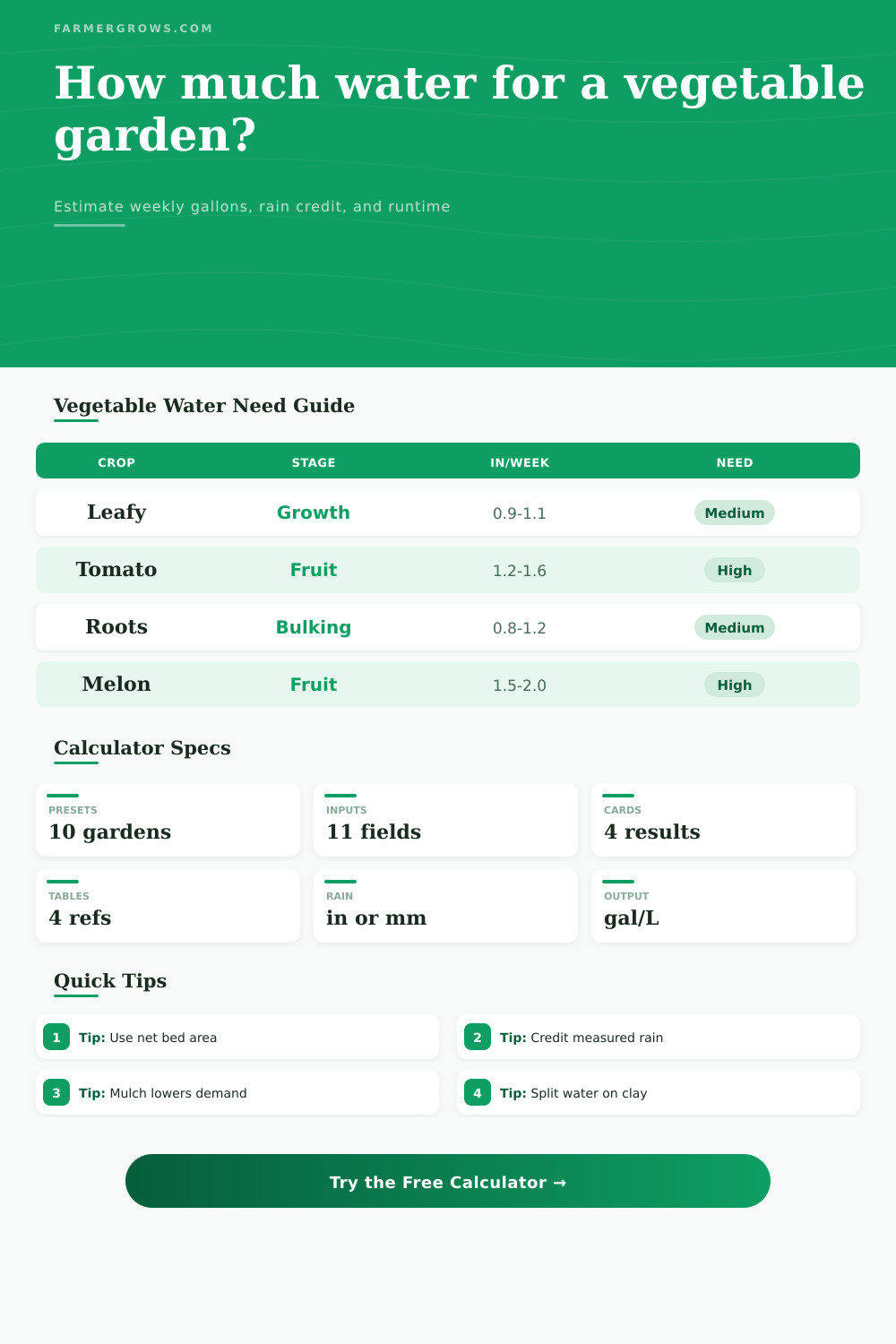
Water For Vegetable Garden Calculator
Estimate weekly vegetable garden water from net bed area, crop mix, soil texture, mulch, rainfall, ET or temperature, growth stage, irrigation method, efficiency, and watering interval.
Use planted bed area, not the whole fenced garden, when paths are not irrigated. One inch of water over one square foot equals 0.623 gallons, and the calculator applies rain, crop, soil, mulch, stage, and irrigation efficiency adjustments.
Leafy greens usually need less water than fruiting tomatoes, cucumbers, squash, melons, and sweet corn during peak growth.
Sandy soil loses water quickly, loam holds a balanced reserve, and clay may need slower split applications.
ET or temperature sets the atmospheric pull before rain credit and bed adjustments are applied.
Drip tape, soaker hose, sprinklers, and hand watering deliver different useful water to the root zone.
Your Vegetable Garden Water Plan
Weekly water estimate based on your garden inputs.
| Vegetable group | Low stage | Peak stage | Typical weekly depth |
|---|---|---|---|
| Leafy greens, herbs, brassicas | Seedling and transplant establishment | Head, leaf, or rapid vegetative growth | 0.8 to 1.2 in/week |
| Tomatoes, peppers, eggplant | Early vegetative growth | Flowering through fruit sizing | 1.1 to 1.6 in/week |
| Cucumbers, squash, melons | Vine establishment | Bloom, fruit set, and fruit fill | 1.3 to 2.0 in/week |
| Carrots, beets, radish, onion | Germination and early tops | Root or bulb bulking | 0.8 to 1.3 in/week |
| Sweet corn, okra, tall crops | Early stalk growth | Tassel, silk, pod set, or ear fill | 1.2 to 1.8 in/week |
| Weather condition | Base ET depth | Water over 100 sq ft | When to use |
|---|---|---|---|
| Cool 60-70°F / 16-21°C | 0.85 in/week | 53 gal / 201 L | Spring, fall, cloudy weeks, low wind |
| Mild 70-80°F / 21-27°C | 1.05 in/week | 65 gal / 247 L | Moderate growth with mixed sun |
| Warm 80-90°F / 27-32°C | 1.30 in/week | 81 gal / 306 L | Common summer vegetable setting |
| Hot 90-100°F / 32-38°C | 1.60 in/week | 100 gal / 378 L | High sun, hot afternoons, active fruiting |
| Very hot or windy | 1.90 in/week | 118 gal / 447 L | Heat waves, low humidity, exposed gardens |
| Method | Typical efficiency | Strength | Runtime note |
|---|---|---|---|
| Drip tape rows | 85% to 95% | Roots only, low leaf wetting | Longer, slow runs soak beds evenly |
| Inline drip tubing | 80% to 92% | Reusable raised-bed watering | Match emitter spacing to crop rows |
| Soaker hose | 70% to 85% | Simple small garden setup | Pressure changes can affect uniformity |
| Sprinkler | 55% to 75% | Covers dense plantings quickly | Wind and leaf wetting reduce useful water |
| Hand watering wand | 60% to 80% | Targeted spot watering | Best for seedlings and small beds |
| Micro-sprayers | 65% to 85% | Good for wide beds and transplants | Watch drift and uneven spray edges |
| Condition | Calculator effect | Best interval | Field check |
|---|---|---|---|
| Sandy soil, no mulch | Raises demand and lowers storage | Every 1 to 2 days in heat | Top 3 in dry quickly after watering |
| Loam with 2 in mulch | Balanced demand and reduced evaporation | Every 2 to 4 days for most crops | Soil holds a cool crumb below mulch |
| Clay soil | Slightly lower demand, slower intake | Every 3 to 5 days, split if runoff starts | Water should enter, not puddle or seal |
| Seedling root zone | Lower total depth, shallow timing | Often every 1 to 2 days | Moist top inch without saturation |
| Deep fruiting crops | Higher demand, deeper root target | Every 2 to 4 days with drip | Moisture reaches 6 to 10 in depth |
Measure before adjusting: Place a straight-sided cup or rain gauge in the bed for one irrigation cycle. Actual delivered depth often differs from the sprinkler, drip, or hose label.
Match water to roots: Seedlings need light, frequent moisture near the surface. Fruiting tomatoes, cucumbers, squash, and corn need deeper watering that reaches the active root zone.
Vegetable gardeners start with best intentions and end up with wilted leaves or boiled roots, because we guessed, rather than measured. Is that a drowning dose of water you just delivered to the basil, or did you give the tomatoes barely enough? Use the calculator at the top to turn your vague worries about overwatering or underwatering into clear numbers, like minutes and gallons. Let it do the conversions and coefficients… And let you do focusing on actual plants.
Here’s the real trick: knowing what makes those numbers tick. The first place to start: what’s underfoot? Is it sandy? Such soil act like a sieve, sending water directly into groundwater without passing any along to your thirsty plants’ roots. Or clay, which holds onto water and rarely lets go until it soaks in. This soaking might not even happen if surface water just sits there until it runs off. That’s why the calculator takes such care to adjust its storage factors to match.
How to Water Your Garden Correctly
In other words: When sand says “deep and infrequent,” the calculator say “shallow and frequent”, the only thing keeping those roots alive. Loamy soil falls somewhere in between, which is perfect balance for a gardener. Heavy soils, however, may require splitting up your watering sessions so water does not run off. This is exactly the kind of detail captured by the intervals and efficiency settings on the calculator.
And then there’s the matter of mulch, something many underestimate. Two inches of wood chips or even some nice straw doesn’t merely make things prettier; it shades soil surface, reducing evaporation greatly by keeping root zone cooler. The cooler soil reduce stress on the plant (less energy spent worrying about heat, more making food). That has a drastic effect on how much water they use; and that’s reflected in the reduction the calculator assumes for moderately- to heavily-mulched areas. If there’s no mulch, you’re essentially paying for water that goes up into air instead of into the plant. Not a lot, but it adds up big-time in terms of your wallet and also our shared water supply.
It’s all about crop type. Because leafy greens has small surfaces and shallow roots, they need frequent attention and lots of light watering to keep soil moist without making it soggy. Other crops, such as tomatoes, peppers, cucumbers…they’re a different beast. They have enormous leaf surfaces that release water very fast (particularly at fruiting stages). The table on the page spells it all out. It depicts how plant demand spike as it shifts from making leaves to making fruit.
That’s the most common mistake: ignoring that shift. In July, you treat your tomato plant like a salad green and what happens? The plant punishes you by setting poor fruit or developing blossom end rot.
Then there’s weather. Wind and sunshine draw moisture from plants and soil, an amount we call evapotranspiration (ET). A few days of cool, cloudy weather will only ask for a fraction of water needed on a hot, breezy afternoon. The calculator makes an estimate based off temperature ranges. Then it presents that number. Your baseline… As something for you to tweak for rain.
That’s when the rain credit kicks in. If you recorded half an inch in your rain gauge, the tool deducts that from the total amount of water any crop need. Overwatering (as much as underwatering) can be harmful, so don’t water what Mother Nature provides.
Last, how will you deliver? It is highly efficient. Because drip tape places water directly onto root zone (with little waste due to evaporation or wind), it’s more efficient than sprinklers (which get foliage wet, encouraging fungal diseases, and also waste water by drifting). The calculator accounts for this. It makes sure that when it recommend a runtime, it provides enough net water to reach target in the soil. In other words, it figures out how many minutes of your system runtime is needed to meet your desired soil moisture level, no guessing required.
Planting is just half the picture; good gardening is really a matter of management. It’s about learning what will grow here (crop), where (soil) and when (weather). It is about looking ahead so that you know what to do, instead of just reacting to drooping foliage. Plan for health, not hope. You should of add only the water that is needed, rather than wishing for rain. That’s the mindshift that makes any patch of ground a garden. Numbers tell you what to do and then your hands and eyes complete the task.