Pasture Seed per Acre Calculator
Estimate pasture seed per acre from acres, livestock type, pasture mix, grass and legume percentages, PLS, germination, establishment method, soil moisture, renovation status, and target stand density.
Choose a real pasture seeding setup, then fine tune the acres, livestock pressure, mix split, seed tag values, establishment method, moisture, and stand target.
Pasture Seed Plan
Results update from your pasture acres, mix, PLS, germination, field conditions, and stand target.
Orchardgrass, fescue, timothy, ryegrass, clover, and alfalfa fit many temperate grazing plans with moderate PLS rates.
More grass and less legume helps keep a dense sod, with bluegrass or fine fescue filling close-grazed spaces.
Brome, wheatgrass, and native grasses use lighter rates by weight, but establishment depends heavily on timely moisture.
Thin sod is easier to improve than thick sod. Existing grass competition lowers the establishment factor in the calculator.
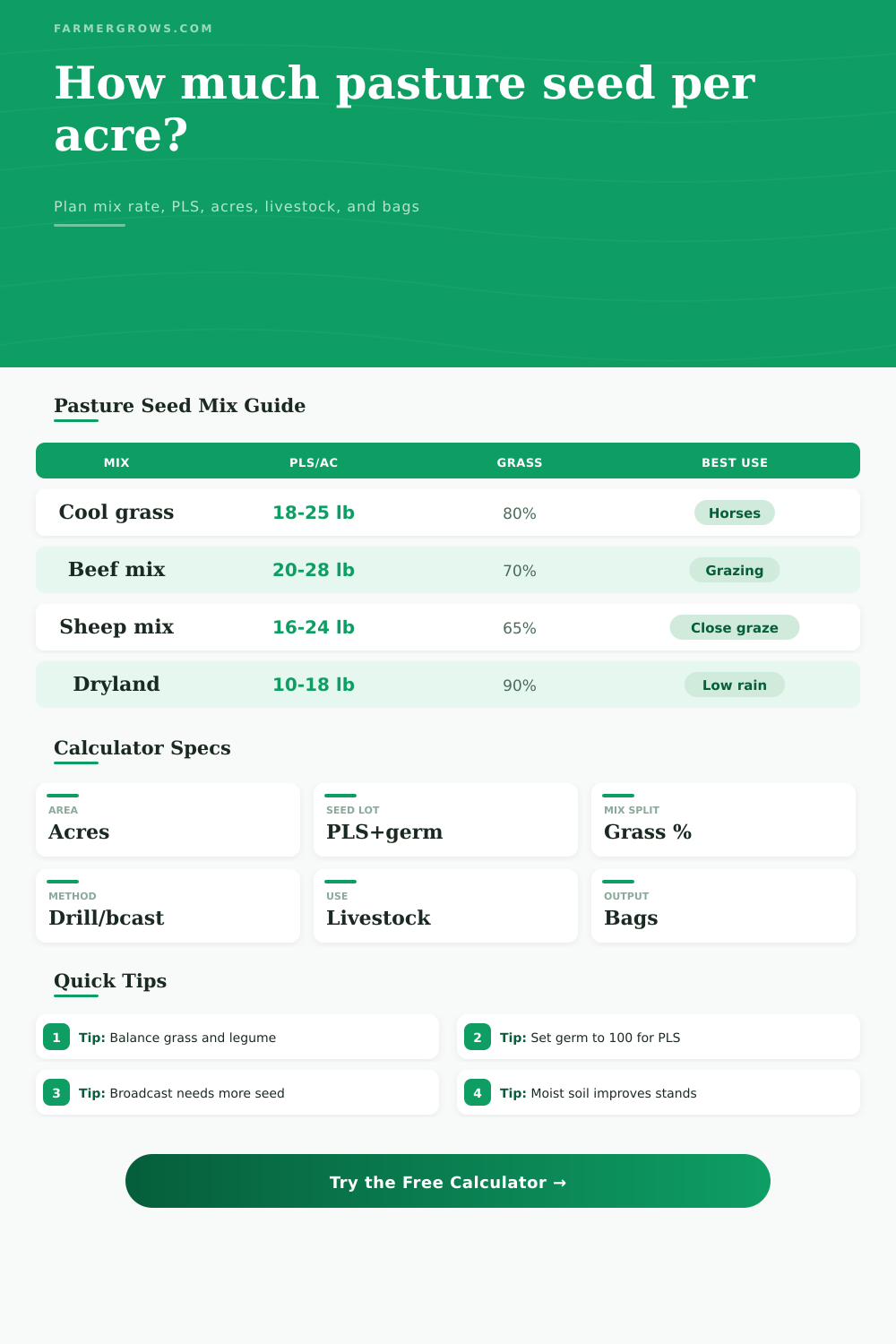
| Pasture mix | Starting PLS rate | Default split | Typical livestock fit |
|---|---|---|---|
| Cool-season horse mix | 20 lb/ac PLS | 85% grass, 15% legume | Horse paddocks, lanes, and sod-strength fields. |
| Beef grass-clover mix | 24 lb/ac PLS | 70% grass, 30% legume | Rotational beef grazing with moderate clover. |
| Dairy ryegrass-clover | 28 lb/ac PLS | 65% grass, 35% legume | High-quality forage under tighter grazing cycles. |
| Dryland brome-wheatgrass | 14 lb/ac PLS | 90% grass, 10% legume | Lower rainfall fields where persistence matters. |
| Native grass blend | 12 lb/ac PLS | 95% grass, 5% legume | Warm-season range, wildlife, and light grazing. |
| Seed tag situation | Calculator entry | Live seed factor | Bulk rate effect |
|---|---|---|---|
| PLS already printed on tag | Enter PLS, set germination to 100% | PLS percentage only | Prevents double-counting germination. |
| Purity and germ listed separately | Enter purity as PLS value and germination separately | Purity x germination | Raises bulk pounds as quality drops. |
| Older carryover seed | Use current germination test | May be below tag value | Re-test before relying on stored seed. |
| Mixed species bag | Use blended lot PLS if available | Weighted average | Individual species tags are more precise. |
| Method | Field factor | Best fit | Calculator meaning |
|---|---|---|---|
| Prepared seedbed drill | 1.00 | New pasture after tillage and firming. | Baseline placement with shallow depth control. |
| No-till drill | 0.92 | Renovation where sod is opened by coulters. | Good contact but some existing sod competition remains. |
| Broadcast then cultipack | 0.82 | Prepared fields without a drill. | Needs firming before and after spreading. |
| Frost seed or dormant seed | 0.68 | Legume-heavy renovation into open sod. | Weather drives seed-to-soil contact and timing. |
| Aerial overseed | 0.60 | Large rough fields with limited equipment access. | Highest contact risk and the widest stand variation. |
| Condition | Factor range | What improves success | Risk note |
|---|---|---|---|
| Moist seed zone | 0.95 to 1.05 | Seed into firm soil with rain or irrigation nearby. | Small-seeded clovers still need shallow placement. |
| Dry surface | 0.72 to 0.80 | Wait for rain, drill shallow, or reduce sod competition. | Broadcast seed may sit exposed too long. |
| Thin pasture renovation | 0.78 to 0.86 | Graze or mow close before seeding, then rest the stand. | Old sod competes for light and water. |
| Horse or dairy traffic | 0.92 to 1.08 | Use durable grasses and keep animals off new seedlings. | Hoof traffic can remove seedlings before tillering. |
| Bulk rate and acres | Total seed needed | 25 lb bags | 50 lb bags |
|---|---|---|---|
| 18 lb/ac on 5 acres | 90 lb | 4 bags | 2 bags |
| 24 lb/ac on 12 acres | 288 lb | 12 bags | 6 bags |
| 32 lb/ac on 25 acres | 800 lb | 32 bags | 16 bags |
| 15 lb/ac on 60 acres | 900 lb | 36 bags | 18 bags |
Keep the mix honest. Grass and legume percentages in this calculator are PLS weight shares, so a clover-heavy seed count can still be a modest legume percentage by pounds.
Rest renovated pasture. After no-till, broadcast, or frost seeding, delay grazing long enough for seedlings to anchor before hoof traffic and close grazing return.
Unless you start replacing guesswork with measurement, there’s always an element of risk when seeding a pasture. And it all comes down to Pure Live Seed (PLS), or knowing what percentage of your seed is alive. The vast majority of folks just go by weight in the bag.
Guess what? That doesn’t cut it. PLS eliminates dead seeds and other inert matter so you know exactly how many actual plant you’re sowing. Plan for your crop. Don’t hope for one.
Why You Should Measure Your Seeds
After entering your planting method, the quality of your seed, and number of acres to plant, it does the rest. It makes you look at how good your seed is. Do you have an eight-eighty-eight percent germinating, ninety percent pure seed? Then you’re only putting in about seventy-nine percent live seed. And it’s multiplying that number and correcting based on how you plant it.
Why does that matter? Because when you use a no-till drill, each seed goes into moist place where it has good contact. When you broadcast over rough ground that’s dry, all those seeds is subject to drying out, wind and other predators. That risk raises the rate of seed you need to get to your desired density; so there is establishment factor.
Look beyond yield to find a strategy for the right mix. Sod strength is important for horse. Although they’re gentle grazers, they have hooves that can tears up loose soil, so a mix that’s heavy on grass such as fine fescue or orchardgrass binds soil well and resists damage.
Beef cattle are rougher operators; they pull up roots and strip fields bare, so a beef mix may include legumes (such as red clover) or a robust grass base to handle rotational grazing. Because legumes is tiny, separating the calculations also matters; with the calculator you can split your mix by weight. If the calculator says you need just two pounds of clover per acre, mixing that into a fifty-pound bag of grass seed won’t distribute it evenly.
Should you of blended carefully, or broadcast the legume separately? One variable that you cannot control is soil moisture at the time of seeding. But you should account for it. Moisture influence germination, and the tool accounts for wetness or dryness accordingly. Dry soil lowers the establishment factor. That means: Plant additional seed so as many germinate as possible in spite of that lack of moisture. It is a minor point, but it do matter.
By contrast, when you’re frost seeding legumes in late winter, freeze-thaw action work to plant the seed for you. Even then, the establishment rate isn’t as high than when ground is prepared and seeded. The calculator takes that into account with a lower efficiency factor, so we don’t overdo it on the seed count.
The last thing that keeps it on budget is bag planning. The tool will round up to whole bags, so you don’t run out at the end of the field. It will also let you calibrate for irregular field shapes or errors with plan by setting a buffer percentage. Ten percent is normal, but more like 15 or 20 percent if it’s really thick, competitive sod you’re trying to renovate.
You’ve got to fight what’s there and the more seed the better, as you try to punch through. Throwing seed on the ground does not make a good pasture. A good pasture matches plant to pressure. It adjusts to seed quality. It respects the environment. Your local conditions gives the numbers from the calculator their meaning. And when you look into that last bag of what you’re buying, you’re not just buying a commody… You’re investing in a specific outcome.