Vetch Seed per Acre Calculator
Estimate hairy, common, or Cahaba vetch seed for a pure stand or companion crop mix with acres, target PLS rate, seed tag quality, inoculation status, drill or broadcast method, and winterkill risk.
Choose a practical vetch starting point, then adjust the acres, target PLS rate, companion crop share, seed tag numbers, bag size, and winterkill risk to match the field.
Vetch Seed Estimate
Calculated vetch seed plan appears here after input changes.
Best fit for overwintering cover, spring nitrogen, and rye-vetch mixes. It is the hardiest option here, but late planting and wet soils still reduce spring stand.
Often used for forage, pasture, and cover crop blends where winters are moderate. It establishes well but has more winterkill risk than hairy vetch.
A warm-season vetch option after small grain or silage windows. Treat winter survival as low where freezing weather is expected.
| Vetch type | Drilled full stand | Broadcast full stand | Common mix range |
|---|---|---|---|
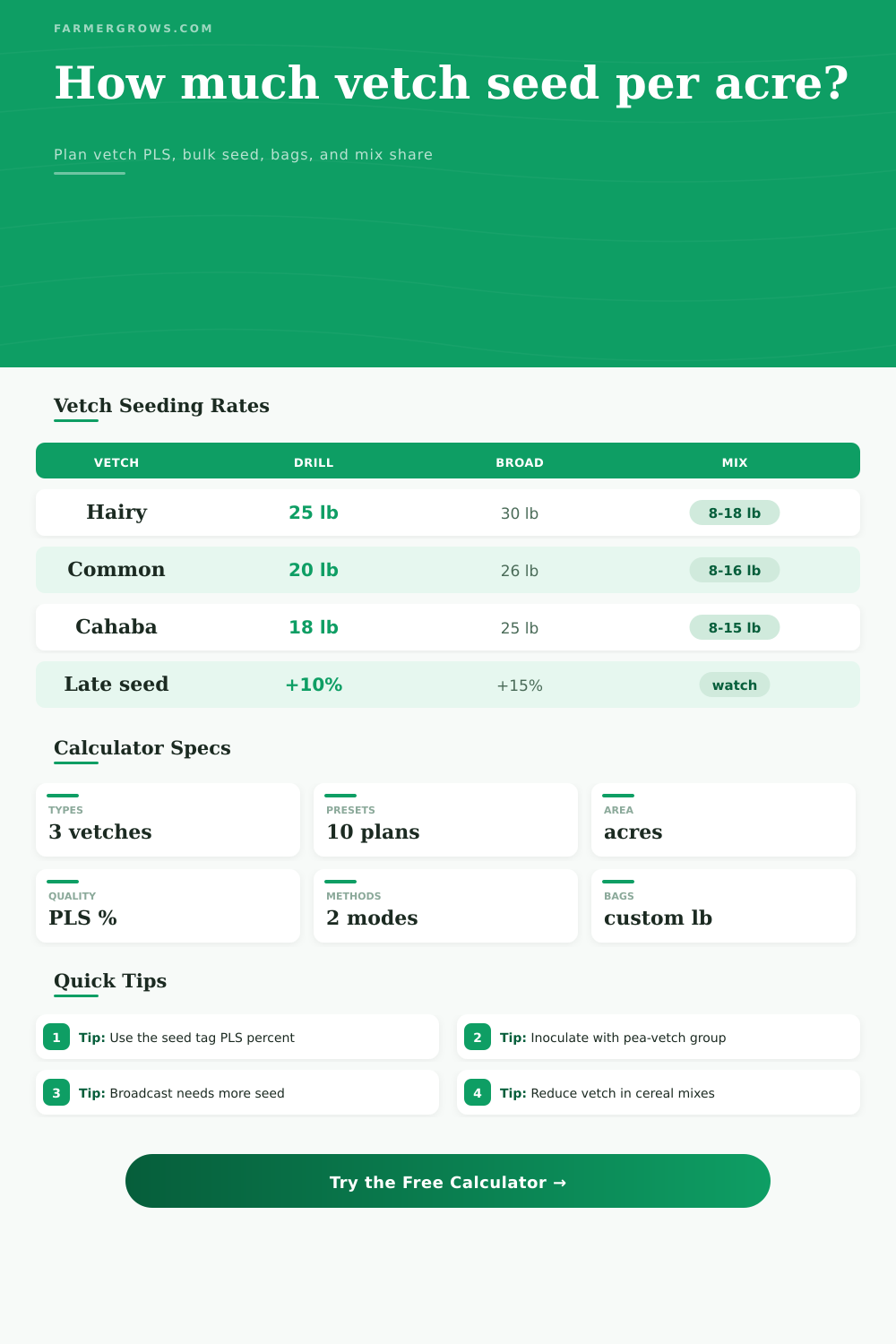
| Hairy vetch | 20 to 30 lb PLS/ac | 25 to 35 lb PLS/ac | 8 to 18 lb PLS/ac with rye, oats, wheat, or brassicas. |
| Common vetch | 18 to 24 lb PLS/ac | 24 to 30 lb PLS/ac | 8 to 16 lb PLS/ac with pasture, forage oats, or cereals. |
| Cahaba vetch | 15 to 20 lb PLS/ac | 20 to 30 lb PLS/ac | 8 to 15 lb PLS/ac after wheat or silage in warm-season mixes. |
| Late or rough planting | Add 5% to 10% | Add 10% to 20% | Use the buffer field when seedbed contact or timing is less reliable. |
| Seed tag example | PLS percent | Bulk seed for 100 lb PLS | Planning note |
|---|---|---|---|
| 90% germ, 98% purity | 88.2% | 113.4 lb bulk | High-quality lot needs a modest correction from PLS to bulk seed. |
| 85% germ, 95% purity | 80.8% | 123.8 lb bulk | Common legume lot with a clear bag-count effect. |
| 75% germ, 90% purity | 67.5% | 148.1 lb bulk | Low PLS increases the order sharply and should be verified before planting. |
| 60% germ, 85% purity | 51.0% | 196.1 lb bulk | Weak or old seed may justify a fresh test rather than simply raising pounds. |
| Scenario | Calculator factor | Use with | Field note |
|---|---|---|---|
| Drilled seed | 1.00 x | No-till drill or grain drill | Best placement and seed-soil contact for vetch establishment. |
| Broadcast seed | 1.15 x | Spinner spreader or hand seeding | Extra PLS offsets surface loss before the field buffer is added. |
| Pure stand | 100% vetch | Green manure, seed block, or legume cover | Uses the full target vetch rate before PLS correction. |
| Companion mix | 100% minus companion share | Rye-vetch, oat-vetch, wheat-vetch | Companion crop share reduces vetch pounds so the mix does not become too heavy. |
| High winterkill risk | Survival cut | Late fall, exposed soil, wet feet, warm-season Cahaba | Keep cereal insurance in the plan if spring vetch biomass is critical. |
| Planning item | Common unit | Rounding rule | Use note |
|---|---|---|---|
| Small plot bag | 5 to 10 lb | Round up to whole bag | Useful for gardens, wildlife openings, and test strips. |
| Field bag | 25 or 50 lb | Round up and calibrate | Most cover crop and forage jobs are loaded by bag or tote weight. |
| Pea-vetch inoculant | Often 25 to 100 lb seed | Round packets up | Use fresh inoculant and keep treated seed shaded until planting. |
| Inventory check | Bags on hand | Compare pounds available | Extra seed can cover headlands, but avoid heavy doubles in wet spots. |
Use PLS pounds for the target, then buy bulk seed. A 25 lb PLS rate becomes more bulk seed when the tag says 82% PLS, and the difference grows quickly on larger acreages.
Keep the companion crop from crowding the vetch. In rye, oat, or wheat mixes, reduce the vetch rate by share and avoid planting cereals so heavy that vetch cannot climb and fix nitrogen.
Getting vetch to survive through the winter takes some thoughtful planning; especially when planted in autumn. Farmers worried that their vetch won’t come back up next spring should of remember that it will take off with the right growing conditions. However, without proper seed rate, it could be a total loss.
Use this calculator to figure out how much seed to order. It do all of the conversion math for you (for both the buffer coefficient and pure live seed). It eliminates the guessing game.
How to Plant Vetch Seeds Correctly
The other thing many grower fail to consider: not all seeds in the bag are live. That’s why your seed tag says both purity and germination. Good seed will have a purity and germination rate of about 80 percent, meaning only eight out of every ten pounds of seed in the bag is alive. To account for that, the calculator converts the desired amount of pure live seed into actual weight of seed required to get it. If you forget to account for this discount, you’ll end up with fewer plants then planned per unit area. That results in spots where no plant were sown and areas of low nitrogen fixation. Little bit of math mistake = big biological consequence.
The starting point is deciding what kind of variety to grow. If you’re in a cold climate, the standard choice (hairy vetch) will reliably overwinter; if it’s milder, common vetch is the go-to (it’s also good for forage). For warm zones, there’s a warm-season variety called Cahaba vetch. It is planted later or even used like a quick biomass booster. It dies at first hard freeze. With this tool, you can toggle among them. Each have its default rate, and its winter survival probability. It’s not simply a matter of seed, you’re purchasing a survival strategy.
It all depends based off how you plant. If you drill seed into the ground, you give it the contact (and moisture) it needs to sprout and grow. When you broadcast, however, you scatter the seed on top where it’s exposed to wind, birds and drought. Inconsistent broadcast planting require that you make up for the shortfall by sowing much more seed than normal. That’s why the calculator multiplies the broadcast rates. It recognizes that broadcast planting is a numbers game; you have to sow more seed to achieve same level of establishment.
There is another problem with mixes. It’s popular to plant vetch with an oat or rye crop, for instance, but if the vetch proportion in the mix is too high, the cereal will outcompete and smother it. The vetch must have some light to flower and even to climb up as it go. With this tool, you can adjust a companion crop share, which lowers the vetch rate by a matching amount, thus maintaining a balanced mix. If there’s too little vetch, no nitrogen benefit; if there’s too much cereal, no legume potential. There’s a Goldilocks spot to find… And knowing that these things are competing for the same real estate help.
It’s impossible to predict winterkill. There’s no such thing as a weather predictor like that. But you can calculate your own exposure. Low fields, late plantings, and soggy soils increases the risk of vetch kill dramatically. The tool identifies high-risk situations. It recommends a cereal cover crop as an insurance policy. Lose the biomass in the vetch? No big deal. Still get the soil protected and covered by rye or wheat anyway. It is a hedge against the weather. It is practical wisdom.
Legumes MUST be inoculated, vetch requires certain rhizobia bacteria to pull nitrogen out of the air. You can use pre-inoculated seed (be sure); otherwise apply new inoculant just prior to sowing. The calculator guesses at your total bulk seed weight, then figures out the number of packet required. Inoculant expires; read the label. Look for pinkish roots in springtime: that’s a sign of a good nodulating job. No nodules = no go. Vetch will fail if it doesn’t get it.
Then finally top it off with a buffer. No field condition is ideal. There are metering mistakes, headland skips, clumps, and other issues that cost you seed. Ten to fifteen percent on top of your total takes care of those holes. Better to be over by a little bit, then not make it all the way around the field. Your main goal is a full stand across the entire field; one that protects the soil and fixes nitrogen. When you see those first green shoots poking up in the spring, you’ll know the numbers added up. That peace of mind is why the planning pays off.