Peas Growth Time Calculator
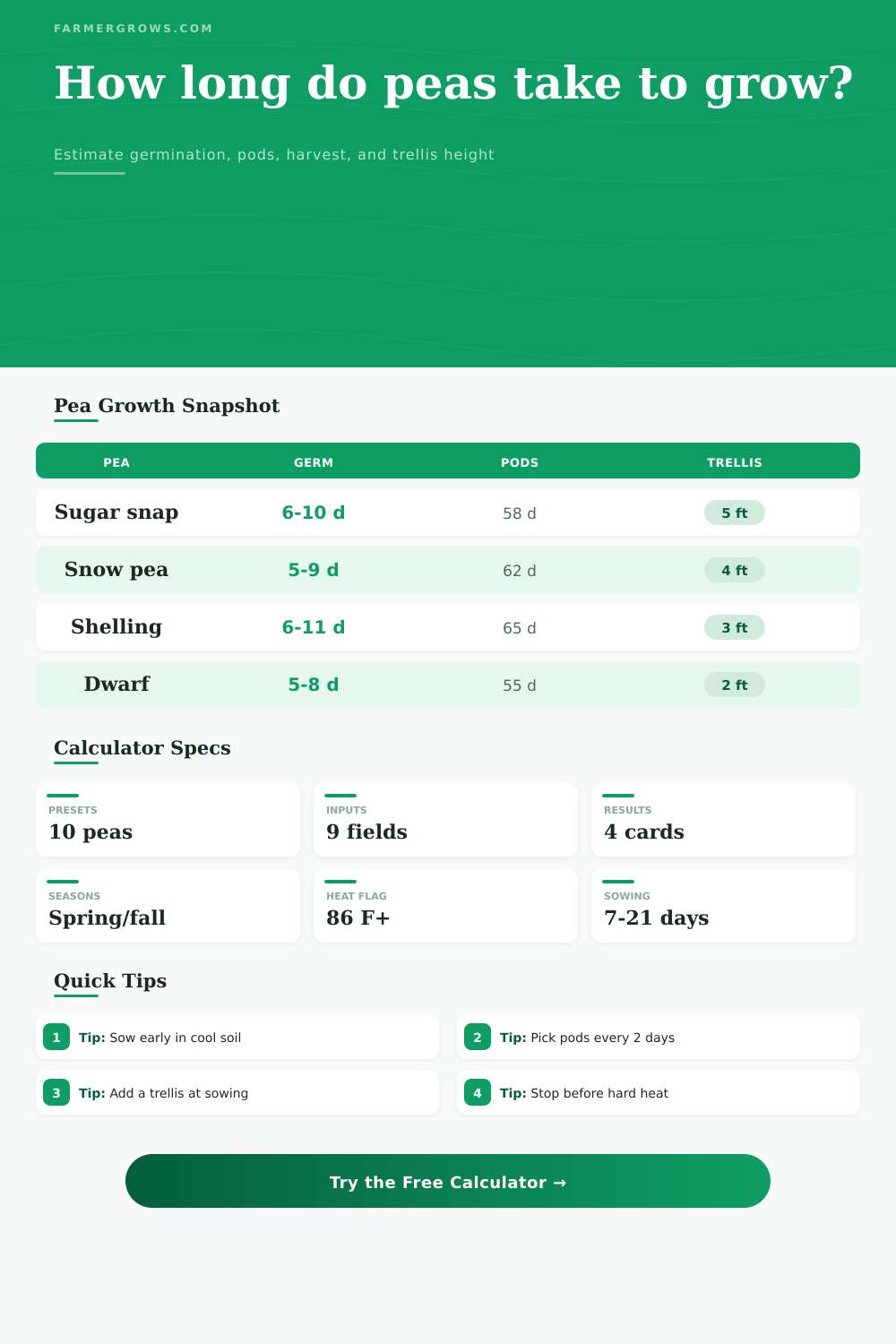
Estimate pea germination, first pods, harvest span, succession sowing dates, heat cutoff risk, and trellis height from pea type, soil temperature, planting season, and local weather timing.
Load a pea type and realistic season, then adjust sow date, soil temperature, heat cutoff, row length, and succession interval for your garden.
Eat pods and peas together. Most need 4 to 6 ft support and frequent picking for steady pods.
Picked flat before seeds swell. They tolerate close harvests and often finish before hot weather arrives.
Grow for full seeds inside pods. Dwarf forms can use short brush; tall forms need netting.
Short vines suit containers, raised beds, and exposed sites where tall trellises are awkward.
Your Pea Growth Timeline
Results update after calculation.
| Sowing | Sow date | Sprouts | First pods | Harvest window | Heat status |
|---|---|---|---|---|---|
| Calculate to fill the succession grid. | |||||
| Soil temperature | Typical sprout time | Stand risk | Gardener move |
|---|---|---|---|
| 38 to 44 F | 14 to 25 days | Slow and uneven | Use fresh seed; avoid soggy beds |
| 45 to 49 F | 10 to 16 days | Fair | Good early spring range |
| 50 to 59 F | 6 to 10 days | Strong | Best balance of speed and cool growth |
| 60 to 70 F | 4 to 7 days | Fast | Watch heat timing after emergence |
| 71 to 75 F | 5 to 9 days | Declining | Shade soil and harvest early |
| Over 75 F | Unreliable | High | Wait for fall or use another crop |
| Preset | Type | Days to first pods | Harvest span | Trellis |
|---|---|---|---|---|
| Sugar Ann | Dwarf snap | 52 to 56 | 14 to 21 days | 2 ft |
| Super Sugar Snap | Tall snap | 60 to 64 | 21 to 30 days | 5 to 6 ft |
| Oregon Sugar Pod II | Snow pea | 60 to 64 | 18 to 28 days | 3 to 4 ft |
| Wando | Shelling pea | 68 to 72 | 14 to 24 days | 2.5 to 3 ft |
| Little Marvel | Dwarf shelling | 58 to 63 | 12 to 20 days | 2 ft |
| Mammoth Melting | Tall snow pea | 68 to 74 | 21 to 30 days | 5 to 6 ft |
| Season | Best sowing signal | Timing adjustment | Heat or frost watch |
|---|---|---|---|
| Early spring | Soil 45 to 55 F | Base days plus soil temp | Beat regular 86 F afternoons |
| Late spring | Soil 55 to 65 F | Fast sprouts, risky pods | Stop sowings if pods land in heat |
| Fall | 8 to 10 weeks before frost | Add 5 to 12 days | Pods must form before cold stalls vines |
| Mild winter | Cool, drainable soil | Use spring timing | Protect from hard freezes |
Soil temperature: Peas tolerate cold air better than cold, wet soil. A raised bed that reaches 45 to 55 F usually gives a stronger stand than a muddy early bed.
Succession sowing: Sow small rounds 10 to 14 days apart in spring, but stop when the first pod date would land in your heat cutoff window.
Trellis setup: Put netting, brush, or string in place when seeds are sown. Young tendrils grab early and are easy to break later.
Harvest rhythm: Pick snap and snow peas every 1 to 2 days once pods start. Mature pods left on the vine slow new flowers.
Calculator dates are planning estimates. Variety, seed age, soil moisture, day length, disease pressure, and sudden heat waves can move real harvest dates by several days.
When you plant A pea seed, the clock starts ticking, but the peas don’t always grow steady. To plan when to sow your peas, you need some combination of both biology and weather forecasting; you’re pitting the race of the slow-to-wake-up-in-spring seed against the race of the fast-to-shut-down-in-summer pea plant. This little calculator, found on this page, can help you plot that tight little window, translating hopey-gooey wishes into actual dates.
Here’s how it works best: What makes those numbers tick? That’s all about soil temperature. Peas is cool-season crops: They tolerate chilly air far better than soggy, frozen dirt. Germination can be delayed up to three weeks if your soil temperature are only in the forties. That’s a long time for vulnerable seeds to sit out there waiting, getting nibbled at or succumbing to rot.
When to Plant Peas
We’re conditioned by calendars. When the calendar page turns to March, we think it must be time to plant, even though our beds may still be near freezing. Nobody thinks twice about what the actual temperature of the soil really is. The tool factors in sprouting time based off the temperature you input for soil. It pushes the harvest day way back again, if your soil was still near freezing, you’d have skipped another succession sowing of peas, or two or three, to save seeds from being wasted where nothing but bolts ever came.
Heat kills pea yields and makes them tough. NO WAY. When days heat up above eighty-six degrees, peas quits producing flowers and focus on setting seeds. This means the pods turn starchy and tough, instead of the sweet and crunchy taste you grew them for. This is the cut-off point where heat matter. It is key to guess how soon your location will reach this temperature consistently in early summer or even late spring.
Unless you’re prepared with some shade cloth, a heat wave occurring one week before your expected harvest date could lead to a dud crop. The calculator alert you to any high-risk sowings in time to avoid planting more rounds.
The physical reality is that variety choice matter, because Sugar Ann snap peas are tall and require a serious support structure from the start, while Little Marvel dwarf shelling types will happily grow in a container or narrow raised bed with minimal fuss. For the middle ground: snow peas tend to complete their cycle before summer heat sets in, so they are safe bets for beginners. These presets load realistic expectations right into each variety. You won’t have to guess how many days it takes for Mammoth Melting Snow or Oregon Sugar Pod II to reach maturity. Connecting the dots between variety traits and timeline estimates simplifies the decision.
To extend a harvest over time, succession sowing produces a continuous crop over the course of the season, rather than a big one-time planting of everything now. You stagger each round ten or two weeks apart so one is just coming into bloom when another is finishing up. How many times can you do it? Not as many as you think. The calculator shows you how. If you plan to sow every 10 days or two weeks, some plantings will likely hit the heat wall and fail to produce a usable pod in time.
Also: it calculates how much seed (and how long of a trellis) you’ll need for each row length, saving you from having to make more halfway through your row. One-hundred-foot-long cucurbits vines? No problem!
The time you pick your peas also influences the harvest. If you leave a pod that’s ready to pick on the vine, the pea will signal “no more.” Leave them on the vine and soon there’ll be no more. When peas are at their prime, I like to strip the vine each day or so and have them productive for weeks, not days. It is a small detail. But it can make the difference between handfuls versus a freezerful.
Peas are all about using early soil chill to germinate and then taking advantage of the still-mild spring air to help develop the vines. After that, the race is on against the hot summer sun. A calculator can give you a date, but watching the ground for signs will show you when it’s naturaly time.