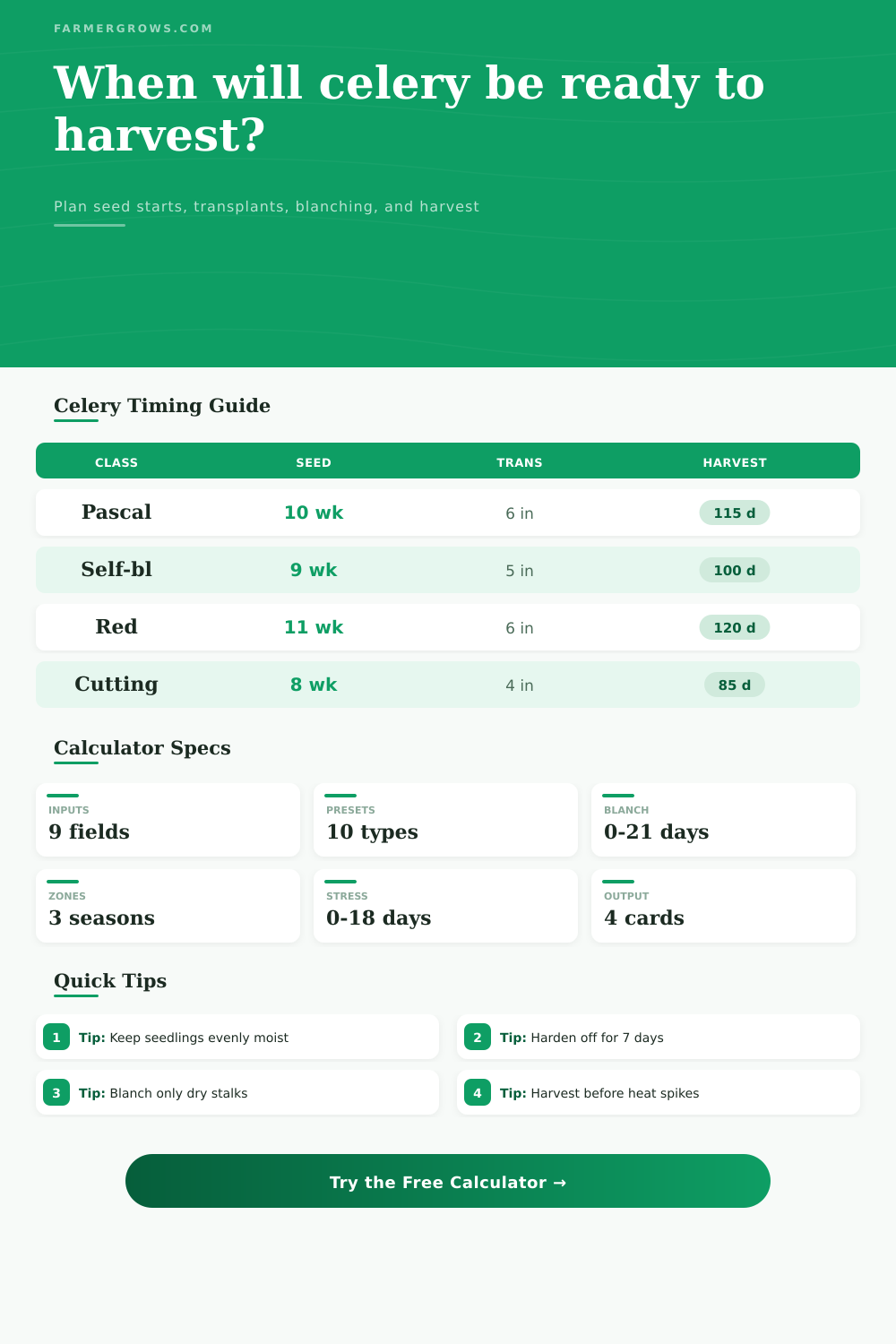
Celery Growth Time Calculator
Estimate celery seed starting dates, transplant timing, blanching period, cool-season fit, moisture stress delay, stalk harvest window, and variety-specific maturity from one planting plan.
Choose a celery plan, then adjust the planting date, variety class, transplant age, blanching days, and stress factors for your season.
Your Celery Timeline
Celery timing updates when you change the form.
Classic thick stalks. Best with long, cool growth and optional blanching for pale ribs.
Quicker golden stalks. Less field blanching, but less tolerant of rough weather.
Colorful stalks usually need patient growth and steady water for tenderness.
Leaf and soup celery can be cut earlier, with a wider harvest window.
| Variety class | Seedling stage | Field days after transplant | Blanching need |
|---|---|---|---|
| Pascal green stalk celery | 63 to 77 days | 45 to 60 days | Optional 10 to 21 days for paler stalks. |
| Self-blanching golden celery | 56 to 70 days | 38 to 50 days | Usually 0 to 7 days, mostly for flavor. |
| Red or pink celery | 70 to 84 days | 45 to 60 days | Often grown unblanched to keep color. |
| Leaf or cutting celery | 42 to 60 days | 30 to 45 days | No blanching; cut leaves as needed. |
| Fast compact celery | 56 to 70 days | 35 to 48 days | Optional short blanch for stalk sweetness. |
| Long-season storage celery | 70 to 84 days | 55 to 70 days | Blanch late and harvest before hard freeze. |
| Season fit | Best timing | Growth effect | Watch point |
|---|---|---|---|
| Cool spring, mild summer | Start indoors 10 to 12 weeks before transplant | Fast, steady stalk filling | Protect young plants from late cold snaps. |
| Short spring before heat | Start early and transplant promptly | Moderate delay risk | Harvest before repeated 85°F afternoons. |
| Fall crop after summer heat | Transplant when nights cool | Often high quality | Count backward from frost or hard freeze. |
| Mild winter coastal or low desert | Plant for winter to early spring harvest | Long but stable growth | Use steady irrigation in dry weather. |
| Warm humid pressure | Use heat-tolerant class or shade cloth | Higher stress delay | Bolting, pithy stalks, and disease pressure. |
| Protected tunnel or shade cloth | Use cover to buffer heat or frost | Can recover 4 to 8 days | Vent tunnels to avoid soft, weak growth. |
| Moisture pattern | Timing adjustment | Stalk quality risk | Practical correction |
|---|---|---|---|
| Even moisture, mulched soil | 0 days | Lowest stringiness risk | Keep root zone damp but not saturated. |
| Mostly even, brief dry spells | +4 days | Minor rib toughness | Use mulch and deep watering intervals. |
| Occasional moisture stress | +9 days | Stringy ribs and slower fill | Water before plants wilt in afternoon. |
| Frequent dry-down stress | +15 days | Strong flavor, hollow or pithy stalks | Improve drip coverage or add compost. |
| Container or sandy stress risk | +18 days | Short stalks unless irrigation is precise | Use larger containers and daily checks. |
| Blanching choice | Days before harvest | Best for | Harvest cue |
|---|---|---|---|
| No blanching | 0 days | Green, red, and cutting celery | Full stalks with good color and crisp ribs. |
| Short sleeve blanch | 7 days | Self-blanching or compact stalks | Paler inner ribs but still firm leaves. |
| Standard wrap blanch | 10 to 14 days | Pascal stalk celery | Ribs lighten while outer leaves stay healthy. |
| Deep trench blanch | 18 to 21 days | Long, pale stalks in cool weather | Harvest before trapped moisture causes rot. |
| Cutting harvest | Repeated cuts | Leaf celery and small bunching celery | Cut outer leaves when 8 to 12 inches tall. |
Count celery backward: In hot climates, set the harvest date first, then work backward through blanching, transplant age, and seed start time.
Do not rush tiny seedlings: Celery is slow early. Transplant sturdy plants with several true leaves rather than calendar age alone.
Blanch late: Start blanching only when stalks are nearly harvest size, and avoid wrapping wet plants during humid spells.
Water drives texture: Celery is shallow-rooted and moisture-sensitive, so steady irrigation matters as much as the variety date.
Celery likes moist but not sodden soil (the roots will rot), and cool but not cold temperatures (seedlings will rot). It’s also a fussy seedling. Sow a barely visible dot in your soil, then watch week after week as a field of baby grass appear, gradually rising into those pale, crisp stalks we call celery.
How quickly this happens depend on timing. Get it right, and you’ll have tender ribs, not tough green weed. Get it wrong, and you may end up with bitter, stringy stalks in high summer heat or mushy ones rotting in the cold mud come winter.
Tips for Growing Celery
To calculate transplant time (i.e., when to set those babies out in garden), take into account the growing conditions where you live and variety you selected (classic Pascal or quicker self-blanching type?). Each category of variety grows at a different pace; for instance, traditional green-stalked celery require a relatively long and cool growing season to reach full size. Under best conditions, it would of been about three months from sowing seed to picking time. The secret: Start them early inside, far ahead of final frost date, so they’re up to strength before venturing outdoors.
Self-blanching types is a little bit speedier, since their leaves naturaly shade the developing interior stalks, removing the need for mounded-up soil or paper collars. There’s also the matter of moisture inconsistency, which is a challenge to most gardens. Because celery roots are shallow, they responds quickly to any drying out. A week or two between consistent watering can set them back, forming woody fibers.
The device factors your watering schedule into the projected growth time. Those who garden in pots, or whose soil dries out fast (such as sand) will add an additional days, since the plants will go slowerer. Water stress stops the plant’s developmental clock, so it’s not simply a question of days on the calendar. A well-drained soil, kept evenly moist with mulch, help meet a timely timeline.
Celery does not like heat, and heat stress will reduce its quality considerabley. It loves the cooler days of late fall and early spring. When daytimes push above eighty degrees Fahrenheit, growth begins to slow. To give you a realistic harvest window, the calculator takes into account possible heat spikes during this season. Don’t count on a springtime crop planted in June to race toward maturity if your area suddenly gets hot that month.
Plan for a later harvest, or re-schedule everything: A fall crop is often more successful, especially in terms of higher-quality stalks, because the cooling nights help these plants concentrate their energies on growing out the ribs instead of staving off heat exhaustion. If you want to add an extra layer of complexity (and tastiness), you can blanch your celery. To do that, you block out the light from the stalks… Known as blanching. For ten to twenty days prior to harvest, which not only reduces bitterness but lightens their coloring.
The tool assists you in knowing when exactly to start mounding up or wrapping your plants, in order to start blanching them at just the right point in their growth cycle. If your seedlings are too young and tender (thin, basically) it’s a waste of time trying to blanch them, sun first! Once the stalks reach enough thickness to stand up, then begin the blanching process. This way you’ll end up with sweet white ribs without sacrificing plant vigor, or risking rot from moisture-trapping mounds.
Spacing affects growing times, which is another factor people forget about. Too crowded? Plants has to fight for water and nutrients, making it take longer to get big enough for harvesting. Widely spaced? You’ll be able to manage your blanching better, and also there’s more airflow between plants. Giving celery more room result in thicker, cleaner stalks.
The table below (from the page) breaks down field days (and seedling stages) by different climate zones, so you can see where all these variables come into play. Growing celery is less about following the calendar and more about reading what your garden says; use the estimated dates as a guideline, but pay attention to how it’s faring. Are the plants showing signs of stress or stunting? Adapt your care to reflect that. Success with celery means picking a crop of full, crisp stalks that break off at a clean point, that’s the payoff for regular watering and careful timing.