Basil Growth Time Calculator
Estimate basil germination, transplant-ready size, first pinching, cutting harvest date, warm-night delays, indoor or outdoor speed, and the next succession sowing date.
Basil is fast in warm, bright conditions and frustratingly slow in cool nights. This calculator uses cultivar type, seed or transplant stage, indoor/outdoor conditions, transplant size, pinching, and harvest style to build a practical basil calendar.
Best baseline for first cut timing, usually ready for repeated leaf harvest after strong branching.
Often handles heat well, but cool nights delay transplant recovery and first flower clusters.
Good for short sowing cycles when leaves are picked young and plants are replaced often.
Expect a small delay compared with green sweet basil, especially in lower light.
Excellent for containers and edging, but usable cutting size is smaller than full-size basil.
Basil Growth Results
Adjust the inputs and calculate to build your basil timeline.
| Cultivar type | Germination | Transplant size | First cutting target | Timing note |
|---|---|---|---|---|
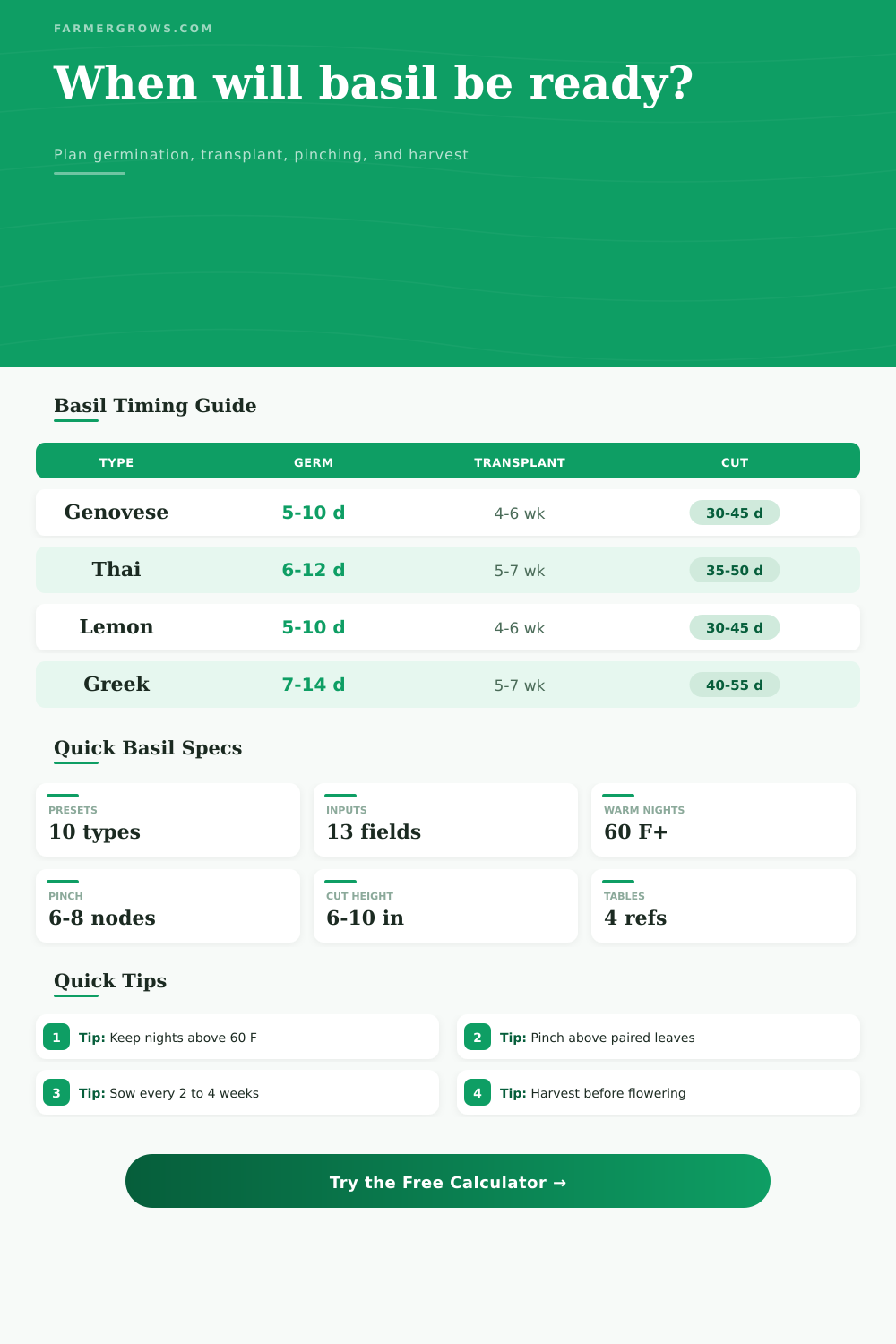
| Genovese basil | 5 to 10 days | 4 to 6 weeks | 30 to 45 days after transplant | Classic pesto basil; responds well to early pinching. |
| Sweet basil | 5 to 10 days | 4 to 6 weeks | 30 to 45 days after transplant | Good all-purpose baseline for outdoor and container basil. |
| Thai basil | 6 to 12 days | 5 to 7 weeks | 35 to 50 days after transplant | Handles heat well but still dislikes cold nights. |
| Lemon basil | 5 to 10 days | 4 to 6 weeks | 30 to 45 days after transplant | Often managed as a quick young-leaf succession crop. |
| Holy basil | 7 to 14 days | 5 to 7 weeks | 40 to 55 days after transplant | Warmth is especially important for steady early growth. |
| Purple opal basil | 7 to 14 days | 5 to 7 weeks | 40 to 55 days after transplant | Color types often slow down under lower light. |
| Greek dwarf basil | 7 to 14 days | 5 to 7 weeks | 40 to 55 days after transplant | Compact habit means smaller, more frequent clipping. |
| Condition | Good range | Delay used | What it changes |
|---|---|---|---|
| Seed zone temperature | 75 to 85°F | 0 to 8 days | Cool seed mix stretches germination and early seedling timing. |
| Night temperature | 60°F or warmer | 0 to 12 days | Cool nights slow transplant recovery and branching. |
| Day temperature | 70 to 90°F | 0 to 5 days | Cool days reduce leaf expansion; excessive heat can stress pots. |
| Light level | 6+ sun hours outdoors | 0 to 10 days | Weak light delays cutting size and favors leggy seedlings. |
| Indoor LED | 12 to 16 hours | -3 to 4 days | Consistent light can speed harvest compared with a dim window. |
| Schedule | First pinch | First branch cut | Best use |
|---|---|---|---|
| Early pinch | 6 nodes | About 18 to 28 days after pinch | Bushy plants for repeated kitchen cutting. |
| Standard pinch | 8 nodes | About 14 to 24 days after pinch | Balanced height, branching, and first harvest size. |
| Light pinch | Tip only | About 12 to 22 days after pinch | Small containers and young leaf harvests. |
| No pinch | Skipped | Earlier single stem, weaker regrowth | One-time cut or flowering stem use. |
| Growing plan | Sow interval | Plant count cue | Calendar note |
|---|---|---|---|
| Kitchen herb pot | 21 to 28 days | 3 to 6 plants | Replace tired plants before flowering dominates. |
| Pesto batches | 14 to 21 days | 12 to 24 plants | Stagger sowings so cutting windows overlap. |
| Market bunches | 10 to 14 days | 24+ plants | Use multiple ages to smooth bunch size. |
| Indoor winter basil | 28 to 42 days | 4 to 12 plants | LED light keeps timing steadier than window-only growth. |
Do not rush basil outside just because days are sunny. Nights below 55°F can stall seedlings and add a week or more to first harvest timing.
Pinch above a pair of leaves once plants have enough nodes. That short delay usually gives a stronger first cutting harvest and better regrowth.
For steady kitchen basil, sow a small new batch every 2 to 4 weeks instead of trying to keep old flowering plants tender forever.
A bright window may keep basil alive, but a 12 to 16 hour grow-light schedule is much closer to outdoor growth speed.
The thing with basil: It’s sensitive to temperature swings (it loves heat but also goes yellow on you if you took seedling outdoors one week early). When it get below 60 degrees at night, growth halts. This can delay your harvest by weeks. Basil’s a heat-lover; and hates it when mercury falls below 60 after sundown. It’s heat or bust for this crop, which stalls out in the dark.
Knowing day versus night can help put an end to guesswork about when to sow. Plug in type of basil you want to grow, along with light hours and soil temperature, and this calculator does the rest.
How to Grow Happy Basil
Gardening calendars are always so vague. They don’t take into account the local microclimates.) So most of us just read the back of the seed packet for germination information, and then we stop right there. But the after part is where things get interesting. What really matters is how fast basil grow once those first leaves appear.
When it’s cold out, nothing, basil will sit still. And if you have nights cooler than sixty degrees F., the plant simply hits the pause button. Yes, it lives, but it ceases growing, accumulating no leaf mass until warmer weather return. A couple of days of slowing down here and there can add weeks to your wait time for first harvest, and leave you with an army of spindly, leggy plants that barely look like basil anymore, at least not as far as the cook’s knife goes.
Basil varieties vary in growth patterns, which affects all other considerations. Some take much longer to get going (Thai basil likes woody, vertical stems; it doesn’t do bushy so well). Some are inherently slower (the purple ones) partly because producing the color uses up some of the plant’s resources. And then there are quick-and-easy types like Genovese, classic for pestos and reliable.
All this breaks down in the chart on the page, where you can see that Greek dwarf may make a nice small plant for a windowsill, but not yield nearly as many leaves as full-sized sweet basil in the garden. Match your desired harvest to what the plant naturaly does. For preserving or selling in bulk, you’ll need a speedy variety and room to spare to hold them. A slow-and-steady compact variety will suffice for garnish-type use, say, a leaf or two for salad.
People also underestimate light; it is another non-negotiable. To produce thick, flavorful leaves, basil requires intense brightness. Even if soil is warm, the plant will stretch toward the light in a dim window, wasting energy producing stems instead of leaves. This results in weak plants that are likely to collapse from their own weight.
Put them in full sun or under some sort of grow lights, and the game changes entirely. The tool takes this into account because it adjusts its estimates based off how many hours of light you report. If you’re indoor-growing in winter, don’t expect much unless you provide twelve to sixteen hours of good artificial light. It’s not only about keeping the plant alive, it’s about forcing it to work as efficienty as possible.
The trick is to succession sow, never trying to outsmart the plant’s life cycle. Basil, like many other herbs, wants to go to seed (flower) when it gets older, but the leaves then gets small and turn bitter. If you try to make one plant last for months by repeatedly cutting it back aggressively, generally the plant will eventually give up on you. Better to start more every couple of weeks or so, rather than attempt to revive an old basil plant. Staggering your starts this way means there will always be a younger generation coming into prime just as an older one fades or flowers. Use the calculator to plan your sowing dates so that your kitchen is never without herbs.
So what does basil want? Basil wants its soil warm while it’s germinating, then not-too-cold (above 60ish at night) once transplanted. It wants a little pinching back by pinching off top growth to keep it bushy. It also needs new seeds before the older ones bolt. And there are only those handfuls of things you should of not do. Do all that, and basil grows really well; but do it correctly!
So how do you know? Well, thanks to the power of math, you don’t need to guess; the math figures out the answer for you. With a date on your calendar, the next thing you’ll be doing is going from “Oh, I hope we get some basil” to “Here’s my basil.” You’ll thank yourself for nailing down the dates now; your future self with a bucketful of fragrant green bushes in the garden will thank you too.