Fish Fertilizer Per Plant Calculator
Estimate fish fertilizer concentrate, water volume, per-plant dose, nitrogen delivery, bottle needs, and season totals from your label rate, plant count, crop stage, and feeding interval.
Enter the rate printed on your fish emulsion or hydrolysate label, then adjust for plant age and crop demand. The calculator keeps label math visible so you can avoid overfeeding tender roots.
Your Fish Fertilizer Mix
Use these numbers as a planning estimate. Product labels, crop condition, and local soil tests should override calculator output.
| Label rate | Equivalent per gallon | Metric equivalent | Best use |
|---|---|---|---|
| 1 tsp per gallon | 1 tsp/gal | 1.30 mL/L | Seedlings, herbs, houseplants |
| 2 tsp per gallon | 2 tsp/gal | 2.60 mL/L | General garden vegetables |
| 1 tbsp per gallon | 3 tsp/gal | 3.91 mL/L | Established heavy feeders |
| 2 tbsp per gallon | 6 tsp/gal | 7.81 mL/L | Only when the product label allows |
| Plant situation | Suggested factor | Why it changes | Watch for |
|---|---|---|---|
| Seedlings and cuttings | 0.25 to 0.50 | Small roots need weak nutrition | Tip burn or stalled growth |
| Leafy greens and herbs | 0.50 to 0.85 | Moderate nitrogen demand | Soft growth in low light |
| Tomatoes, squash, corn | 1.00 to 1.25 | Higher demand during rapid growth | Too much leaf at fruit set |
| Containers and sandy soil | 1.00 to 1.15 | Nutrients leach faster | Salt buildup if overused |
| Plant size | Typical drench | Metric drench | Notes |
|---|---|---|---|
| Seedling cell or plug | 0.25 to 0.5 cup | 60 to 120 mL | Moisten root zone only |
| Small herb or flower pot | 0.5 to 1 cup | 120 to 240 mL | Stop before runoff |
| Vegetable transplant | 1 to 3 cups | 240 to 710 mL | Pour around active roots |
| Large container or shrub | 0.5 to 1 gal | 1.9 to 3.8 L | Scale by root-ball size |
Label first: Fish fertilizer products vary widely. If your label gives a lower rate for young plants, use that lower number in the calculator.
Soil moisture: Apply liquid fertilizer to moist soil when possible. Very dry potting mix can channel liquid away from feeder roots.
Foliar caution: Foliar fish sprays should be weak, strained, and applied during cool parts of the day to reduce leaf spotting.
Balance matters: Fish fertilizer is often nitrogen-forward. Use soil tests and crop response before increasing frequency.
There are twelve tomatoes in the sun, all waiting for you to grow them big and strong. To do just that, what do you think? Use a bottle of fish emulsion to give every plant a healthy splash off plant food. Most gardeners burn things down like this. Fertilizer isn’t often the issue; it’s the presumption that more = better.
The key is that the fish-derived stuff feed fast, delivering nitrogen in a nitrate form that plants absorb easy. Fast is good…except when you aren’t precise. Drowning delicate root systems in full-strength feed will shock, not feed.
How to Use Fish Emulsion Safely
Plug in your plant count and label rate, and the calculator above do the rest, no more guesswork on conversion and coefficient numbers. No more chaos; the garden row come into sharp focus, reduced to a clear recipe for mixing. What do all those inputs mean? How can you get the final number right if you don’t know what they’re realy saying?
To begin, look at the product label rate. That’s the starting point. The concentration level the manufacturer recommends as the “healthy” baseline for established plants. For most fish emulsions, that’s roughly two teaspoons to a gallon of water. It is middle ground (about right) for general vegetables, certainly. But not every plant in your garden ask for that intensity at the same time.
A new seedling is a delicate creature with a tiny root system that doesn’t know what to do with a bunch of excess nitrogen or extra-salty water. If you treat a four-week-old transplant like a full-grown pepper plant, you will soon notice some leaf tip burn. With this little tool you set the strength according to your plant’s age, reducing it to half (or less) the recommended amount on the label for baby plants. That’s not much on the screen but an enormous difference when you look down at the ground. What you’re doing is sort of training the plants to eat instead of forcing them to eat.
Dial it back up again once the plants get bigger and they starts demanding more for producing a big crop. Squash and tomatoes is well-known heavy feeders when they’re really in their prime bloom period. They’ll suck the nitrogen out of soil quickly. Without isolation or separate feeding, they can leave other plant weak in their wake.
They also forget one other variable: How much water per plant? You may feel like you’re watering all those plants a gallon apiece, but if the ground’s dry and water-repellent, it’ll simply run downhill from the shrubs’ surfaces, into the driveway. The calculator assumes you are applying your solution to moist soil that will soak into the root zone. Apply liquid fertilizer onto bone dry dirt and what happens? Channels, not saturation.
First thing: Always water with just plain water first, if the soil’s tight to the touch. That way the nutrients won’t simply sit atop it or wash right through.
There’s another kind of ground altogether: Sandy soils. They does not retain nutrition well. For example, when it is heavy clay and the fertilizer just sits there awhile, you can feed less frequent. With fast-draining soil like sand, or a container with fast-draining medium, those minerals will wash out with each storm. And yes, the tool has options for soil type. It is not based off hypothetical bookkeeping, but on how real soil works. A bed filled with good compost retains its fertility for weeks; too much time between light feedings makes sense, versus starving your plants if you’re shortchanging them in low-fertility soil, which then runs right off the surface to waste your cash.
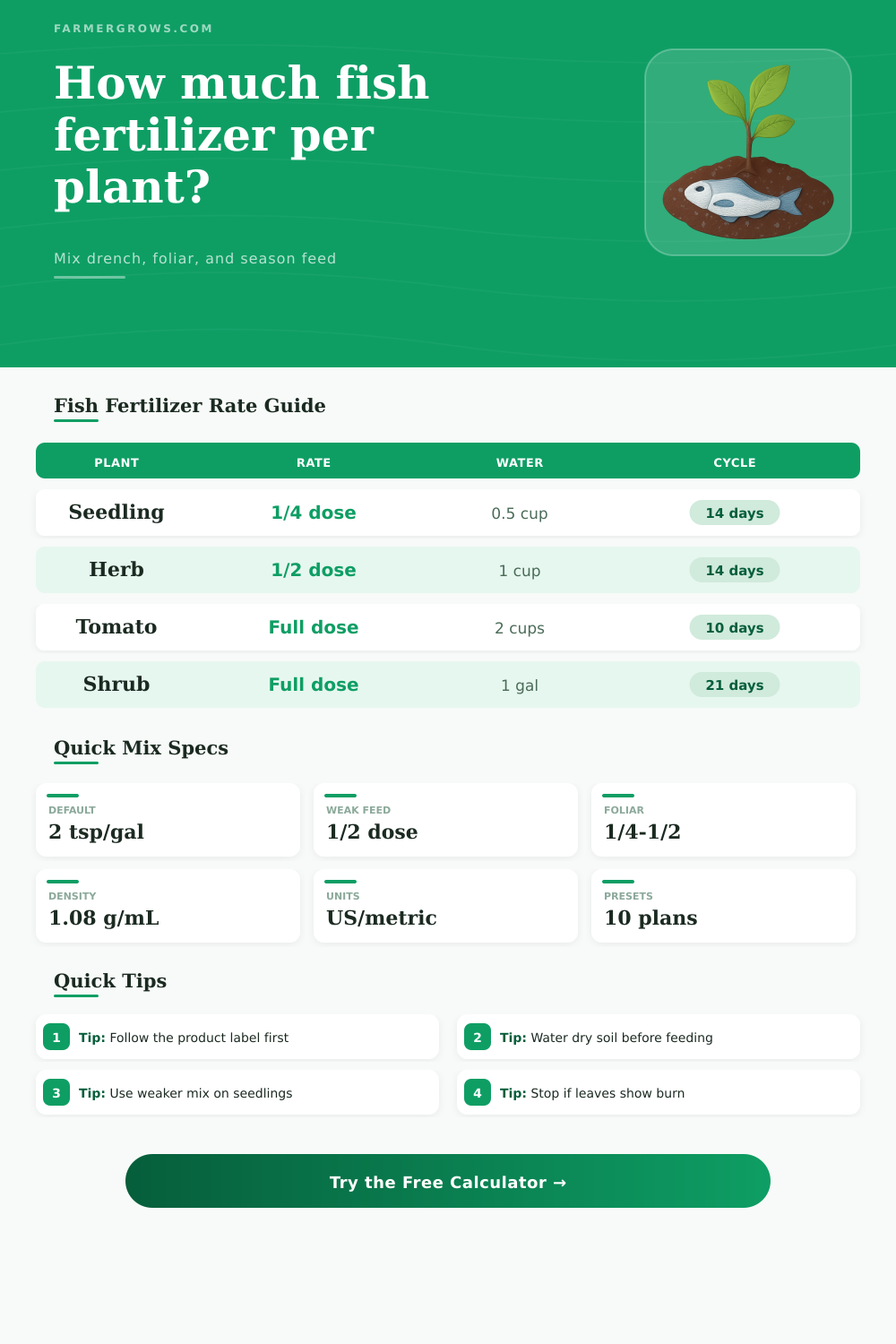
Another issue involves foliar sprays, which can have a positive effect when stressed roots do not take up nutrients well, but they must be diluted enough so they won’t spot foliage. Strong solutions simply burn plants’ tissues by sitting on them when exposed to sun. The table of references on the left explain how much spray to use for each plant type. It is a good snapshot for making quick decisions when you are in the garden and have no time to do your math.
Ultimately, it’s not math; it’s observation that matters most when it comes to success with any kind of plant food. Yes, the numbers provides a place to start safely, but it’s what your plants say to you about their true needs that counts. Is it too little? Maybe yellowing leaves tip you off it was nitrogen. Maybe it is too much of something else? Maybe stunted growth says there’s been too much nitrogen instead. Use the calculator initially for your mix, and then keep an eye on what happens in your garden during each of those two week periods between feedings. Tweak up or back according to what’s happening with color, vigor, even fruit set. It smells like crap from the bottle, but proper dosing makes for great results.