Caladium Bulb Planting Depth Calculator
Estimate soil cover, total hole depth, spacing, tuber count, and warm-soil readiness for caladium tubers in garden beds, patio containers, hanging baskets, and shade borders.
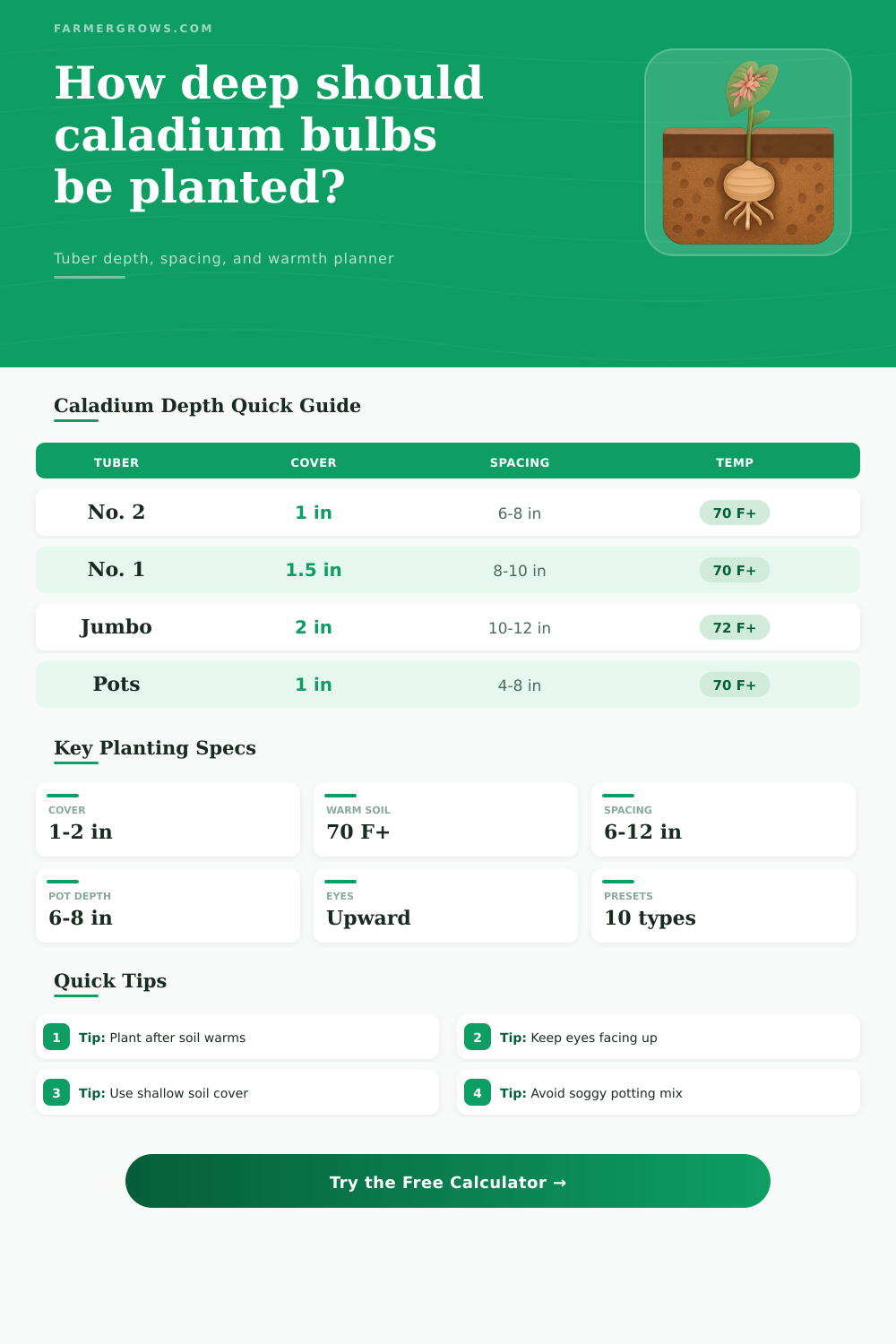
For caladiums, depth means loose soil cover above the tuber. The total hole depth also includes the tuber thickness, and planting should wait until soil stays warm.
| Caladium cultivar | Leaf habit | Usual cover | Spacing guide |
|---|---|---|---|
| Candidum | Fancy leaf, white and green | 1 to 1.5 in | 8 to 10 in |
| White Christmas | Fancy leaf, bright white | 1 to 1.5 in | 8 to 10 in |
| Red Flash | Large fancy leaf | 1.5 to 2 in | 10 to 12 in |
| Freida Hemple | Red center fancy leaf | 1.5 in | 9 to 12 in |
| Florida Sweetheart | Strap leaf, compact | 1 to 1.25 in | 6 to 8 in |
| Miss Muffet | Dwarf strap leaf | 1 in | 5 to 7 in |
| Tuber grade | Typical diameter | Best cover | Best use |
|---|---|---|---|
| No. 2 small | 1 to 1.5 in / 2.5 to 3.8 cm | 1 in | Small pots and tight edges |
| No. 1 landscape | 1.5 to 2.5 in / 3.8 to 6.4 cm | 1.25 to 1.75 in | Beds, borders, patio pots |
| Jumbo | 2.5 to 3.5 in / 6.4 to 8.9 cm | 1.5 to 2 in | Fast, full container displays |
| Mammoth | 3.5 in plus / 8.9 cm plus | 2 in | Large tubs and focal clumps |
| Soil temperature | Planting call | Expected response | Depth note |
|---|---|---|---|
| Below 60 F / 16 C | Wait | High rot risk, slow sprouting | Do not compensate by planting deep |
| 60 to 69 F / 16 to 21 C | Delay if possible | Uneven sprouting | Use shallow cover and warm pots |
| 70 to 75 F / 21 to 24 C | Good | Reliable root and shoot growth | Use standard 1 to 2 inch cover |
| Above 75 F / 24 C | Excellent | Fast emergence with moisture | Keep evenly moist, not soggy |
| Planting setup | Example area | Spacing | Likely tuber count |
|---|---|---|---|
| 12 inch round pot | 0.8 sq ft | 4 to 6 in | 1 to 3 tubers |
| Window box strip | 3 sq ft | 6 to 8 in | 7 to 12 tubers |
| Shade border pocket | 24 sq ft | 8 to 10 in | 35 to 55 tubers |
| Large patio tub | 4 sq ft | 8 to 12 in | 5 to 9 tubers |
Fancy leaf caladiums
Large leaves usually need wider spacing and enough shallow cover to anchor tubers without burying the growing eyes too deeply.
Strap leaf caladiums
Compact cultivars such as Florida Sweetheart and Miss Muffet can sit closer together for dense edging and basket plantings.
Container planting
Pots warm faster than garden soil, but shallow containers need drainage and a careful eye on soggy mix around the tuber.
Garden bed planting
Outdoor beds need reliably warm soil. Planting into cold soil is a bigger problem than being half an inch off on depth.
Growing caladiums is both a matter of heat and soil science. Get the heat and moisture right (and put in some organic matter), and then don’t mess it up by letting rot set in. A few degrees’ swing in temperatures… Or an inch or two of dirt, can be difference between rousing color and rotting disappointment. Primarily why most gardeners screw up: They either overplant their tropical bulb-like thing, or do so when the ground remains too chilly for comfort yet.
The right soil depth depend on your tuber type (grade) and your planting distance. The calculator takes those factors into account to estimate exactly how much soil should covers each tuber. And why it should be shallow? Because caladiums has eyes up top, which emerge as shoots. Planting deeply means those shoots struggle upward through wet ground until they gets their leaves in sunlight. The soggy conditions also invite rotting fungi until they get root system established.
How to Plant Caladiums Correctly
Lots of spring things go wrong due to soil temperature. Just because frost is no longer predicted on the calendar doesn’t mean that the soil isn’t still cool, which can be long after the air warm up. The tool compares what you report as your soil temp to a baseline of seventy degrees Fahrenheit. Below that, it will flag a delay risk, since metabolism is slowed considerably in cool conditions for tropical bulbs. A tuber waits in sixty-degree dirt, not growing, but rotting while it does so. Better to wait till it’s warmer before you tuck one away hoping for the best.
That’s why this part is all about planting spacings, which are where intuition goes right out the window. In the garden, staggering plants makes things more full sooner (the leaves interlock and create that jungle effect). If you want a looser drift versus a formal grid, adjust the tubers accordingly with the calculator.
In containers: Pots will dry out faster than ground, and warm up faster. So use an airy and loose container soil mix, no heavy garden-type dirt. Adjust the tubers to match. If your mix is holding water, the calculator knows and suggest a little less cover so the tuber isn’t sitting in a wet pocket without any oxygen reaching it.
The type of bulb grade also change the entire planting dynamic. For instance, a jumbo tuber has more energy then a small number two bulb. This makes it more able to handle a bit of heat stress or push its way up through slightly thicker ground. But don’t give it a giant tuber treatment (as though it were a storage onion), because it won’t survive if you do. Each caladium should be treated as a living thing needing just enough protection to make him feel safe but not too much to smother him. The eyes should stay just below the surface, peeking out and waiting to pop up when sun appears.
The page breaks down the details with reference tables for each cultivar’s needs. Before you dig in, you can see how things will look together, compact strap leaves versus decorative leaf ones, for example, as if they were all in place. It’s like planning the shade-garden architecture. Knowing that the right depth keeps the tuber cozy (warm enough to sprout and not too dry) makes the whole process feel much less intimidating. Guesswork becomes planned creation: a microclimate for every bulb.
The secret: It takes some precision (and some patience) to grow caladiums successfuly. Leave enough space for the plants to grow large; use only enough soil cover so it doesn’t smother them, and check your soil temp. When you get the rhythm, it doesn’t feel lucky; it’s as if the first streaks of color that push through are the result of a well-executed plan. And the care with detail is worth it, turning a dim, shady corner in my garden into something bright and lasting all summer long.