Christmas Trees Per Acre Calculator
Estimate Christmas tree planting density, plantable acres, seedling order quantity, expected marketable harvest, annual rotation blocks, row footage, and spacing fit for fir, pine, spruce, cedar, and choose-and-cut fields.
Use this calculator before ordering transplants or laying out a new block. It separates clean spacing density from real field losses such as access roads, headlands, wet pockets, service lanes, mortality, and cull percentage.
Christmas tree density plan
Enter spacing and field assumptions to calculate the planting block.
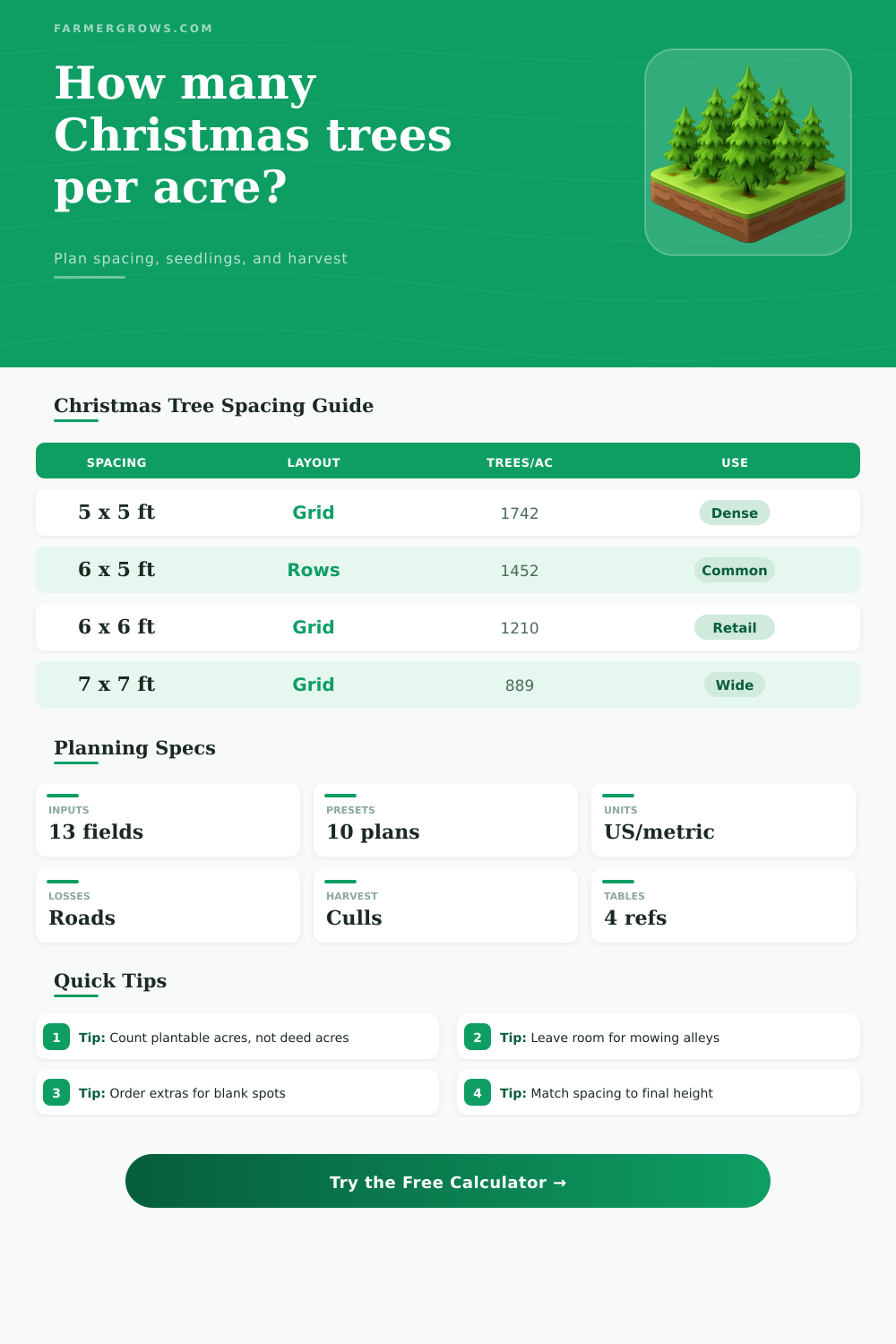
| Tree type | Typical spacing | Approx trees/ac | Rotation note |
|---|---|---|---|
| Fraser fir | 6 x 5 ft to 6 x 6 ft | 1,210 to 1,452 | Often 7 to 10 years depending on site and target height. |
| Balsam fir | 5 x 5 ft to 6 x 5 ft | 1,452 to 1,742 | Dense blocks suit smaller wholesale sizes when mowing access is planned. |
| Douglas-fir | 6 x 6 ft to 7 x 6 ft | 1,037 to 1,210 | Wider rows help shape full trees and reduce crowding before sale. |
| Scotch or white pine | 6 x 6 ft to 7 x 7 ft | 889 to 1,210 | Use wider spacing where lower branches and tractor access matter. |
| Blue spruce | 7 x 7 ft to 8 x 8 ft | 681 to 889 | Slow growth and stiff branches usually favor more room. |
| Row spacing | Tree spacing | Footprint | Trees per acre |
|---|---|---|---|
| 5 ft | 5 ft | 25 sq ft/tree | 1,742 |
| 5.5 ft | 5.5 ft | 30.25 sq ft/tree | 1,440 |
| 6 ft | 5 ft | 30 sq ft/tree | 1,452 |
| 6 ft | 6 ft | 36 sq ft/tree | 1,210 |
| 7 ft | 6 ft | 42 sq ft/tree | 1,037 |
| 7 ft | 7 ft | 49 sq ft/tree | 889 |
| 8 ft | 8 ft | 64 sq ft/tree | 681 |
| Deduction | Common range | What it covers | Calculator input |
|---|---|---|---|
| Headlands | 4% to 10% | Turning space for mower, sprayer, trailer, and planting equipment. | Roads and headlands |
| Service roads | 3% to 12% | Main lanes for harvest crews, customer parking flow, and loading access. | Roads and headlands |
| Wet or shaded spots | 1% to 8% | Areas not worth planting because survival or tree quality will be low. | Unplantable field area |
| Blanking reserve | 5% to 15% | Extra seedlings for replanting misses and keeping the stand even. | Seedling order reserve |
| Gross acres | Spacing | Usable area | Annual cut on 8 years |
|---|---|---|---|
| 2 acres | 6 x 5 ft | 86% | About 312 marketable trees/year before local losses. |
| 5 acres | 6 x 6 ft | 86% | About 650 marketable trees/year before local losses. |
| 10 acres | 6 x 5 ft | 84% | About 1,525 marketable trees/year before local losses. |
| 15 acres | 7 x 7 ft | 82% | About 1,365 marketable trees/year before local losses. |
Count usable acres: Christmas tree fields need drive lanes, turn rows, loading access, and mowing clearance. If those are not deducted, seedling orders can be too high.
Plan for grades: A full stand does not equal a full marketable crop. Cull rate captures poor form, pest damage, skips, and trees held for a later year.
Check final height: Tighter spacing can work for smaller wholesale trees, while taller choose-and-cut trees usually need wider alleys and more shoulder room.
Use rotation math: Annual block counts help keep inventory steady so one planting year does not create a future harvest shortage or surplus.
Before you even see them, if you’ve ever been to a Christmas tree farm, you can smell difference between the good ones and the bad ones. A good one smells like a freshly cut Christmas tree: it has a scent of cut wood, needles mulching on the ground, and no smell of rotting needles from trees that were harvested years ago.
But it takes more than simply growing your seedlings into a tall spruce or fir to grow a successful Christmas tree farm. Whether you have a thicket of useless brush or a tightly packed forest of saleable trees depend on some simple math. The most costly mistake beginner growers make is planning how far apart to space each tree. New growers think every square foot on the deed are available as planting area. This couldn’t be further from the truth. Not all land is good planting land.
How to Plan Your Christmas Tree Farm
After you input your field sizes, the calculator figures out math for you; no more guesswork as to if you can run a six-foot spaced row or not. Always remember balance between density and access. You need to figure out how to put enough trees on an acre to make money, but not so many that they closes the canopy before they are big enough to sell. The bottom of the tree dies off when the canopies meets each other too soon. No lower branches equals sticks with leaves on top, and that gets culled. People don’t understand that part. They focus on getting all these seedlings planted in the ground and forget about where their cutting machinery will go.
First thing: What’s yours? What isn’t? Gross acreage minus unplantables equals…well, what you can plant. Roads occupy space. The turning radius needed for mowing equipment occupies space. Drainage swales and service lanes takes up space. Wet pockets where roots will rot also take up space. Knowing this is key, because you’ll want to order seedlings not by total deed acres, but by your actual clean spacing density. (You could have five acres on paper, but once you account for the drainage swales and service lanes, you may actually have three or four plantable acres.) That difference make all the difference in the starting cost of your investment. If you order too many seedlings because you think each one needs its own inch, you’ll be stuck with extra stock and nowhere to put it, or you’ll have spent money on trees that never get planted.
But then there’s the mortality factor. No matter what, things dies. Some of them won’t survive, from pests or drought or deer or plain old bad luck when somebody plants something wrong. To allow for this loss rate when you’re establishing the beds, the calculator also asks for an establishment loss rate to add on as a reserve buffer. If you want the most beautiful-looking field possible, you’ll want to order up more seedlings than you think you need at the end, because nothing grows at 100 percent efficiency. It’s not pessimistic; it’s just good business. Ugly gaps in the choose-and-cut rows makes customers think the place was poorly run. A seven percent reserve may seem low, but across a big field, that’s plenty of wiggle room to maintain visual appeal without resorting to expensive last-minute purchasing of extra trees during high season.
Then there’s the other layer most beginners miss: the planning. No, you don’t plant it all at one time and hope for the best. You stagger your planting so that a certain block of trees comes up to harvestable height each year. So what does this mean? How much do I need to grow every year to keep my cash flow steady? This is exactly what the calculator shows you. Based on your desired number of years in rotation (e.g., eight years for Fraser firs), it calculates how many marketable trees per acre you’d need to produce each year. Then, it tells you how many trees in your field you should of had ready each year (assuming 100% marketable yield). Failing to have enough trees in each block each year mean boom and bust; running out of inventory in bad years and crashing the price in good ones.
It is also important to know what species you are planting. For example, a conifer like a blue spruce retains its lower branches longer and grows slower. You can space these trees more tightly then an equal-sized Scotch pine, which spreads wider and drops lower limbs quickly when crowded. No matter how much you water or fertilize, they won’t have good shape if spaced incorrectly for the variety you’re using. The built-in reference tables that accompany the tool will direct you to the right spacing based off the type of tree you’re planning to plant; it’s grounded in actual forestry data, not guesswork.
The thing is, though: it’s less about botany and more about geometry. Creating a Christmas tree farm is an exercise in math. You must consider the spacing, the loss factor of what dies along the way, the mechanics of how people move around your property, and the look of the forest itself. Combining biology with access and customer experience is how you engineer a livivng landscape. And that’s how you create an annual business from a plain old field (by getting the numbers right up front). This must happen before anyone puts a single seedling in the ground.