Apple Trees Per Acre Calculator
Estimate apple orchard density by rootstock, training system, area shape, row spacing, in-row spacing, productive acreage, pollenizer share, mortality, reserve trees, and work-zone layout.
Use the calculator before ordering whips, laying out trellis posts, or comparing dwarf and semi-dwarf systems. The core density formula is 43,560 square feet per acre divided by row spacing times in-row tree spacing, then adjusted for usable orchard area.
Apple orchard density plan
Enter spacing and area details to see tree count, pollenizer split, order reserve, and planting batches.
| Apple system | Typical row spacing | Typical in-row spacing | Trees per acre | Planning note |
|---|---|---|---|---|
| Super spindle M.9 or Bud.9 | 9 to 11 ft | 2.5 to 3.5 ft | 1,130 to 1,936 | Needs trellis, irrigation, and very disciplined pruning. |
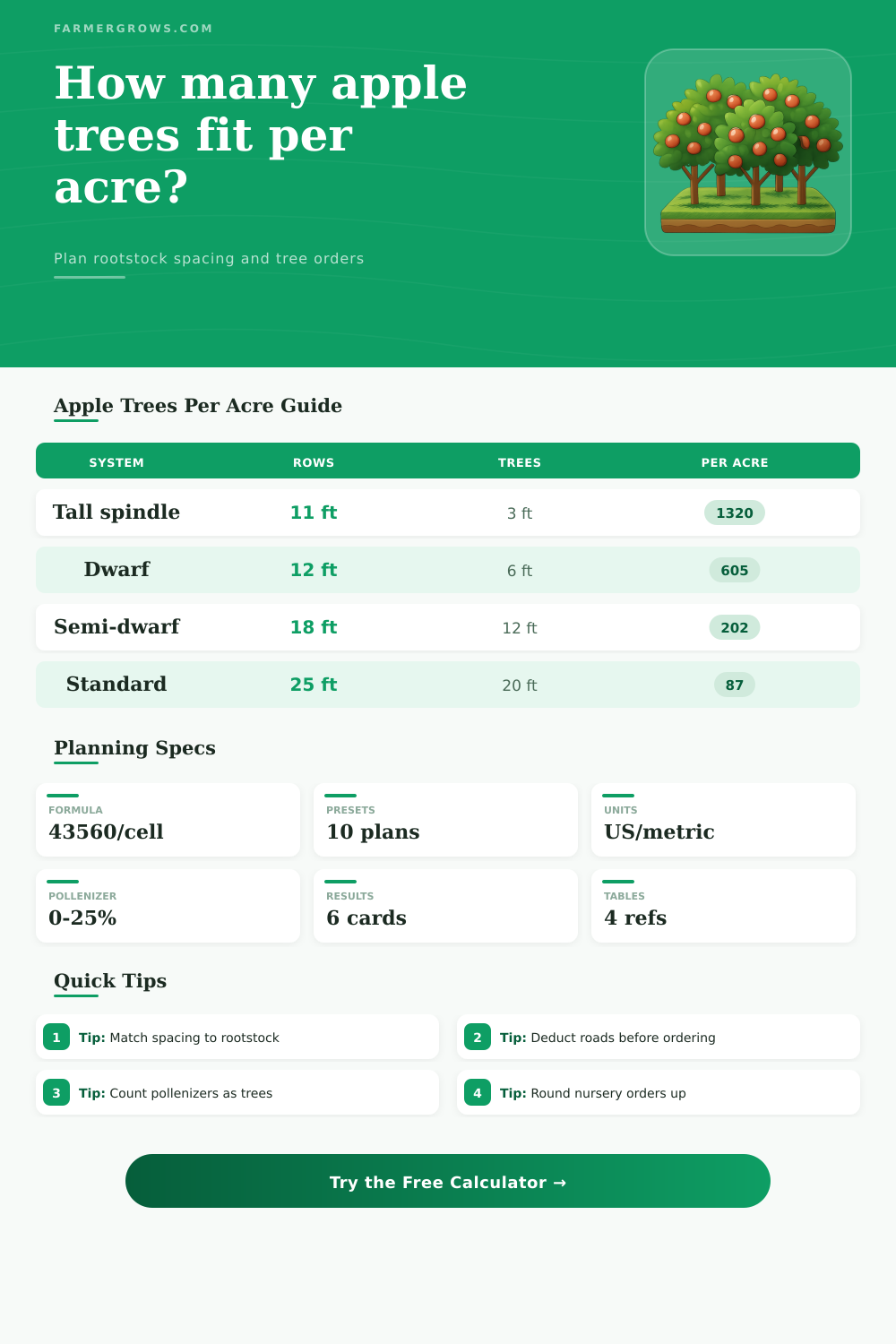
| Tall spindle dwarf | 10 to 12 ft | 3 to 4 ft | 908 to 1,452 | Common commercial high-density apple system. |
| Slender axis dwarf | 12 to 14 ft | 5 to 7 ft | 445 to 726 | Moderate density with support and narrow canopy training. |
| Backyard dwarf | 12 to 14 ft | 6 to 8 ft | 389 to 605 | Fits small orchards when pruning keeps trees accessible. |
| M.26 or small semi-dwarf | 14 to 16 ft | 8 to 10 ft | 272 to 389 | Good small farm spacing with more canopy room. |
| MM.106 medium semi-dwarf | 16 to 20 ft | 12 to 15 ft | 145 to 227 | Allows mower, ladder, and harvest access. |
| MM.111 large semi-dwarf | 18 to 22 ft | 15 to 20 ft | 99 to 161 | Use when vigor, drought tolerance, or sod alleys matter. |
| Standard or seedling apple | 22 to 30 ft | 20 to 30 ft | 48 to 99 | Traditional wide canopy spacing for long-lived trees. |
| Gross area | 10 x 3 ft | 11 x 3 ft | 12 x 6 ft | 18 x 12 ft | 25 x 20 ft |
|---|---|---|---|---|---|
| 0.10 acre | 145 trees | 132 trees | 61 trees | 20 trees | 9 trees |
| 0.25 acre | 363 trees | 330 trees | 151 trees | 50 trees | 22 trees |
| 0.50 acre | 726 trees | 660 trees | 303 trees | 101 trees | 44 trees |
| 1.00 acre | 1,452 trees | 1,320 trees | 605 trees | 202 trees | 87 trees |
| 2.00 acres | 2,904 trees | 2,640 trees | 1,210 trees | 403 trees | 174 trees |
| Allowance item | Low | Typical | High | Use when |
|---|---|---|---|---|
| Headlands and turn rows | 5% | 10% | 20% | Sprayers, platforms, wagons, or trucks need turning room. |
| Roads and irrigation lanes | 3% | 8% | 15% | Mainlines, hydrants, drive rows, or frost lines cross the block. |
| Pollenizer share | 5% | 10% | 20% | Most apple blocks need compatible cultivars blooming together. |
| Establishment loss | 2% | 5% | 12% | Increase for dry sites, wildlife pressure, or weak nursery stock. |
| Extra nursery reserve | 2% | 5% | 10% | Useful where replacements are hard to source midseason. |
| Planting crew plan | Useful batch size | Daily focus | Why it matters |
|---|---|---|---|
| Backyard or small crew | 25 to 75 trees | Layout, planting, watering | Small batches reduce root drying and spacing mistakes. |
| Family farm crew | 100 to 300 trees | Rows, guards, irrigation | Works well for dwarf and semi-dwarf blocks. |
| Commercial trellis crew | 300 to 800 trees | Stakes, ties, fertigation | High-density systems need synchronized support work. |
| Replacement pass | 5 to 15% of order | Weak spots and misses | Reserve trees keep stand density close to plan. |
Rootstock decides density. A 3-foot in-row apple spacing belongs to a supported dwarf system, not an unmanaged semi-dwarf tree. Match the nursery rootstock, training style, soil vigor, and pruning plan before ordering.
Gross acres overstate orders. Productive-area percentage should remove roads, headlands, irrigation access, wet edges, and staging lanes. Pollenizer trees are counted inside the total because they occupy real planting spots.
Here’s how it works: You’ve got a phone in your hand ready to order hundreds of saplings; you’ve got a plot of land and you dream of ripe fruit. But there’s a problem: How do you space them? If they’re planted too far apart, you’ll pay for empty ground that could be earning money. If they’re too close, the canopies will choke each other long before they produce anything worth having. That is where science of a well-thought-out density plan comes in.
Rootstock is a silent dictator. There’s no sense picking a cultivar first and then deciding how much space you’ll give it; your ultimate tree size are dictated by its root system. Vigorous M.9 super dwarfs want to get crowded into a trellis wall and get aggressively pruned into a thin column of fruit. They love crowded blocks where each day sunlight reach deep into the canopy. An MM.111 semi-dwarf rootstock need more space instead. It’s larger, lives longer, and needs wider rows (to fit a harvest platform and mower). Putting a vigorous-rootstock variety into dwarf densities? Recipe for labor headaches and disease. The trees will soon run over what was allocated for them.
Why Apple Tree Spacing Matters
After choosing the desired system, the calculator (above) figures out how dense to plant without making you calculate canopy overlap yourself. It also considers how much space isn’t realy available to plant on: not all square feet are created equal. Most landowners overestimate what is available when viewing a gross acreage number. A field might be ten acres on paper. However, once you take into account the access roads for harvest wagons, the irrigation lanes, and the headlands needed for turning sprayer rigs around, there is not much productive area left. If you don’t factor those non-planting areas in, you’ll order too many trees (leaving you with extra stock that will die before winter sets in) or not enough trees to match the rows you planned on growing.
Before any whips go in the ground, there’s one more logistical detail: You must account for pollination. Unless you’re growing a self-fertile variety (most apples aren’t), each apple needs a compatible partner of roughly equal age, blooming at roughly the same moment, to make a baby apple. That means reserving a portion of your total tree number to be pollenizers. These are not additional trees beyond what’s already in the plan, but a piece of the pie that allows the remaining orchard to have offspring. With this tool, you’ll never spend money and space on too much of one thing or another. It shows exactly how many main crop trees and how many pollenizer trees you should of order from the nursery to maintain your variety balance.
Another aspect of reality is mortality and reserve orders. Even with all the care you can provide when ordering and handling bare-root stock, certain tree won’t make it, whether because they suffer transplant shock, dry winds, wildlife damage, etc. Good growers always count on that and order a few percent more than needed as back-up trees for replacements. This is a little insurance policy against any gaps in your rows which are difficult to fill after the surrounding canopy closes in.
This is all spelled out on the page’s reference table, which makes clear how radically different these numbers are between high-density moddern blocks and old-school heirloom layout. Where a commercial dwarf block could be over a thousand trees to the acre, a typical orchard would contain less than a hundred trees. And it isn’t simply that you get more yield capacity; it’s also a matter of cost of investment upfront (more trees means more money spent initially for things like irrigation infrastructure and trellising) and labor intensity. Dense plantings can repay your investment sooner, though they’ll cost more up front for infrastructure. Sparse plantings has lower establishment costs but take longer to reach economic maturity.
Ultimately, there is a balance between physical limits and what someone wants to achieve when planting an apple orchard. How far apart will you space them? That determines what sort of equipment you’ll invest in. It determines which pruning methods to master. It also determines how many years it will take to get a payoff on your investment. Plotting all this out before ordering from the nursery saves some money, and helps you plan an organized grove that’s not only efficient but should bear fruit consistantly for decades. A little forethought changes a row of trees-in-waiting into something more precise, your own piece of agricultural real estate.