Seeds Per Gram Calculator
Convert a counted seed sample into seeds per gram, thousand seed weight, packet inventory, tray needs, row coverage, and usable seed after germination and sowing buffer.
Use a clean counted sample from the same seed lot. Small vegetable seed can vary by variety, coating, moisture, and grading, so the calculator treats your counted weight as the main authority and uses crop averages only as comparison guides.
Seed Lot Count Results
Results update from the sample and planting plan above.
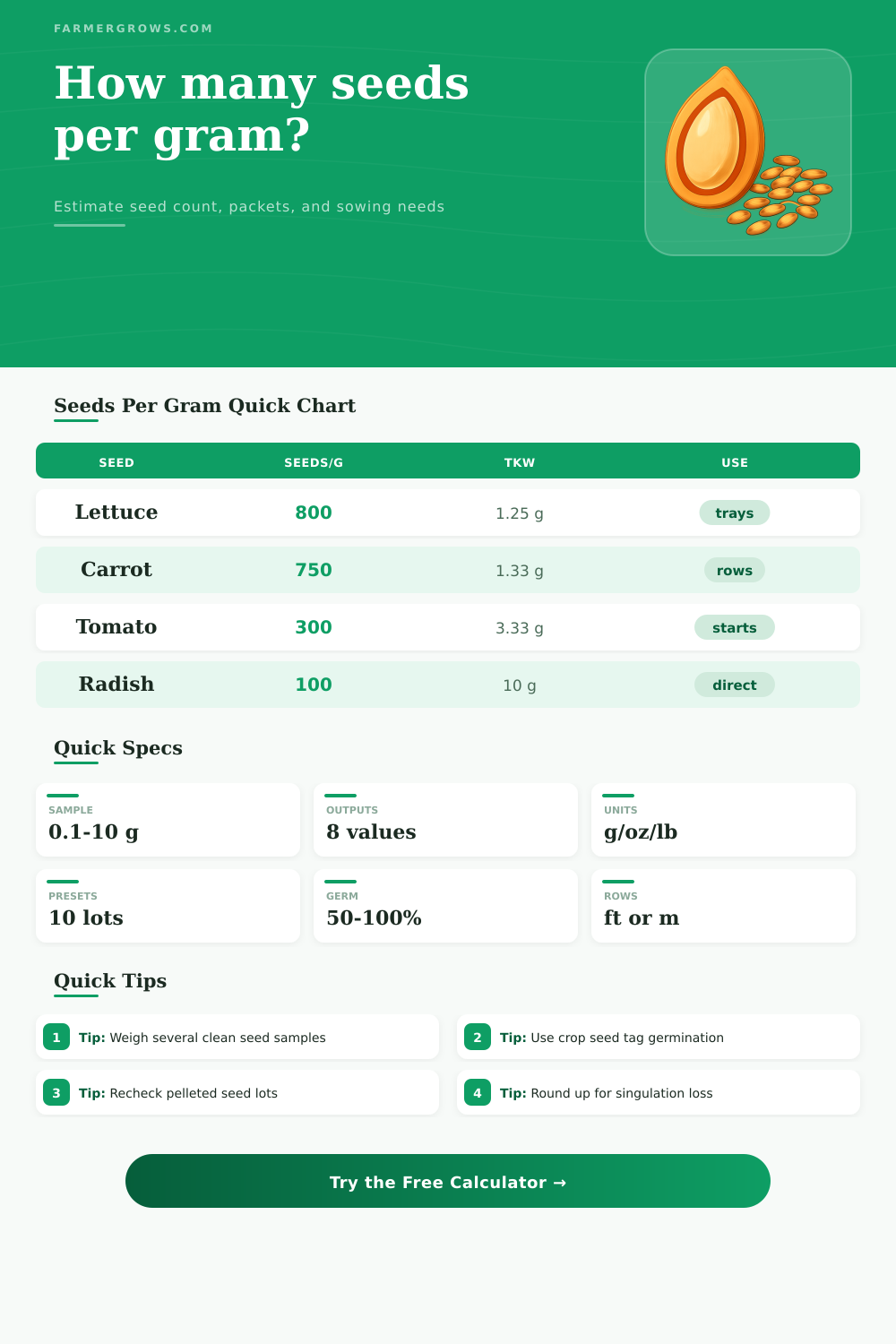
| Seed type | Typical seeds/g | Typical TKW | Planning note |
|---|---|---|---|
| Lettuce | 700-1,000 | 1.0-1.4 g | Pelleting lowers seed count per gram because coating adds weight. |
| Carrot | 600-900 | 1.1-1.7 g | Raw seed varies by grading; count your lot for precision seeders. |
| Tomato | 250-350 | 2.9-4.0 g | Useful for starter trays, grafting rounds, and backup seedlings. |
| Basil | 600-800 | 1.3-1.7 g | Microgreen seeding can use lot grams instead of hand counts. |
| Radish | 70-130 | 7.7-14.3 g | Large enough that packet count shifts quickly with seed size. |
| Onion | 250-400 | 2.5-4.0 g | Older lots often need a germination retest before seeding flats. |
| Cucumber | 25-45 | 22-40 g | Use for hills, plug trays, and backup transplants. |
| Bean | 2-6 | 167-500 g | Counts vary heavily by class, seed size, and moisture. |
| Sample size | Best for | Scale need | Why it matters |
|---|---|---|---|
| 0.1-0.25 g | Very fine seed | 0.001 g | Good for lettuce, basil, and small packets when seed is limited. |
| 0.5-1 g | Small vegetable seed | 0.01 g | Balanced sample for carrot, onion, tomato, brassicas, and flowers. |
| 5-10 g | Medium seed | 0.1 g | Better for radish, beet, spinach, cucumber, and mixed seed lots. |
| 50-250 g | Large field seed | 1 g | Needed for beans, peas, corn, grains, and irregular large seeds. |
| Unit | Grams | Formula | Example use |
|---|---|---|---|
| 1 gram | 1 g | seeds/g x 1 | Small packets, tray planning, and germination tests. |
| 1 ounce | 28.3495 g | seeds/g x 28.3495 | Common market-garden packet and jar inventory. |
| 1 pound | 453.592 g | seeds/g x 453.592 | Bulk seed, cover crop strips, and field inventory. |
| 1 kilogram | 1,000 g | seeds/g x 1000 | Large vegetable lots and farm seed room records. |
| Planning task | Calculator output | Adjustment | Field note |
|---|---|---|---|
| Tray starts | grams needed | germination and buffer | Round up to full trays if you need uniform transplant blocks. |
| Direct rows | row feet covered | seeds per row foot | Change seed spacing before comparing row coverage between crops. |
| Inventory check | total lot seeds | lot weight conversion | Use clean seed weight only, not container or envelope weight. |
| Seeder setup | seeds per gram and TKW | actual sample count | Recount coated, pelleted, treated, or blended seed separately. |
For mixed or irregular seed, combine several small scoops from different parts of the packet before counting. That reduces bias from dust, broken seed, or size separation.
Pelleted and primed seed can weigh much more than raw seed. Do not use raw crop averages for coated seed unless you have checked the actual lot.
Write down count, sample weight, date, crop, and lot number. A simple record helps recalibrate seeders and compare old inventory later.
Seeds per gram tells quantity, not viability. Combine it with germination percentage when planning usable plants or field stand targets.
Tip: If the sample weighs less than 0.25 g, count two or three samples and average the seeds per gram before ordering or seeding a large batch.
Tip: For row crops, enter the seed drop you actually plan to use before thinning, not the final plant spacing after emergence.
Read the packaging: The label says it’s twenty grams. You look at your little packet of carrot seed. Your brain instinctivey tries to convert that weight into a volume of seeds. Except with living creatures, “weight” isn’t the same as “quantity.” A gram of wheat hold far fewer seeds then a gram of lettuce. Sow without reference to what’s on the package and you end up with a crop that’s either threadbare or otherwise impossible to manage.
But wait: How do you count, rather than weigh? Well, that’s where the calculator comes in. Plug in what you have, and it does the rest of the math for you; no unit conversions, no dividing by hand. It translates unhelpful weight into something useful: a planting plan.
Why You Should Count Your Seeds
Before you can make any sense about how many rows you want to plant, or how many trays to fit into, you must know exactly how many seeds are in your jar. The first thing to do is count out a representative sample accurately. Unless you’ve checked with your particular lot, don’t assume that a general catalog average apply to yours. Seed coatings such as pelleting add weight; if you apply normal counts to coated seeds, you’ll overcount what you have on hand.
That’s why the tool lets you override its default numbers by entering the actual seed count you physcially measured. Your measured amount gets used as your assumed true count, and only averaged with other crop averages for comparison.
Why does this matter? Manufacturers can grade different. But then what? Now you have the seed weight, but you need to account for what happens in practice. Not all seeds will germinate. Some will be killed before they come up. Some will be consumed by pests. Others rot.
Germination percentage factors into this, as does something called sowing buffer. A new pack might be 95 percent viable, an old one less (let’s say it was only 70). Then the calculator backs off the number with those percentages. So it doesn’t simply count the seeds that were there physically; it calculates how many viable plant you can expect to get from each bag.
Even if you have perfect germination (which you probably won’t), there’s always some loss of seeds as they are handled; some drop on the ground, others cling to hands. A ten or fifteen percent buffer covers that loss from mechanics. If you don’t include one, your actual number of plants at the end won’t match what you had intended. That’s why using the tool, which automatically includes a buffer, avoids having to back out the buffer math manually.
It calculates just how many grams you should order based off the number of desired plants, and then it details out what all that will cover in terms of feet of row, or full trays. It connects field execution with inventory management. No more guesswork, now you measure. You know precisely whether that two-gram packet is enough to fill one hundred twenty-eight cells or if it only covers half. Or half as much?
It’s simple arithmetic that is also the foundation of good gardening. With knowledge comes control. You’ll plan according to what you’ve got so you don’t run out of seed midway through the season or buy too much and have it go to waste. You should of planned better. The numbers won’t be a cause for worry but a reliable set of data.
Fill up the trays. Let the biology happen now. Trust the math.