Broccoli Sprout Growth Time Calculator
Estimate the soak, rinse, drain, harvest, yield, and chilled storage plan for broccoli sprouts grown in jars, trays, or stack sprouters.
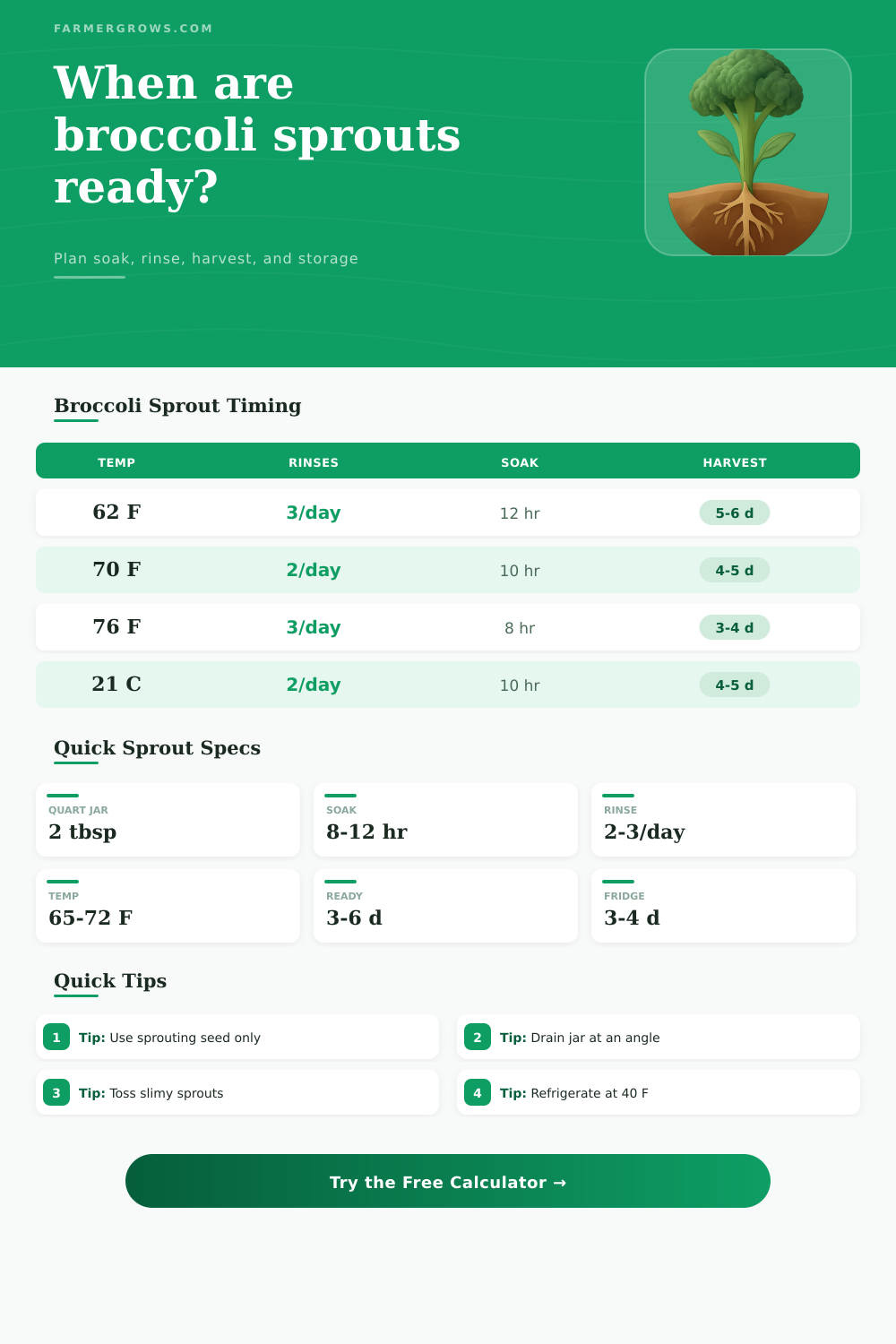
This planner is for true broccoli sprouts grown from sprouting seed in a moist jar or tray, not broccoli microgreens grown on media. It models the normal 3 to 6 day sprout window, seed expansion, rinse workload, final hull rinse, drying time, and refrigeration life.
Your Broccoli Sprout Plan
Enter your seed, rinse, and room conditions to estimate the harvest window.
| Container | Comfortable broccoli seed load | Typical fresh yield | Best use | Watch point |
|---|---|---|---|---|
| Wide-mouth pint jar | 1 tablespoon, about 10 g | 2.5 to 3.5 oz | Single eater or first test batch | Fills quickly once roots tangle |
| Wide-mouth quart jar | 2 tablespoons, about 20 g | 5 to 7 oz | Standard home broccoli sprout batch | Drain angle matters after day 2 |
| Half-gallon jar | 4 tablespoons, about 40 g | 10 to 14 oz | Family batch or meal prep | Shake gently to open the center |
| Flat sprouting tray | 25 to 35 g per 10 x 10 area | 7 to 11 oz | Thin layer with stronger airflow | Edges can dry in strong airflow |
| Stack sprouter tray | 20 to 30 g per tier | 6 to 10 oz | Staggered batches | Middle trays can hold humidity |
| Room temperature | Timing effect | Rinse adjustment | Quality note | Calculator effect |
|---|---|---|---|---|
| Below 60 F / 16 C | Slow sprouting | Usually 2 to 3 times daily | Longer wet time can dull aroma | Adds 1.5 to 2.5 days |
| 60 to 64 F / 16 to 18 C | Cool but workable | Twice daily with full drain | Good flavor, slower tail growth | Adds about 1 day |
| 65 to 72 F / 18 to 22 C | Preferred home range | Twice daily baseline | Balanced speed and handling risk | Baseline timing |
| 73 to 78 F / 23 to 26 C | Fast growth | Three times daily is safer | Needs better airflow and drainage | Shortens 0.4 to 0.8 days |
| Above 78 F / 26 C | Too warm for casual batching | Three to four times daily | Discard if odor, slime, or mold appears | Raises safety risk |
| Stage | Usual timing | Broccoli sprout task | Good sign | Concern sign |
|---|---|---|---|---|
| Initial soak | 8 to 12 hours | Cover seed with cool or lukewarm water | Seeds swell evenly | Soak smell turns sour |
| Day 1 to 2 | After first drain | Rinse, swirl gently, drain at an angle | Small tails appear | Seeds sit in a puddle |
| Day 3 to 5 | Fast root and shoot growth | Keep sprouts damp, not submerged | Fresh broccoli aroma | Musty odor or slime |
| Final rinse | Harvest day | Float hulls in a bowl and skim | Hulls separate from sprouts | Broken, mushy sprouts |
| Storage | After drying | Chill in a clean container | Dry exterior, crisp texture | Condensation or off odor |
| Factor | Lower risk practice | Higher risk practice | Why it matters | Calculator use |
|---|---|---|---|---|
| Seed source | Seed sold for sprouting | Garden seed or unknown lot | Sprout seed is intended for edible sprout use | Changes safety score |
| Sanitation | Clean jar plus seed sanitizing step | Reused screen with residue | Sprouts grow in warm, wet conditions | Changes safety score |
| Drainage | 45 degree angle and no puddle | Flat jar bottom after rinse | Standing water encourages spoilage | Changes fit and risk |
| Drying | Air-dry before chilling | Store dripping wet | Wet storage shortens quality life | Changes storage warning |
| Cold hold | 40 F / 4 C or below | Warm counter after harvest | Cold slows quality loss after sprouting | Sets use-by target |
Drainage tip: After every rinse, invert the jar at an angle so water can leave the seed mass. Broccoli sprouts should stay damp, not sit in pooled water.
Harvest tip: Finish with a bowl rinse to float away seed hulls, then dry the sprouts before refrigerating. Dry exterior leaves keep better than wet clumps.
Safety tip: Discard the batch if you see slime, mold, or smell musty, sour, or rotten odor. This calculator is a planning tool, not a microbial test.
Batching tip: Start smaller than the container limit on your first run. Broccoli seed expands quickly, and crowded jars are harder to rinse and drain well.
We all know it’s going to happen, every single time you start a new batch of broccoli sprouts for the very first time. There you are staring into the jar, hoping for billowy clouds of green, only to see a thick layer of seeds that stink like an old gym sock. It seems that nearly everyone out there starts sprouting with the best of intentions, but timing is often bad.
Three factors (temperature, rinse frequency, and drainage angle) typically determines if they will become delicious, crunchy, sulfurous bites we dream about, or whether they turn to compost-bin fodder. Because most home gardeners simply guess at these figures, this little tool aims to take the guessing out of what you grow in your kitchen counter tests.
How to Grow Perfect Broccoli Sprouts
Broccoli seeds are problematic because when you rehydrate them, they balloon big-time. One tablespoon of dry seed swells to quite a lot, and when you jam-pack a quart jar, as I have been known to do, water gets trapped in the middle. Water = bacteria, and bacteria = slimy sprouts. That’s where the calculator comes in.
It figures the math for you by comparing your number of seeds to the container you’re using. Then, it spits out a fit score to show whether or not you’re overdoing it on seed and suffocating the batch. It’s not just how much space they take up, but how they’ll be able to air out between soaks. Seeds can’t breathe? They’ll rot from inside out long before they even have a chance to develop their true flavor.
The other key factor in this equation is temperature. Warm kitchens speed things along, and heat does too! Warmer temps cause faster spoilage as well. Cool pantries slow things way down (potentialy too far down). To show that, there’s a reference table on the page, which illustrates how harvest window changes with room temperature.
If it’s warmer than 75 degrees in your home, you’ll want to soak the seeds less (to avoid heat stress) and rinse more frequently. Cooler temperatures mean you can expand the schedule (because the seed’s metabolism slows), but don’t overdo it or those sprouts will be mushy. These temperature changes adjusts the estimated day of harvest to help you know just when to pull them up, not before they get bland, but not after they’re mushy.
Most people mess up here, because they’re lazy (or, frankly, proud). At least twice per day, and sometimes three if it’s hot out, you need to thoroughly rinse and drain. And yes, the angle of your jar does matter. How steeply do you tilt it? I tilt mine far enough to ensure water runs completely clear and doesn’t pool around on my mesh lid. Even a little standing water provide a breeding ground for germs in the dark, wet conditions that sprouts adore.
Your drain angle and how frequently you rinse is considered by the calculator, which calculates your safety score… A risk assessment of your handling routine. It tells you that cleanliness is essential; it is foundation of edible results.
Then it’s time to harvest; and make your choice: What exactly do you hope to harvest? Ideally, roots are well-formed (and the tops haven’t been allowed to go too limp). And what about timing, when are the seed hulls too firmly attached to that matted mess? To separate out the hulls, I rinse them one more time in a bowl; the water carries most of the hulls away, leaving me with just tender, hull-free shoots.
Then comes drying. Moisture is not your friend; if you put wet sprouts into refrigerator, they won’t last long. The tool calculates an “expiration” (use by) date. It assumes that you chill them at forty degrees or below F as soon after drying as possible. This slows down any growth, preserves their freshness, and keeps them crisp.
Growing broccoli sprouts isn’t so much a skill as it is a discipline of following a process. It’s a closed system that requires maintenance… Hydration, temperature control, and keeping the growing environment clean. Once you understand that everything inside the jar is small environment that needs to be balanced, the process will become second nature.
Though the calculator (above) will give you the exact numbers based off your set up, the true art lies in watching your sprouts’ response to minor variations in process. Be aggressive with draining, go easy on the seeds at first and follow your nose. Sweet and earthy? Good job! Slimy and/or sour? Toss and repeat. That rinse-and-repeat learning curve would of been your best teacher.