Okra Plant Spacing Calculator
Estimate okra rows, final plant count, seed needs, usable growing area, and harvest potential for raised beds, garden blocks, containers, high tunnels, and field rows.
Use the calculator for spacing plans before sowing or transplanting. Okra grows tall, roots deeply, and needs picking access, so row width, in-row spacing, margins, and expected stand loss all matter.
Okra Spacing Plan
Results count rows and plants from usable bed dimensions, margins, row spacing, in-row spacing, seed rate, germination, and stand survival.
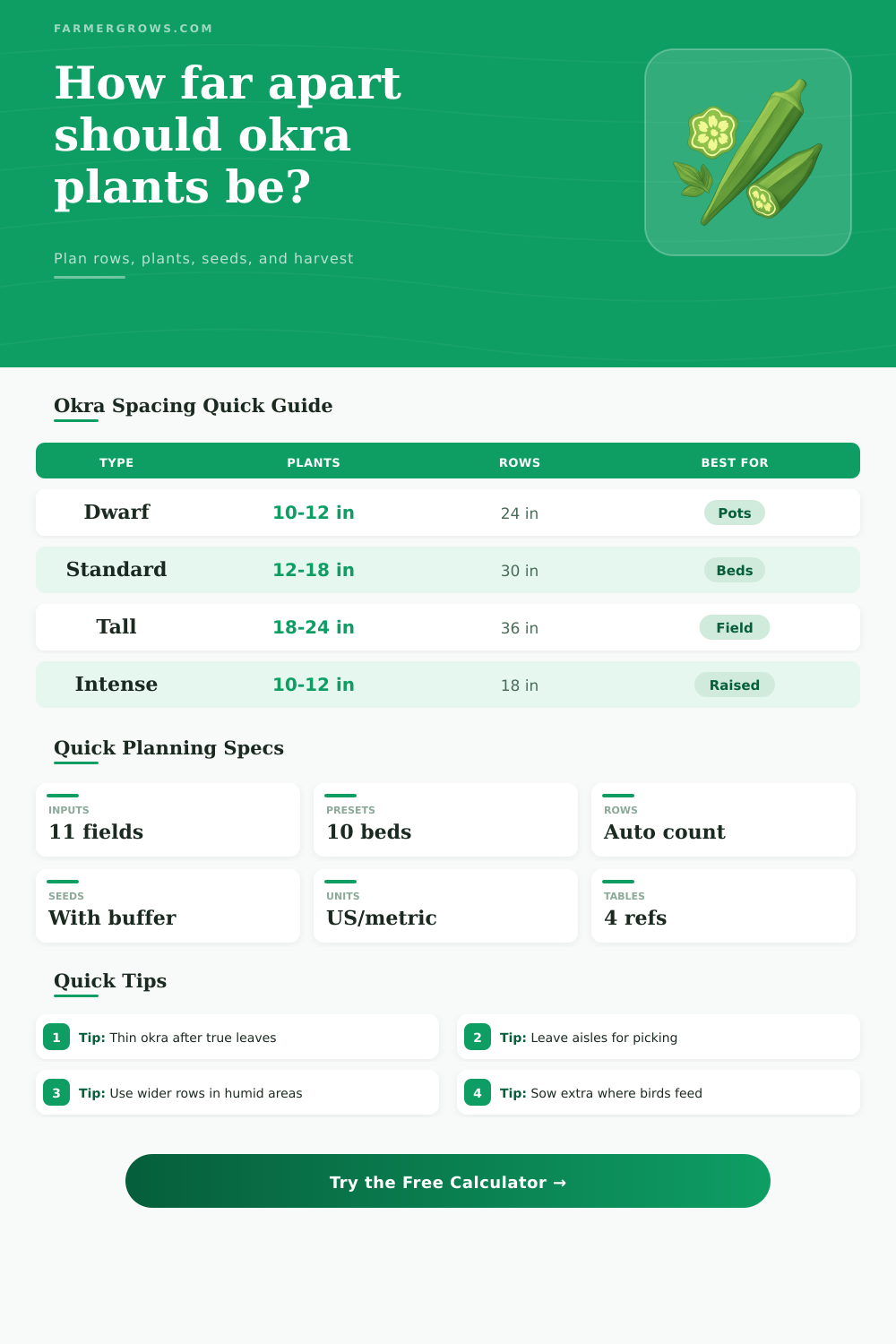
| Okra type | Plant spacing | Row spacing | Plants per 100 sq ft | Best use |
|---|---|---|---|---|
| Dwarf or patio | 10 to 12 in | 18 to 24 in | 50 to 80 | Large containers, small beds, wind-prone gardens |
| Standard garden | 12 to 18 in | 24 to 36 in | 22 to 50 | Home gardens with hand harvest access |
| Tall branching | 18 to 24 in | 36 to 42 in | 12 to 22 | Long-season plants with strong side branches |
| Market harvest | 12 to 15 in | 30 to 36 in | 27 to 40 | Frequent picking and straight row cultivation |
| Seed saving | 24 to 30 in | 36 to 48 in | 7 to 17 | Pods left to mature, more branch room needed |
| Bed width | 18 in rows | 24 in rows | 30 in rows | 36 in rows |
|---|---|---|---|---|
| 2 ft container strip | 1 row | 1 row | 1 row | 1 row |
| 3 ft narrow bed | 2 rows | 1 to 2 rows | 1 row | 1 row |
| 4 ft raised bed | 2 rows | 2 rows | 1 to 2 rows | 1 row |
| 5 ft broad bed | 3 rows | 2 rows | 2 rows | 1 to 2 rows |
| Field row strip | Use aisles | Use aisles | 1 row | 1 row |
| Row length | 12 in plants | 15 in plants | 18 in plants | 24 in plants |
|---|---|---|---|---|
| 8 ft row | 8 plants | 6 plants | 5 plants | 4 plants |
| 12 ft row | 12 plants | 9 plants | 8 plants | 6 plants |
| 30 ft row | 30 plants | 24 plants | 20 plants | 15 plants |
| 60 ft row | 60 plants | 48 plants | 40 plants | 30 plants |
| 100 ft row | 100 plants | 80 plants | 66 plants | 50 plants |
| Planning factor | Conservative value | Typical value | Strong stand value | How to use it |
|---|---|---|---|---|
| Seed germination | 65% | 80% | 90% | Use lower values for old seed or cool soil |
| Seedling survival | 75% | 90% | 95% | Accounts for thinning, pests, gaps, and transplant loss |
| Seeds per station | 1 seed | 2 seeds | 3 seeds | Thin to one healthy plant after establishment |
| Harvest season | 4 weeks | 8 weeks | 12 weeks | Warm climates and regular picking extend production |
| Yield per plant | 0.7 lb | 1.5 lb | 3.0 lb | Variety, heat, picking frequency, and soil fertility matter |
For humid gardens: Choose the wider end of the spacing range. Okra can handle heat, but dense foliage traps moisture and makes picking harder.
For direct sowing: Sow extra seed at each station, then thin to one sturdy plant. The calculator separates final plants from seed needed.
You may start with nice, evenly-spaced okra plants, but in three weeks, five-foot-tall plants will be competing for sun. Why do so many gardeners start with tight quarters when okra want plenty of room, plus lots of air flow and warmth? The right number of seeds (and thus also the right number of plants) isn’t obvious, though, unless you use the calculator up top, which turns abstract measures of inches and feet into concrete ones of actualy seed packets and numbers of plant to sow. Knowing why those numbers translate makes all the difference between having a failed crop whose spacing kept it from producing its best.
Okra’s challenge is the gap between seed packet size and garden space. You plant in big areas; you think in little ones. Dwarf varieties notwithstanding, they still require air circulation around their trunks or the foliage may rot (a particular problem in humid climates where moisture linger overnight). Are there too many plants planted too closely together? Their lower leaves goes dark and rot and drop by the time any pods has formed. We think about how many plants we can squeeze into a spot rather than how to best grow a plant in it.
Why Okra Needs Space
Keep in mind: You don’t have to enter only what you’ll sow at first; account for all stages of a plant’s lifecycle when figuring out how much space you have. “How many survive,” it asks (meaning after germination), along with germination rate. That matters. Some seeds are tough. Some aren’t. Even those can fail if birds don’t gobble them up or if soil conditions shifts, as they always do. You should of sow a couple of seeds per spot to ensure one makes it. If not, you’ll have some empty spots here and there, which waste space. The tool figures in those expected failures. Your bottom line number of plants represent how many will make it to harvest time.
Wider rows is good in growing okra, you might think wider rows waste space by reducing your plant count, but that’s just another place where intuition can mislead. You’ll be walking through these plants frequently picking tender pods before any are fibrous, since each one continue producing from July till frost. Narrower rows require bruising and damaging of outer leaves to get at those inner ones. And the damaged leaves stress the plant and invite pests. Give yourself some body room when harvesting by leaving a minimum of 30 inches between rows.
It’s not just a matter of getting variety to fit. The reference tables shows exactly how much space to leave between beds, though it also depend on what kind of soil you are working with. For example, if you have heavy clay and your soil retains moisture, provide extra wiggle room so the roots don’t rot. A bit closer is fine in good soil where drainage is better and suffocation is less of a danger. The calculator illustrates that balance for you, it shows you an estimate of how many pounds of produce you’ll get based off your given layout. That’s a lot easier to grasp than a theoretical concept like “spaced out enough,” since it’s translated into pounds of veggie.
Okra is a tall-season crop, meaning it take time and thought to get growing: You’re building a structure for months of heavy foliage (and lots of pods). Spacing makes all the difference. It means less tending, fewer weeds, easier harvesting, and more air circulation. This turns an overcrowded garden into a successful system where each plant get enough room and sun to reach its full potential. Trust the needed space, do the math, and let the plants fill in.