Ranunculus Bulb Bloom Time Calculator
Estimate first bloom, peak bloom, harvest span, chill adequacy, and expected stems for ranunculus corms planted in beds, tunnels, greenhouses, or containers.
Ranunculus timing varies with cool rooting, corm size, variety, protection, and heat pressure. Use this as a planning estimate, then adjust from your own farm notes after each planting.
Bloom Schedule Estimate
Dates are planning windows. Cold stalls, warm spells, saturated soil, and cultivar differences can move ranunculus bloom by one to three weeks.
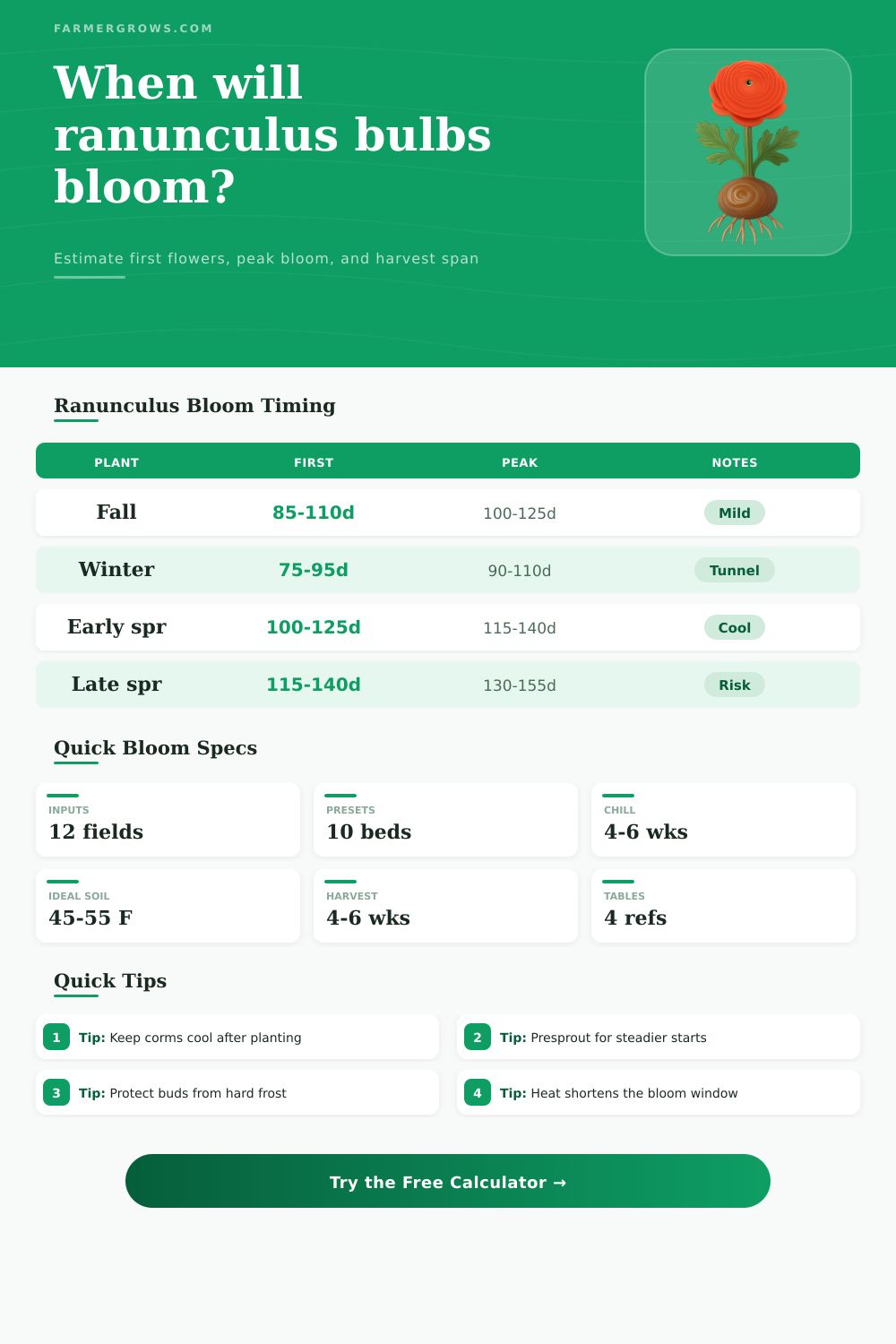
| Planting style | Typical first bloom | Peak bloom | Best use | Risk to watch |
|---|---|---|---|---|
| Fall planted, mild winter | 85 to 110 days | 100 to 125 days | Earliest cut flower harvests | Hard freezes without cover |
| Winter greenhouse | 75 to 95 days | 90 to 110 days | Protected florist production | Warm days and poor airflow |
| Early spring field | 100 to 125 days | 115 to 140 days | Cold climate outdoor beds | Late heat shortening stems |
| Late spring field | 115 to 140 days | 130 to 155 days | Trial plantings only | Heat and short harvest window |
| Forced pots | 65 to 85 days | 80 to 100 days | Benches, patios, small batches | Weak roots if started warm |
| Soil temperature | Timing effect | Rooting response | Management note |
|---|---|---|---|
| Below 38°F | Add 12 to 18 days | Slow or stalled | Wait for workable soil or use protection |
| 38 to 44°F | Add 5 to 9 days | Slow but useful | Good for cool rooting if beds drain well |
| 45 to 55°F | On schedule | Strong roots | Ideal planting and establishment range |
| 56 to 64°F | Add 5 to 12 days | Faster tops than roots | Shade, mulch lightly, and irrigate evenly |
| 65°F and warmer | Add 14 to 25 days | Heat stress likely | Bloom may be short or uneven |
| Corm grade | Stem estimate | Timing effect | Planning note |
|---|---|---|---|
| Small 2/3 cm | 2 to 4 stems | About 8 days slower | Useful for bedding or trials, less uniform |
| Standard 3/5 cm | 3 to 5 stems | Baseline | Common field production grade |
| Large 5/7 cm | 4 to 7 stems | About 5 days faster | Good balance for cut flower rows |
| Jumbo 7+ cm | 5 to 8 stems | About 8 days faster | Best for strong early crops if healthy |
| Spacing and bed | Corms per 50 ft | Typical stems | Best fit |
|---|---|---|---|
| 4 rows at 8 in | 300 corms | 1,050 to 1,500 | Airier garden beds |
| 4 rows at 6 in | 400 corms | 1,400 to 2,000 | Standard flower farm row |
| 5 rows at 6 in | 500 corms | 1,750 to 2,500 | High-yield tunnel beds |
| 6 rows at 6 in | 600 corms | 2,100 to 3,000 | Intensive protected growing |
For steadier bloom: Soak, pre-sprout cool, then plant once root nubs show. Avoid warm, wet starts because corms can rot before they root.
For longer harvest: Keep growth cool, vent tunnels on sunny days, and cut stems early in the morning as buds begin to color.
When your ranunculus send up foliage but never get around to flowering, you’re tempted to think you’ve done something wrong, or maybe even made yourself unpopular with the plants, which have waited all winter to see you again.
But truth about those corms belowground is what’s causing the confusion: They aren’t simply biding their time until spring. No, they need to build a root system, one that works best in cooler temperatures. Too-warm soil slows everything down; too-cold soil, and they go to sleep.
How to Grow Perfect Ranunculus
How do you hit that happy spot? It takes math. It uses chill hours and soil temperature as variables to produce a realistic estimate of your possible harvest date. It does not say “sometime after April” or “about June,” but provides actual dates, one for first bloom and another for peak. That makes a difference between success and failure in the business. The moment of that first bloom may bring me great satisfaction; but I need to know it was peak bloom so I could cut forty stems per hour, instead of one every twenty.
Okay, so when do I plant? That’s obvious. But how does soil affect things? The answer: Soil temperature also affects growth rate, and ranunculus loves to grow in cool soils (between 45-55 F). If the soil is too hot, he’ll start directing his efforts toward shoots (and not roots). Result: Tall but week plants that cannot hold up their heavy blooms.
The tool takes into account what the soil conditions are where you live. And adjusts accordingly. If you’ve got warm soil and plant late in October, it will nudge the bloom dates further out. It forces you to face facts…not buck them.
Another key detail is that many gardener don’t pay attention to chill hours. These corms like a cool period to come out of dormancy and really get going. If they don’t have enough chill, their flowers might be small or uneven. The calculator takes into account where you live relative to average chill hours, estimating how well it will grow in your area. It also advises whether it’s worth taking extra time pre-sprouting (which jump-starts root growth prior to planting). Pre-sprouting shortens the process. It also gives a better idea of when blooms will happen so you know if it will meet your target market date.
When is it time? Timing varies by corm size. Not only do larger corms yield larger flowers, but because they have higher stored energy, they bolt sooner. Small corms will delay their start, which extends the harvest period. Planting a mixture of sizes will help even out the cut-it-every-day workload. Planting all one size means that everything goes off simultaneously, followed by nada. The charts above show how these timings differ depending on your planting style.
For instance, fall-planted bulbs in milder areas mean an earlier crop. However, they may be prone to rot if soil doesn’t drain well.
With ranunculus, it’s less about forcing nature than it is planning for it. No amount of coaxing with a corm is going to make it bloom if the conditions aren’t right. But you also don’t have to wait in the dark, not knowing when things might fall into place. The calculator helps me see the bigger picture of my growing season. It makes guessing a thing of the past and making way for strategy. Knowing what to anticipate is how patience looks like silence underfoot. You no longer worry whether plants are alive or dead, but instead trust that they’re doing their work.