
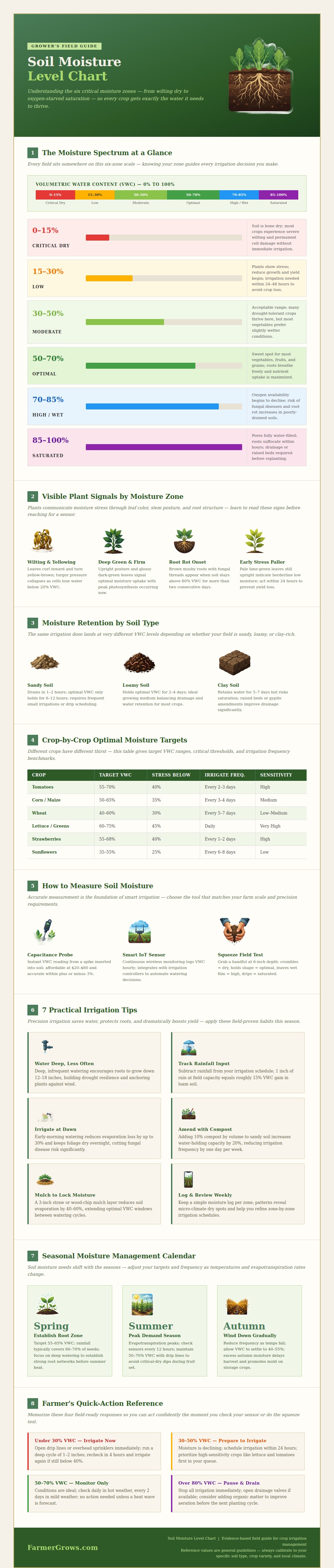
Are you drowning the plants? Or is your hose inadequate? That’s a question growers ask themselves every day: Are you doing enough with the hose, or too much? Water is pooling around the leaves and you worry they’ll rot. The leaves go dry, and now you’re worried they need more. Fact is, soil moisture isn’t just about being wet or dry. Soil moisture exist on a spectrum, and every percentage point is different, affecting what happens underground. Learning this range makes gardening with hoses a science, not a guessing game.
Here are six zones (the chart above), starting with critical dryness, then moving up to dangerous saturation. The narrow band of gold is where most folks want to be, though they don’t realize exactly how narrow it is. Fifty to seventy percent volumetric water content is the sweet spot. There is enough nutrients available and enough air in the root zone so that the roots can breathes. Seems like plenty of room there, doesn’t it? It sounds generous, but plants can swing wildly outside those bounds if you let them.
How to Water Your Plants Correctly
Below fifteen percent, you’re in critical dry territory. Cells collapse and internal water pressure fails. The damage is done long before the plant turns brown on the surface. And that’s what people miss. Wilting isn’t an early-warning sign: It’s a late-stage alarm bell. You don’t know your plants by their leaves alone. To read them, you’ve got to learn how they speak to you; specifically, the language of the soil below them.
An upright leaf with a pale, lime-green color says “I’m getting stressed out.” It hasn’t wilted. However, its moisture is rapidly depleting from reserve tanks. Do something in the next day or so and you’ll save its yield. If you sit back and watch it fail, it will never recover.
High moisture levels present their own set of silent killers. Once soil reaches an eighty-five percent capacity, water completely fills pores. Out goes oxygen. In go suffocating roots within hours, which become the perfect breeding ground for fungal rot. Giving plants water isn’t the only thing you give them. You also give them air.
Wherever you fall on this spectrum, know that the speed of drainage is based off your soil. Sandy soils will lose that all-important moisture within less than half a day so plan for repeated but small applications. Clay will retain moisture for days, sounds great, right?, unless there’s a deluge and then it will trap saturated soil right up against roots. The sweet spot is loam: the stuff that holds an ideal balance between fifty and seventy percent for days at a time.
If you have a clay- or sandy soil, consider yourself blessed (but also a bit cursed) and get out the amendments. Compost will help the structure of all soils. A 10-percent mixture by volume is enough to change how much water it holds. This could of potentially change your watering schedule altogether.
Accurate measurement beats guesswork. While smart sensors can automate decision making after you establish your baselines, you don’t have to spend much to begin. The old “squeeze test” is actualy pretty effective: grab a handful of soil six inches below the surface. Does it fall apart? It is dry. Does it hold its shape but feel cool to the touch? It is probably within your target zone. If it drips water when squeezed? You’ve overshot. You went further then you should.
For people who like their measurements digital, capacitance probes let you instantly see if you’re getting close to stressing plants. They are an inexpensive way to get immediate feedback that you haven’t gone too far.
Irrigation timing makes all the difference. Early morning is best. Watering then minimizes evaporation loss and lets plants dry off before dark. This cuts down on fungal diseases in particular. Deep, infrequent watering encourages roots to grow downward, while shallow sprinkling keeps roots near the surface where they dry out faster. Regular deep soakings like this help develop deeper root systems that better resist summer’s heat stress.
Don’t skimp on mulch, it helps hold moisture in place longer and extends the time between when watering is needed. Remember to keep track of how much rain you recieve, too. An inch of rain will add a large amount of water to loamy soils so you can miss one of those planned irrigation cycles with no penalty.
Tune in to the season: Springtime is about getting deep-root systems in place ahead of the heat. Summer means extra vigilance (highest water loss period). Fall’s a slow-down time to avoid moldy storage crops. Maintain an easy log of which zones are wet/dry. You’ll spot patterns fast; things you never knew were dry… and hone your timing.
Learn the spectrum. Trust the numbers. You’ll grow healthier crops that require far less fuss then you might think.