Garlic Scape Growth Time Calculator
Estimate hardneck garlic scape emergence, curl stage, best cutting date, bulb-size effect, and the final bulb harvest window from planting date, cultivar group, leaf stage, GDD, and spring field conditions.
This calculator is for true hardneck garlic scapes: the curling flower stalk that appears before bulb harvest. It is not a general garlic bulb growth planner and it excludes elephant garlic flower stalk timing.
📋Hardneck Scape Presets
🌿Hardneck Group and Scape Stage Grid
⚙Scape Timing Inputs
Garlic Scape Timing Results
Your hardneck scape timing estimate will appear here.
📈Scape Stage Quick Grid
📚Reference Tables
| Hardneck group | Typical scape timing | Best cutting stage | Expected bulb effect | Field note |
|---|---|---|---|---|
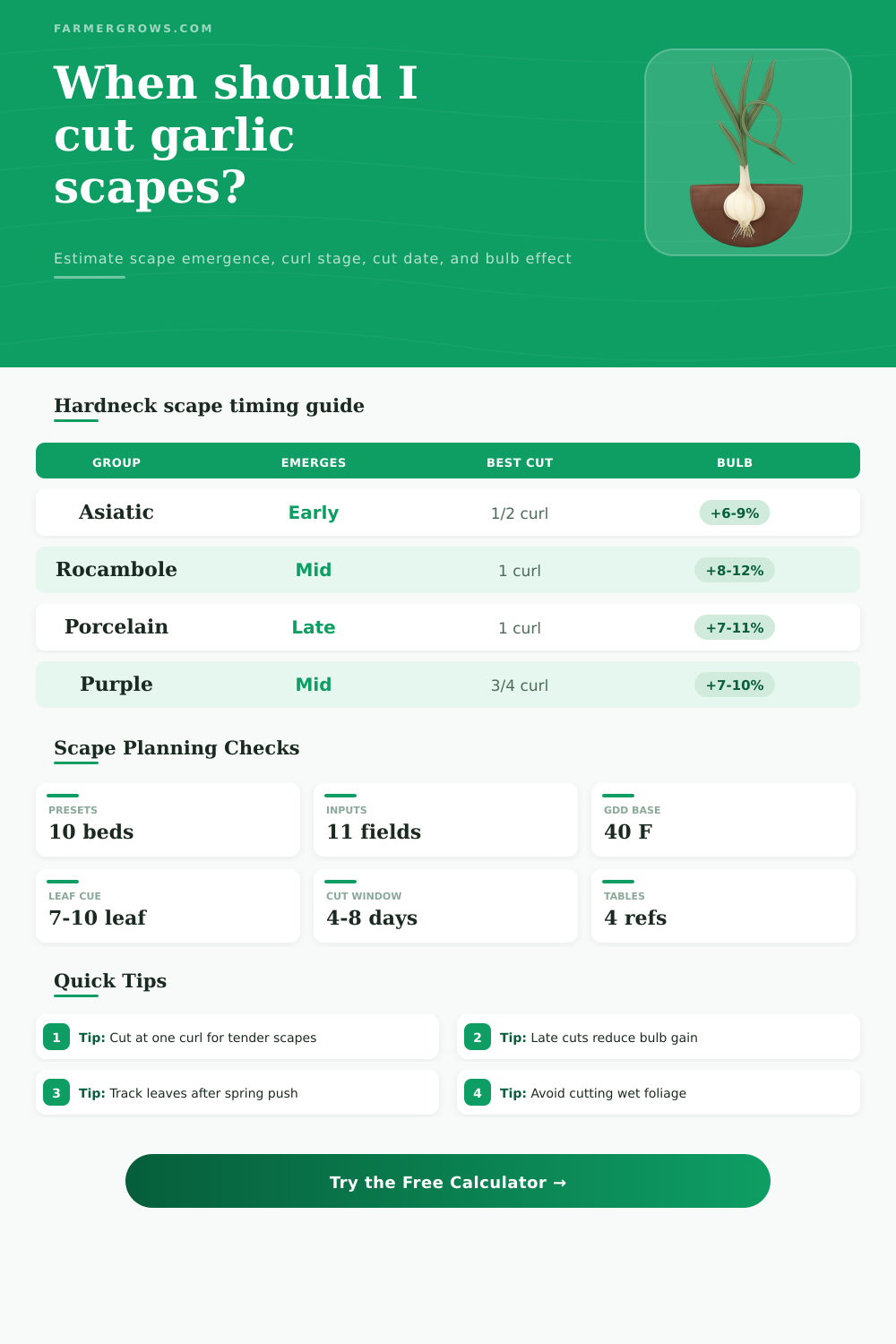
| Asiatic hardneck | Early, often quick after spring push | Hook to half curl | About 6% to 9% larger than leaving scapes | Do not wait for a dramatic loop in hot weather. |
| Rocambole hardneck | Midseason with strong curling | One curl | About 8% to 12% bulb-size support | Excellent eating quality at one loop. |
| Purple Stripe hardneck | Midseason, steady curl | Three-quarter to one curl | About 7% to 10% bulb-size support | Works well with two harvest passes. |
| Marbled Purple Stripe | Mid to late, thick stalks | One curl | About 8% to 11% bulb-size support | Large scapes can turn fibrous quickly. |
| Porcelain hardneck | Late and often tall | One curl, before straightening | About 7% to 11% bulb-size support | Thick stalks need a clean pull or cut. |
| Scape stage | Visual cue | Days to best cut | Kitchen quality | Bulb-size note |
|---|---|---|---|---|
| No scape visible | Only leaves and central stalk | Watch GDD and 7 to 9 leaf stage | Not ready | No cut yet; protect foliage. |
| Tip emerging | Pointed stalk above leaf whorl | Usually 4 to 8 days | Very tender but small | Cutting now gives less edible length. |
| Hook stage | Scape bends like a hook | Usually 2 to 5 days | Tender, mild, good for bunching | Fine for bulb-first growers. |
| Half to one curl | Loop forming or complete | Cut now or within a few days | Best balance of tender and size | Typical maximum bulb benefit window. |
| Straightening | Loop opens, stalk toughens | Cut immediately if removing | Fibrous lower stems | Bulb gain is reduced but still useful. |
| GDD and leaf cue | What it suggests | Scouting action | Cutting decision |
|---|---|---|---|
| Under 450 GDD, base 40°F | Usually pre-scape in many beds | Scout weekly | Do not cut unless tips are visible. |
| 450 to 650 GDD | Early scape watch for fast groups | Scout every 2 to 3 days | Asiatic and warm sites may start. |
| 650 to 850 GDD | Main scape emergence range | Scout every 1 to 2 days | Plan labor and bunch harvest. |
| 850 to 1050 GDD | Many beds are curling or ready | Cut tender curled stalks | Delay only if scapes are still short. |
| 7 to 10 green leaves | Common scape appearance band | Check central stalks | Use leaf count with GDD, not alone. |
| After cutting scapes | Typical interval | Bulb check | Harvest action |
|---|---|---|---|
| First week after cut | 0 to 7 days | Leaves should stay green and upright | Keep moisture even, avoid heavy nitrogen. |
| Bulb fill period | 14 to 28 days | Bulbs size while wrappers still form | Keep the bed from swinging dry to soaked. |
| Early harvest signal | About 25 to 35 days | Lower leaves begin browning | Test dig one plant if uncertain. |
| Main harvest signal | About 35 to 50 days | Several lower leaves brown, uppers green | Lift before wrappers split. |
| Late scape removal | Less than 25 days to harvest | Smaller bulb benefit | Cut only to improve harvest handling. |
💡Scape Cutting Tips
Scout in short intervals: Once the first scape tip appears, check the bed every day or two. A warm week can move a hardneck stand from hook to full curl quickly.
Keep bulb timing separate: Cutting scapes supports bulb fill, but bulb harvest still depends on leaf senescence, wrapper condition, moisture, and cultivar maturity.
Then there’s spring, when garlic growth gets notoriously unpredictable. October has passed since you tucked your hardneck cloves into the ground. You hoped all that winter would find them growing dormant under the frozen ground. Come May, though, those shoots can begin to cease feeding the bulb and push upward instead, preparing to bloom. Those are scapes.
They’re impossible to time: A swing in weather here or there (more days than more weeks) can make all the difference. Catching the scape in that tight sweet spot just as the loop has formed; but not yet, is tricky; once it gets really going down there, the lower portion of the scape go tough and fibrous. It is no good in a dish, and it is not helpful to the underground bulb either. It siphons energy off that developing bulb.
How to Harvest Garlic Scapes at the Right Time
The trick is getting that scape up out of there while it’s still tender, but not so long past that it shifts its focus completely to reproduction. How? Once you input your starting date (the day you see any leaves poking up) and your leaf count into the calculator above, the rest of the math are done for you. That means you won’t have to guess a date on the calendar anymore.
And why does it work? Because plants don’t grow according to dates; they grow according to growing degree days, gathered units of heat, which forms the backbone of such an estimate. To calculate that rate of accumulation (because thermal time accumulates faster or slower in each garden), you first set your zone and spring restart date. This sets your baseline for how quickly thermal time is accumulating in your particular microclimate.
Why should it matter? Two gardens 10 miles away can have their timing out of sync, with one sitting on a sunny slope and the other in a cold-air-draining valley. Such differences are included here, so the tool can predict the moment the scape tip emerges through the leaf whorl, then how long until it’s curled enough for harvest.
No, choosing which one of these groups (known as “cultivar” groups) won’t be easy. For example, if you get a Rocambole type, it will tend to make super-tight, dramatic loops that look great. But if a heat spike happens at mid-season when they first start emerging, those tight loops may also quickly turn tough.
Porcelains tend to come up later and build thicker stems. This makes them go woody faster in warm temperatures, so you’ll need to watch for an even narrower harvest window. Asiatics may emerge earlier and send up their flower stalks more slowly. However, you will need to check them sooner if you want to keep the bulbs as large as possible.
All that said, the table on the page spells out those subtleties, so you understand what each group does and don’t expect. It’s easy to make a mistake by treating every garlic like it’s following the same universal growth curve, but know yourself: Know your kind of garlic!
One important check-and-balance is to compare the temperature information with the number of leaves the plants have grown. Depending on vigor and strain, scapes typically form after the plants reaches between seven and ten green leaves. So if you’re counting five leaves and your GDD tally says they should already have emerged, it could mean that you had an odd weather event, maybe some late snow to set back the growth clock; or just that this particular strain is a relatively weak bolter (like Creole garlic).
Is it the other way around, with lots of leaves but not many visible scapes? That’s what the tool warns you about, so you don’t waste time waiting for stalks that will never materialize. Combining these two inputs, physical count of how many leaves are up, plus the calculation of total heat, makes for a stronger prediction different than any one input alone.
There is also a tradeoff to consider with the cut: you lose yield from the kitchen, but gain potential bulb size. By removing the scape, you send energy back down to the corm. Depending on when it’s done, that could result in up to a 12 percent bigger bulb at the end of the day. If you act early, the increase could be seven to twelve percent.
The tenderest cut would be at the halfway point between the bulb and the emerging flower stem, or at the hook… Though you’ll get a fair portion of those nutrients even if you just go ahead and trim off the flower once it’s half-curled. If you wait ’til the flower stalk is fully vertical, the plant will have spent so much of itself trying to grow a flower, and the bulbs won’t get as many benefits. Ideally, for both goals, most growers wants to remove them at about one full curl.
Moisture stress adds another layer of complexity. Even when temperatures are right, dry conditions can stunt scape growth and delay emergence, whereas too much moisture increases disease pressure which also impacts general plant health. To account for this, the calculator checks recent field conditions so that expectations can be adjusted upward (or downward) properly. A perfectly modeled thermal picture doesn’t mean squat if the roots are either parched or drowned. A little thing, but it adds up to better timing accuracy.
So, when do we scape? Basically, be patient and scout regularly. When those tips emerge, inspect your beds daily, or even more often if it is a hot year. Harvest as soon as possible so you still have delicious pesto material and hopefully some heavier bulbs by summertime. Planning with the tools helps, but what’s really key are your eyes in the field. That’s how to turn that wild spring surge into a controlled harvest rhythm.