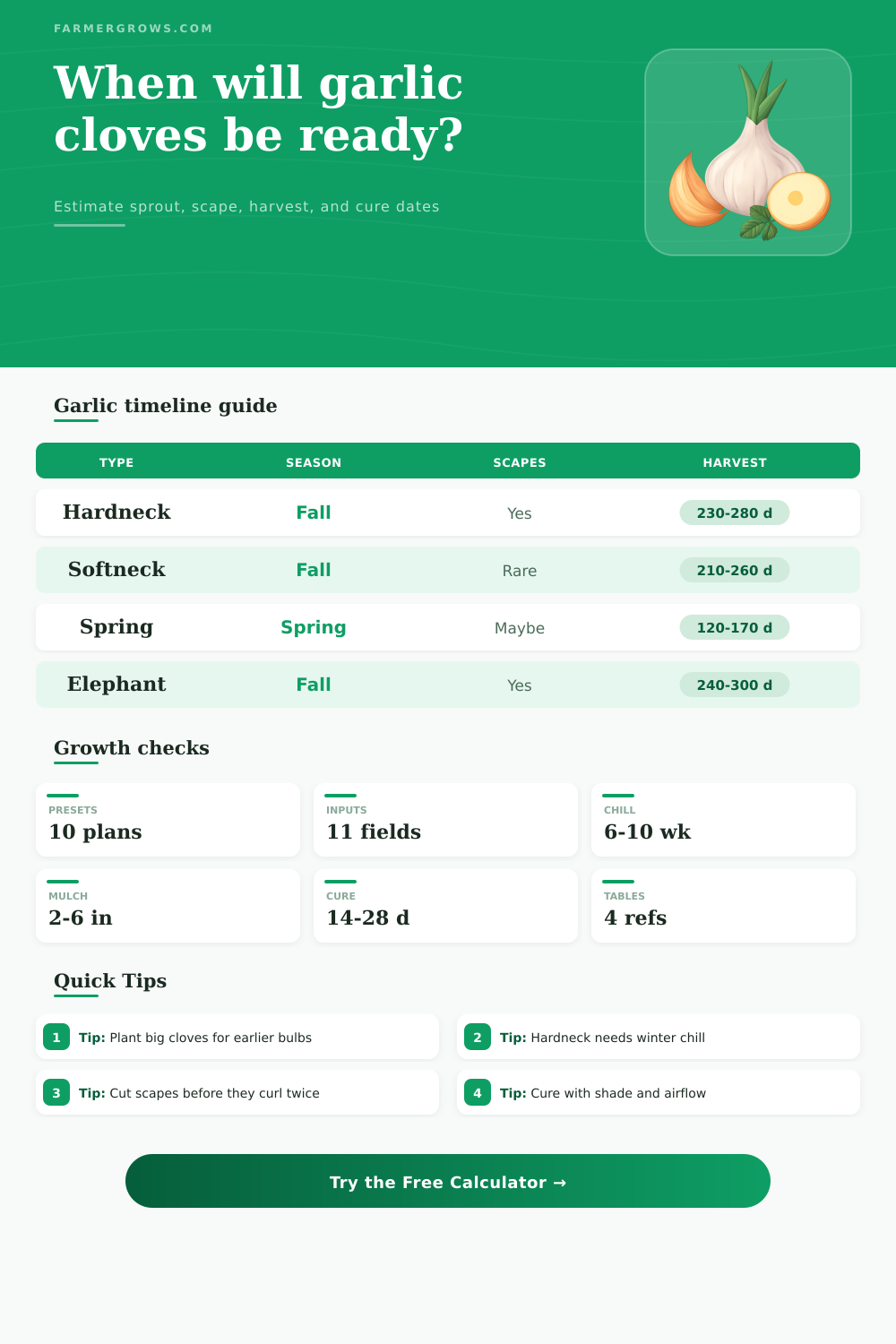
Garlic From Clove Growth Time Calculator
Estimate visible sprouting, hardneck scape timing, bulb harvest, and cure-complete dates from planting season, garlic type, zone, vernalization, clove size, mulch, and curing plans.
Choose a realistic garlic bed scenario, then tune dates and field conditions. Presets include cold-zone hardneck, mild-zone softneck, spring-planted cloves, elephant garlic, deep mulch, and storage-focused seed stock.
Garlic Growth Timeline Results
Your garlic clove schedule will appear here.
| Garlic type | Typical planting | Scape behavior | Harvest timing | Storage habit |
|---|---|---|---|---|
| Rocambole hardneck | Fall in cold zones | Reliable curled scapes | About 235 to 275 days fall planted | Rich flavor, moderate storage |
| Porcelain hardneck | Fall, deep winter mulch | Large scapes | About 245 to 285 days fall planted | Large cloves, solid storage |
| Artichoke softneck | Fall in mild zones | Rare scapes | About 210 to 255 days fall planted | Long storage and braiding |
| Creole or turban | Fall to winter in warm zones | Occasional weak scapes | About 205 to 245 days fall planted | Good warm-zone performance |
| Elephant garlic | Fall preferred | Produces tall scapes | About 250 to 300 days fall planted | Mild flavor, large bulbs |
| Zone band | Common planting window | Cold exposure | Mulch target | Timing note |
|---|---|---|---|---|
| Zones 3 to 4 | Late Sep to mid Oct | Plenty for hardneck | 4 to 6 inches | Deep mulch protects cloves from heaving. |
| Zones 5 to 6 | Mid Oct to early Nov | Usually enough | 3 to 5 inches | Plant after heat breaks but before freeze. |
| Zones 7 to 8 | Late Oct to Dec | Variable for hardneck | 2 to 4 inches | Softneck and prechilled hardneck both work. |
| Zones 9 to 10 | Nov to Jan | Often limited | 1 to 3 inches | Use softneck, creole, or refrigerated seed. |
| Spring planting | As soon as soil works | Prechill helps | 1 to 2 inches | Expect smaller bulbs if chill is short. |
| Stage | What to look for | Calendar clue | Action | Risk if missed |
|---|---|---|---|---|
| Sprouting | Green tips through mulch | 2 to 6 weeks after fall planting if warm | Leave mulch loose over shoots | Heavy crusting can slow emergence. |
| Spring push | Rapid leaf growth | After soil warms in spring | Feed lightly and keep even moisture | Dry beds reduce bulb sizing. |
| Scapes | Hardneck stalk curls | About 25 to 40 days before harvest | Cut while tender and curled once | Late cuts divert energy into flowers. |
| Bulb harvest | Lower leaves brown, upper leaves green | Late spring to midsummer | Lift gently and keep skins intact | Late harvest splits wrappers. |
| Curing | Necks dry and wrappers papery | 14 to 28 days after digging | Shade, airflow, no washing | Damp curing invites rot. |
| Step | Temperature | Air and light | Duration | Garlic-specific note |
|---|---|---|---|---|
| Field dry-down | Warm, dry day preferred | Keep out of harsh sun | Same day as harvest | Move bulbs under cover quickly. |
| Primary cure | 60 to 80°F | Shade with steady airflow | 14 to 28 days | Do not wash bulbs before curing. |
| Trim and sort | Room temperature | Dry work area | After necks dry | Save largest healthy bulbs for seed. |
| Softneck storage | 55 to 65°F | Dry, ventilated, dark | 6 to 10 months | Longest keeper group. |
| Hardneck storage | 50 to 60°F | Dry, ventilated, dark | 3 to 6 months | Use damaged bulbs first. |
If you’ve ever tried to grow garlic, you know your mental calendar gets it wrong about the timing. Yes, you tuck a clove into the ground in October, expecting something to happen…but then there’s just darkness and stillness out there in the garden until March pops up green shoots seemingly overnight. But in fact the shoots was waiting all winter long. Enter this handy dandy garlic calculator above. Plug in your zone. Add your estimate of how much cold you had (you do remember what kind of year it was?). Include type of garlic you planted and month you planted it. The rest of the math are done for you. No more guesstimating when to stop watering, or look for those scapes, or when to harvest and cure. Just get down to some hard dates.
There is not just one type of garlic, but many; each has its own temperament. Grow just the wrong ones (and grow them all alike) and you’ll be disappointed. For instance, hardnecks require some serious chill to wake up right. If you plant hardnecks in a Zone 9 where the winter isn’t realy that cold, you must pre-chill those plants in your fridge first. They sits around confused as the ground warms beyond their comfort zone. To reflect that, the tool enables entering vernalization weeks, telling it if the clove recieve the cold shock necessary to go on and divide into bulbs instead of simply growing tall stalks. Softnecks, meanwhile, are more accommodating to mild winters, and also mature slower. But there’s a tradeoff; they also keep longer in storage.
A Helpful Tool for Growing Garlic
How much mulch should you use? Few newbies knows the answer to this question. Thick layers of leaves or straw create a kind of blanket over the soil, moderating temperature. Extreme weather can cause freeze-thaw action to heave the cloves from their beds. This leave them vulnerable to rodent damage and rot. To account for the effect of mulched soil on your estimate of the sprout window, the calculator includes mulch as an input; once the roots start growing, insulation makes a difference. So does planting depth. Too-deep cloves may be unable to grow again when warmer days finally come; too-shallow ones will freeze. In general, about two and a half inches seems optimal for most Zones. Enough to protect but not so deep that they has to work hard to get up and at ’em.
Hardneck lovers: This is your sign of progress. The scapes (those curly green antennas that poke up in late spring or early summer) tell you the bulb has started to swell. They also show that the plant is moving on from leaf production. Removing them redirects the energy of the plant downward where you want it, in the soil. If you don’t cut them off, what happens? The bulb won’t get very big, because the energy goes toward making a flower instead. It is a simple energy transfer equation. You pick the scape (and use it for pesto or in stir-fries), and the garlic gets bigger as its reward. Get it right and you harvest the stalks before they get woody. However, don’t harvest too soon, so the bulbs still has plenty of time to plump up before their foliage begins to fade.
Most of us go wrong with the timing of the harvest, noting that intuition is not a reliable tool. If you dig too soon while there are still many green leaves, thinking they will all fall off, what happens next? The wrapper leaves have come off and the individual cloves show; they’re open to rotting. We want the top half of the plant to stay green while the bottom half turns brown. That’s a good sign it’s ready, as it has sized up as a bulb. If you dig too soon, you get many thin layers of wrap and tiny bulbs. Dug too late: no good storage life; sorry, garlic, but I messed up. The page explains when to harvest by linking changes in the color and number of leaves to a specific timeframe starting from your own start date; there are tables here.
The key to successful storage is curing. Pile freshly dug garlic up all moist and shapely in some dark corner of your basement right away, and what happens? It wants to get all moldy because it’s still plenty juicy. First, set it out in an airy, shady spot to dry for at least a couple of weeks, till the stems and necks are tight and papery. Trim off those roots and stems next; but not before! Skipping this step turns months of work into compost within weeks. The tool figures out how long before your cure is done, then you’ll really be ready to put it into seed stash or pantry.
Garlic has A SCHEDULE of its own, based off the daylength, the soil warmth, even the number of “chill” hours, and it’s a time that doesn’t correspond to any human calendar. It’s simply up to us to listen to what our garlic has to say (as opposed to trying to make it tick along with the clock). If we think of winter as an active period of dormancy, not just passively waiting, we treat the bed differently. We don’t fret because there’s no activity; instead, we follow the leaf clues and trust in what’s going on under there. The biology’s always the same, though the timing depends on your conditions. Plant big cloves for extra-big bulbs. Water steadily throughout the bulb-bulking phase in spring. Then, step back and let nature do the heavy lifting. Just sit back and wait for the leaves to signal when they want something from you.