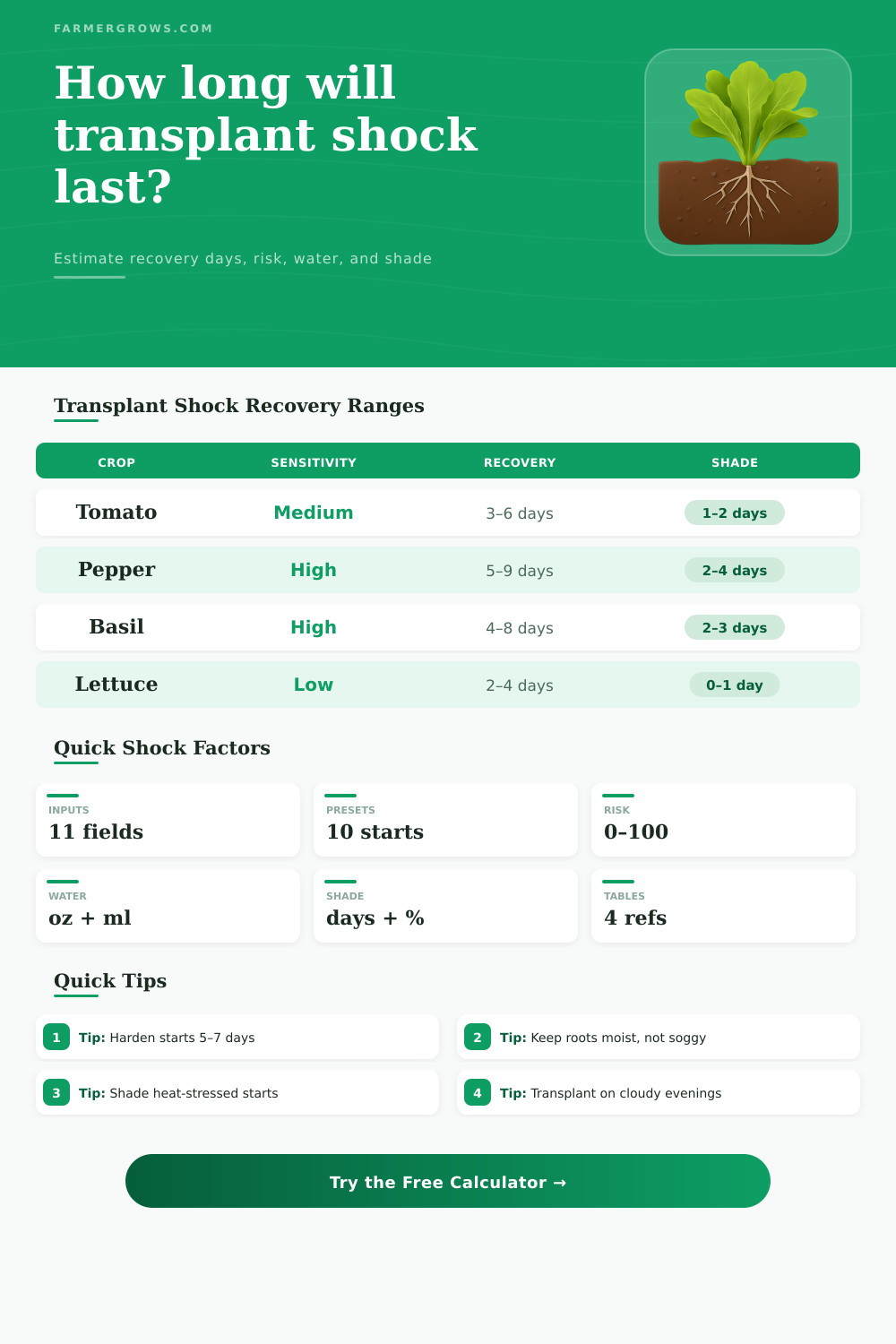
Transplant Shock Duration Calculator
Estimate how many days vegetable and herb starts may need to perk up after planting, with risk scoring, watering rhythm, and a shade schedule based on crop sensitivity and root condition.
Use this as a planning guide for healthy starts going into prepared soil. Wilting from disease, frost injury, herbicide drift, or severe drought needs direct diagnosis rather than a recovery estimate.
Transplant Recovery Estimate
Adjust the inputs above to estimate shock duration, risk, watering, and shade timing.
| Crop or start | Sensitivity | Base recovery | Most important stress trigger |
|---|---|---|---|
| Tomato | Medium | 3 to 5 days | Cold soil and uneven watering |
| Pepper | High | 5 to 8 days | Cool nights below warm-season comfort |
| Basil | High | 4 to 7 days | Cold wind and chilly soil |
| Cucumber, squash, melon | Very high | 5 to 10 days | Root ball crumbling or vine age |
| Lettuce or romaine | Low | 2 to 4 days | Hot sun after a cool nursery period |
| Broccoli or cabbage | Low | 2 to 4 days | Oversized starts and dry plugs |
| Parsley or cilantro | Medium | 4 to 7 days | Deep root disturbance |
| Onion or leek | Low | 2 to 5 days | Drying before roots re-anchor |
| Root score | What it looks like | Recovery effect | Planting response |
|---|---|---|---|
| 1 | Loose white roots, mix holds lightly | Shortens shock by about 1 day | Set intact and water in gently |
| 2 | Filled plug, little circling | Neutral baseline | Normal transplant handling |
| 3 | Light circling at plug edge | Adds about 1 day | Open edge roots only if needed |
| 4 | Firm ball with visible circling | Adds 2 to 3 days | Loosen edge and monitor moisture |
| 5 | Pot-bound, matted, or torn roots | Adds 4 or more days | Shade and water carefully while new roots form |
| Condition | Low shock range | Moderate shock range | High shock range |
|---|---|---|---|
| Hardening-off time | 6 to 10 days | 3 to 5 days | 0 to 2 days |
| Temperature swing | 0 to 10°F | 11 to 20°F | Over 20°F |
| Sun exposure change | Bright outdoor week | Partial outdoor week | Indoor direct to full sun |
| Wind exposure | Sheltered or light breeze | Open bed breeze | Hot, drying wind |
| Risk score | Water rhythm | Shade cloth | When to back off |
|---|---|---|---|
| 0 to 25 | Water in once, check next day | Usually none or 1 bright afternoon | Leaves remain upright by morning |
| 26 to 50 | Check daily for 3 days | 30% cloth for 1 to 2 days | New growth or steady leaf angle |
| 51 to 75 | Check morning and evening in heat | 30% to 40% cloth for 3 to 4 days | Wilting stops after watering window |
| 76 to 100 | Small drinks, avoid soggy soil | 40% to 50% cloth for 4 to 6 days | Roots anchor and midday flagging fades |
Water by feel, not the calendar. A wilted transplant can be dry, overheated, or oxygen-starved from saturated soil. Check the root-zone moisture before adding more water.
Remove shade gradually. If leaves stand upright in the morning but flag in hot sun, reduce shade hours before removing cloth completely.
Early spring transplant shock happen when seedlings droop once they are planted in the garden. Though you hardened them off just right and watered well, they appear weak by late afternoon. It is not a death sentence. More often than not, it’s a skirmish between greedy leaves and compromised roots, and it’ll pass, eventualy. The calculator helps you know how soon. It factors in weather exposure, root condition, and the crop’s sensitivity to stress.
Don’t panic, because that causes overwatering which is a bigger mistake than underwatering. The other key is root disturbance. Torn-out roots create more stress then leaving a plant in place with its own soil still attached. Cell packs holds the root ball together and also create less shock. Moving plants out of bigger pots that has their roots wrapped around the walls creates even more serious stress. That’s why you’re asked to rate root health with the tool.
Why Plants Look Weak After Planting
When the rootball is bound up tightly, it can’t take in water well right after planting. It takes some time to send out fresh feeder roots into surrounding area. In the meantime, it has to live on water rations.
Another variable in the acclimation process: Growers frequently rush things here, too. Two days of sheltered-porch exposure does not equal readiness. The calculator includes such prior outdoor time in its predictions. Proper hardening time mean thicker leaves and adjusted stomata that respond properly to lower humidity. Without that buffer, the sudden change in wind and sun causes rapid water loss.
Survival mode takes over when the plant shuts down its pores. No more growing so all appears to have stopped. The plant is just changing how it works.
Some species are realy touchy; others not so much. Broccoli and lettuce is hardy crops. Their roots are aggressive, even if cut or bruised slightly, and will often recover in a few days. Cucumbers and peppers do not do well. Delicate roots don’t like being disrupted once they’re growing. Even though a cucumber or pepper start may appear pitiful for a week (and then die), it’s building back up its infrastructure.
To set expectations, the reference tables indicates the range of what’s typical. So when your peppers go floppy on day five, it’s nothing unusual. Ditto with your lettuce, which hasn’t recovered by day four, it must be something else.
Most of us do this wrong: We water when we think something needs it instead of following a proper rhythm. And if it does need water, you have already poured too much because damaged roots cannot soak it up fast enough. They sits there in soaked excess wetness around their crowns and invite rot.
Water when the soil feels dry to touch, but do not water sooner than the calculator says you should of start again (based off starting moisture and pot size). You don’t want to have soaked it so thoroughly you’ve made an anaerobic mud of the soil; but you also want it thoroughly moist, so the roots are functioning.
And then there is shade cloth. Root systems needs fewer resources to catch up if 40 percent or more of the sun is blocked during the hottest part of the day. It’s not a large expense but it will buy some time. The calculator predicts how long to keep the shade up, taking into account temperature fluctuation and wind exposure.
Warmer nights promote recovery; cooler nights limit water use when plants aren’t active (but also limit growth). Be patient with this. Don’t push a plant to develop before it’s ready. It won’t happen. But that’s where the calculator comes into play, taking the guessing out of those nail-biting early days.
Observation is also an art. Look at your leaf in the AM: Is it firm? Good. Look again at noon. Is it beginning to wilt a bit but perk up again at night? Normal. Flat afterward? After water. Something’s not right. Believe your eyes. Wait for the roots to grab hold. Let them have breath and drink only what they need, and when they do, they’ll come around.