
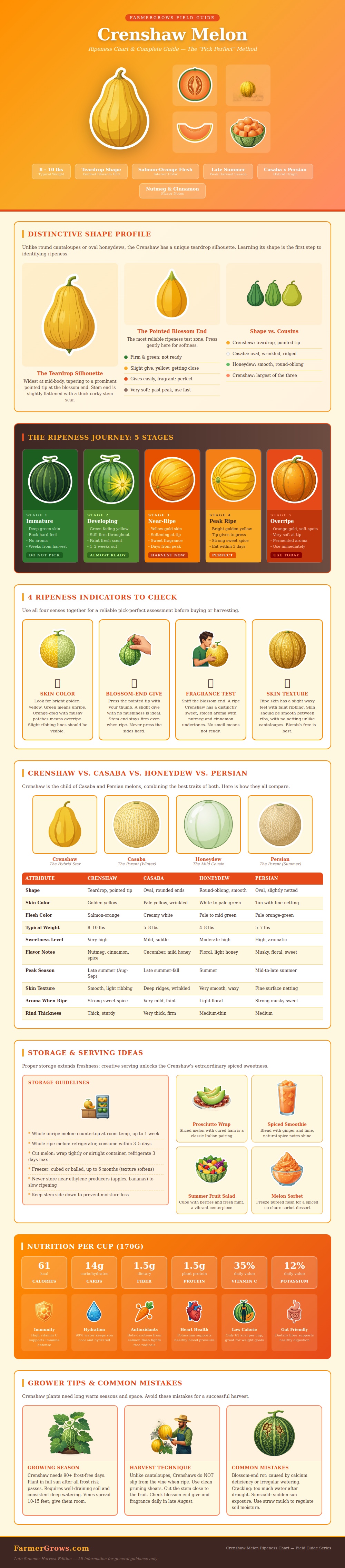
We all know that buying a melon and having it turn out to taste like slice of wet cardboard is one of our most common kitchen failures. Did you know there’s an exception to all the melon rules? Meet the Crenshaw melon, which are unlike any other cantaloupe in the way it looks or even how you come to know when its ripe. A cross between the Persian and Casaba melons, it share traits from both but uses its own signs for ripeness. Here’s what you need to look for to know when your Crenshaw is ready to eat.
So what does a Crenshaw look like? Unlike other melons which are basically round, it’s more teardrop- or even pear-shaped, tapered toward a point on one end. That pointed blossom end (the opposite end of where you would eat), is key for judging ripeness. And forget about evenly soft all over; pay attention to the tip. Look at the visual guide below to see five stages of ripening, from hard green to golden peak. You don’t have to guess by sight. Just use your finger as well as your eye.
How to Pick a Ripe Crenshaw Melon
When testing for ripeness of fruits with texture (such as melons), many does it wrong: squeezing too hard, not knowing where to touch, etc. Try gently touching the tip end of melon with your thumb. Is it really rock-hard? Too bad, it’s not ripe yet and won’t taste good; put that one back on shelf. Does it give a bit when squeezed, but doesn’t feel squishy-mushy? Then you got yourself some melon.
Pale-green to rich golden yellow is the other change in the melons skin that also tell us that there are internal changes occurring. It’s a clue we can trust. Inside, the melon will turns a vivid salmon-orange. Another good sign to look out for with this type of melon is that they has a distinct, although mild smell: at the blossom end, a ripe Crenshaw smells spicy, even vaguely of cinnamon and nutmeg. No odor? Not ripe (yet). Alcohol/fermented-smelling? Too far along.
Compared to milder melons such as Honeydew, the Crenshaw really packs some punch when it come to fragrance; the flavor has ripened in all senses of the word. Home melon-growers often make a common error: they wait for the fruit to fall off the vine by itself. Since the Crenshaw doesn’t just drop and the stem doesn’t slip free, checking it yourself will be even more important. Trust what you smell and feel, not how well the fruit stick to the vine… To signal readiness.
When the melon gets to your house, there’s a small window when it’s really at its best. An unripe Crenshaw can sit in a coolish spot a couple of days more but when that top end begins to soften, when it smells right, put it in the fridge or slice into it now. Forty-eight hours after peaking, the texture starts to turn mealy instead of creamy. Storing the fruit properly matters too.
Because of the melons’ high water content, don’t expose them to air or they will dry out. If you’re going to halve it and not eat all at once, make sure to wrap up the rest of melon flesh really well. Also, store the entire melon separately from other fruits (like bananas or apples), which produce ethylene gas that’ll cause uneven spoilage. With proper care, the spiciness is balanced by sweetness. Eat the melon chilled, on its own, or pair it with some salty cured meat.
Knowing what to look for makes this more than a guessing game; it’s a handy skill that gets you a perfect bite each time. You should of looked for these signs earlier! Actually, it’s moddern advice for anyone wanting delicious fruit.