Jalapeno Pepper Growth Time Calculator
Estimate jalapeno germination, transplant timing, green harvest, full-color harvest, heat-unit progress, frost margin, plant count, and spacing pressure from real variety choices and garden conditions.
Pepper packet days usually count from transplant, not from dry seed. This planner separates germination, seedling age, transplant delay, soil temperature, harvest color, and fall frost so jalapeno timing feels closer to the garden bed.
Best when the season is short and you plan to pick firm green pods before full color.
Standard jalapeno types balance yield, wall thickness, heat, and predictable green maturity.
Mucho Nacho and Goliath need wider spacing and may ripen slower if crowded.
Specialty color choices change the picking target, so harvest color matters more than packet days.
Low-Scoville jalapenos are useful for salsa volume when heat tolerance is limited.
Your Jalapeno Growth Timeline
Results update after calculation.
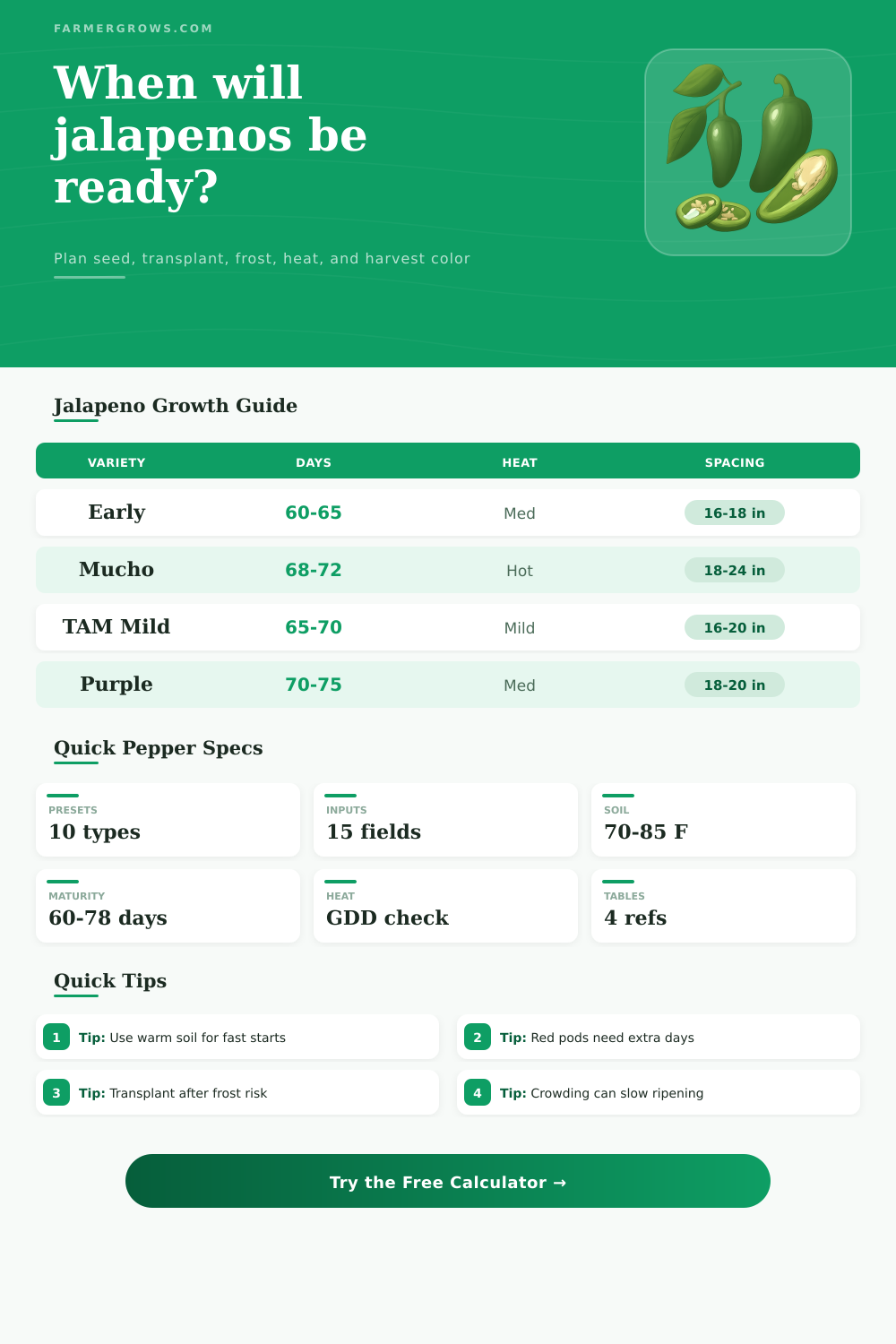
| Variety | Typical green maturity | Common use | Planning note |
|---|---|---|---|
| Early Jalapeno | 60-65 days from transplant | Short-season green pods | Good when first fall frost arrives early. |
| Jalapeno M | 70-75 days from transplant | Pickling, salsa, stuffing | Classic balanced jalapeno timing. |
| TAM Mild | 65-70 days from transplant | Mild fresh eating | Lower heat, still needs warm pepper weather. |
| Mucho Nacho | 68-72 days from transplant | Large pods and nachos | Give extra spacing for pod size and airflow. |
| Goliath Jalapeno | 72-78 days from transplant | Thick walls and stuffing | Large plants may color later in cool zones. |
| Jedi Jalapeno | 70-75 days from transplant | Uniform market harvest | Useful for steady green harvest scheduling. |
| Lemon Spice | 70-75 days from transplant | Yellow specialty pods | Use yellow target rather than red target. |
| Purple Jalapeno | 70-75 days from transplant | Colorful immature harvest | Purple stage can arrive before red ripeness. |
| Fooled You | 65-70 days from transplant | Heatless jalapeno flavor | Good for volume without much heat. |
| Craig's Grande | 75-80 days from transplant | Big roasting pods | Needs a generous frost buffer for ripe color. |
| Soil or tray temperature | Expected jalapeno germination | Growth effect | Planner adjustment |
|---|---|---|---|
| Below 55 F | Very slow or uneven | Seeds may sit and rot | Adds major delay warning. |
| 55-59 F | 18-24 days | Weak, patchy start | Use heat mat if possible. |
| 60-64 F | 12-18 days | Slow but workable | Adds cool-soil delay. |
| 65-69 F | 9-13 days | Acceptable start | Small delay only. |
| 70-79 F | 6-9 days | Good pepper range | Near normal timing. |
| 80-85 F | 5-7 days | Fastest common range | Best seed-start setting. |
| 86-90 F | 7-10 days | Can become stressful | Watch drying trays. |
| Above 90 F | Uneven or delayed | Heat stress risk | Adds heat-stress warning. |
| Planting style | In-row spacing | Row spacing | Timing and care note |
|---|---|---|---|
| Compact patio bed | 14-16 in | 24-30 in | Works for smaller types with careful watering. |
| Standard garden row | 18 in | 30-36 in | Good balance for most jalapenos. |
| Large pod types | 20-24 in | 36 in | Helps Mucho Nacho and Goliath size up. |
| Hot humid climate | 20-24 in | 36-42 in | Better airflow can reduce disease pressure. |
| Containers | 1 plant per 3-5 gal | Separate pots | Timing depends heavily on watering consistency. |
| High tunnel row | 16-20 in | 30-36 in | Warm nights can speed early harvest. |
| Variety | Green harvest estimate | Full color add-on | Typical heat range |
|---|---|---|---|
| Early Jalapeno | 60-65 days | 14-20 more days | 2,500-5,000 SHU |
| Jalapeno M | 70-75 days | 18-24 more days | 2,500-8,000 SHU |
| TAM Mild | 65-70 days | 16-22 more days | 1,000-3,500 SHU |
| Mucho Nacho | 68-72 days | 18-24 more days | 4,000-6,500 SHU |
| Goliath Jalapeno | 72-78 days | 20-26 more days | 4,000-6,000 SHU |
| Jedi Jalapeno | 70-75 days | 18-24 more days | 2,500-6,000 SHU |
| Lemon Spice | 70-75 days | Yellow at maturity | 2,500-8,000 SHU |
| Purple Jalapeno | 70-75 days | Red after purple | 2,500-8,000 SHU |
| Fooled You | 65-70 days | 16-22 more days | 0-500 SHU |
| Craig's Grande | 75-80 days | 20-28 more days | 2,500-5,000 SHU |
If the packet says 70 days, treat that as transplant-to-green-harvest unless the seed source says otherwise. Indoor seed adds germination time plus seedling time before that clock really starts.
Green jalapenos can be harvested earlier, but red, yellow, or mixed harvest goals need extra warm days. In short-season gardens, pick some green pods first and leave healthy plants to color.
When you plant your jalapeno peppers, know that the timetable printed on the seed packet is typically counted from transplant time, but realy it gets started weeks prior with seed sowing and then seedling growth. Add to that frost dates (or soil temperature); add to that color of ripe fruit at harvest; and also subtract when first cool night comes. And the pods remains green. It is a simple thing to underestimate.
The warmer, the better. Peppers germinate very slowly below 60 degrees. Most germinate in a week or less when the soil are warm, around the mid-seventies. And then that initial delay accumulates with compounding effect: A ten-day delay in transplanting due to a cool beginning shorten the window for full color later. So how does that play out? Just plug in what temperature your growing medium actualy was and if/when you used a heat mat, and let the calculator (above) crunch those numbers for you. It will show you just how many days an earlier green harvest might be.
How to Time Your Jalapeno Harvest
The main timing pitfall is transplantation. Some people transplant too early; others are waiting till May and finds the soil still too cold to get things growing well. It’s not just the frost-safe date, but the fact that the soil must stay warm enough, above sixty-five degrees. To promote good root development. The countdown clocks used in seed company advertisements don’t start ticking until then.
Another time element is harvest color. While you might pick your green jalapenos on the date on the pack, they’ll require more days of warmth to turn red (or purple or yellow). When it seems like a long season in June it’s easy to forget to add that extra time. Often in shortening seasons, the practical approach is to leave best plants to color, picking some of the other as green pods for now use. The color step actually cost you how many days? And do you have enough margin left before your first frost according to the calculator?
It’s counterintuitive, but ripening is more dependent on plant count and row spacing different than you’d think. Wide-spaced plants will be done sooner because they has room to reach their full potential without competition. Close-planted ones take longer because there is less air circulation between them. Tables of suggested spacing (along with other details) is on the page, where you can compare your planned layout against how soon each variety is ready.
A second check on calendar dates: Heat units. To fully mature and take on their coloring, peppers requires some number of growing degree days. Last year, for example, your 70-day variety might have finished on schedule; this year it could of been an 85 if your daily average is less than target. Watching accumulated heat compared to your target helps account for how variable results can be from one season to another.
And then there’s frost margin. What seems like a great plan on paper won’t work out if the first fall frost occurs while your fruit are not yet at their best color. Allow yourself a two- or even three-week buffer, and you have room for cooler periods that will also delay ripening, but won’t harm the crop. In the end, timing jalapeños means aligning their requirements with actual soil-bed conditions, not assuming that the packet date will apply. Treating frost date and color desires and transplant timing, for instance as pieces of a series makes managing the plants easier, and the harvest more predictable.