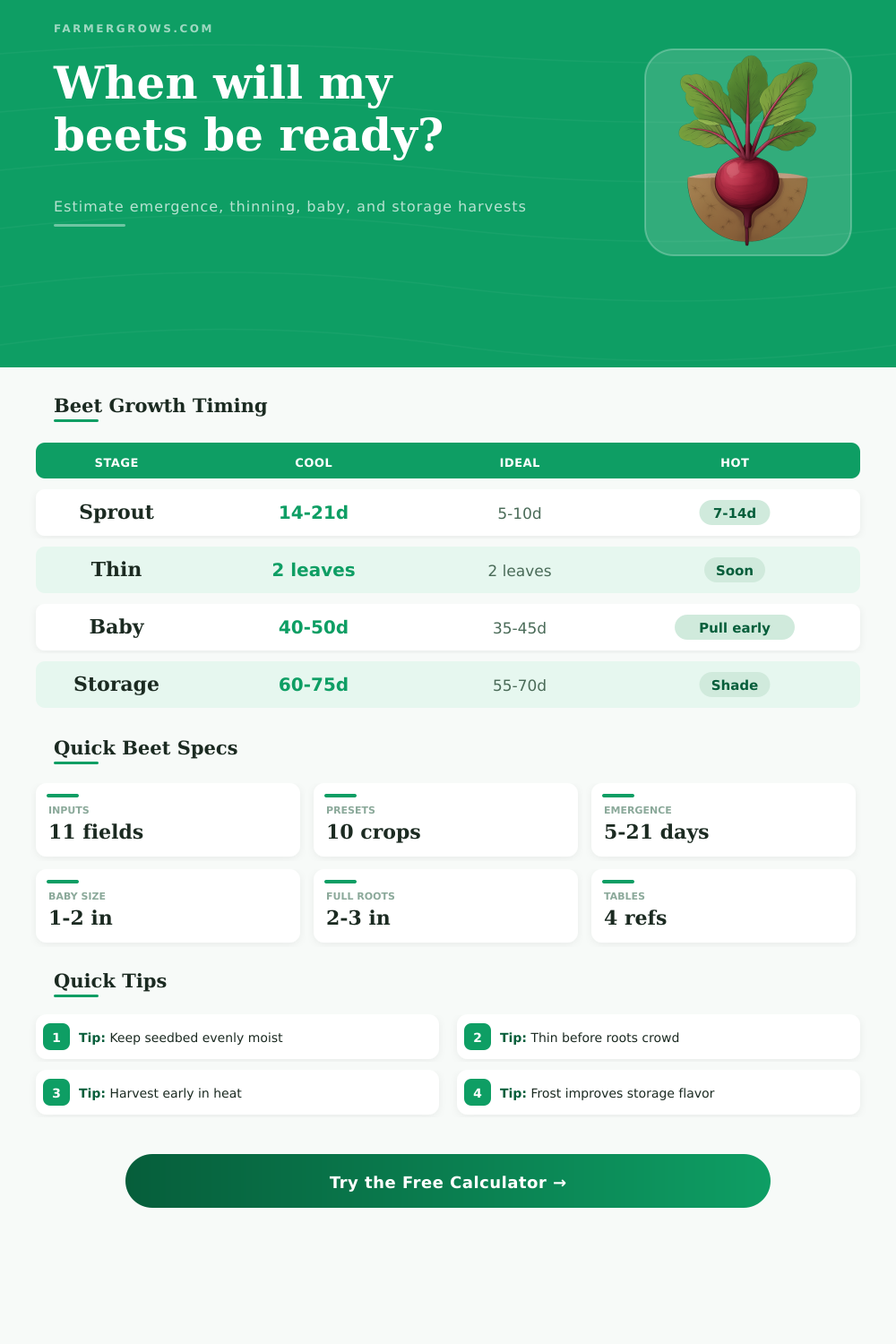
Beet Growth Time Calculator
Estimate beet emergence, thinning, baby beet harvest, and full root or storage harvest dates using variety maturity, soil temperature, spacing, moisture, zone, and seasonal pressure.
Beets can germinate in cool soil, but timing changes quickly with seedbed temperature and moisture. This calculator treats each beet seedball as a small cluster, so tight sowing and late thinning add real crowding pressure to the schedule.
Beet Growth Timeline
Dates update after calculation.
| Soil temperature | Expected emergence | Stand quality | Calculator adjustment |
|---|---|---|---|
| Below 40°F | Very slow or uneven | High rot and gap risk | Adds 12 or more days and shows warning |
| 40 to 44°F | 14 to 21 days | Possible but slow | Adds cool-soil delay to harvest dates |
| 45 to 49°F | 10 to 16 days | Usable early sowing range | Adds a modest cool delay |
| 50 to 59°F | 7 to 12 days | Strong spring germination | Near baseline timing |
| 60 to 75°F | 5 to 8 days | Best speed and stand | Fastest emergence window |
| 76 to 85°F | 6 to 10 days | Fast but moisture sensitive | Adds heat-quality caution |
| Above 85°F | 9 to 14 days | Poor stand risk | Adds heat delay and early-pull warning |
| Variety | Baby roots | Full roots | Best use |
|---|---|---|---|
| Detroit Dark Red | 38 to 44 days | 55 to 60 days | Reliable table beet, spring or fall |
| Chioggia | 35 to 42 days | 52 to 58 days | Baby harvest and fresh slicing |
| Golden Beet | 38 to 46 days | 55 to 60 days | Mild fall roots and mixed bunches |
| Cylindra | 42 to 48 days | 58 to 65 days | Uniform slicing and storage rows |
| Bull's Blood | 30 to 40 days | 55 to 60 days | Greens first, roots later |
| Early Wonder | 32 to 38 days | 48 to 52 days | Fast succession and bunching |
| Lutz Green Leaf | 45 to 55 days | 65 to 75 days | Large roots and winter storage |
| Merlin | 34 to 40 days | 45 to 50 days | Uniform market bunching |
| Crop goal | Seed spacing | Final thinning | Seed depth | Row spacing |
|---|---|---|---|---|
| Micro greens or young tops | 0.5 to 1 in | Cut or thin at 2 in tall | 0.25 to 0.5 in | 4 to 8 in bands |
| Baby beets | 1 to 1.5 in | 1.5 to 2 in apart | 0.5 in | 8 to 12 in rows |
| Bunching roots | 1.5 to 2 in | 2 to 3 in apart | 0.5 in | 10 to 14 in rows |
| Full table roots | 2 to 3 in | 3 to 4 in apart | 0.5 to 0.75 in | 12 to 18 in rows |
| Storage roots | 3 to 4 in | 4 to 5 in apart | 0.5 to 1 in | 14 to 20 in rows |
| Harvest target | Root diameter | Texture cue | Storage note |
|---|---|---|---|
| Greens | No root target | Leaves 4 to 6 in tall | Cut lightly; keep crown alive |
| Baby beets | 1 to 1.5 in | Tender skin, small tops | Short holding, best fresh |
| Bunching beets | 1.5 to 2.5 in | Round shoulder visible | Trim tops to 1 in for holding |
| Full table beets | 2.5 to 3 in | Firm root, smooth shoulder | Good fridge storage if unwashed |
| Storage beets | 3 to 4 in | Firm, not woody or cracked | Lift before hard freeze; store humid and cold |
Moisture matters: Beet seedballs have a corky coat and often contain multiple seedlings. Keep the top half inch evenly damp until emergence, then thin before roots start pushing shoulder to shoulder.
Season fit matters: Spring beets can stall in cold soil, while summer heat can make roots tough. Fall and mild winter plantings often hold quality longer after light frost.
With beets, it’s all about right timing (and waiting). Wait until they’re ready to grow instead of sowing too soon and having seeds rot in cool ground before springing to life. Plant too late and by the time you gets around to eating them, roots are woody. Know not just when to start what, but exactly when things like germination or maturing happen in your area. The growth time calculator figures that out for you.
Every factor has an impact on the timing. How fast will a seed take up moisture and sprout into seedling, depending off soil temperature where it’s planted? Will its roots gets enough space to spread out, or are they crowded by neighbors preventing further growth? Is there consistent moisture, whether faster or slower, and does that affect not only the time it takes for things to start emerging but eventual quality of their roots? If you’re facing seasonal extremes like a late frost or a heat wave all of a sudden, what effect do those conditions has on how fast plants progress from tiny shoots to fully formed storage roots? Change one of these factors and the timeline either expands or shrinks.
Timing and Thinning Beets
The second thing most growers miss is thinning. Even when you think you’ve spaced your beets properly, beet seedballs usually result in several seedling per seedball. This means that while your bed may have looked well-spaced at planting time, it now just seems crowded with baby plants. If you wait too long to thin them, they will start to compete underground, roots tangle and don’t reach the diameter they’re supposed of. The calculator will tell you when’s the right moment.