
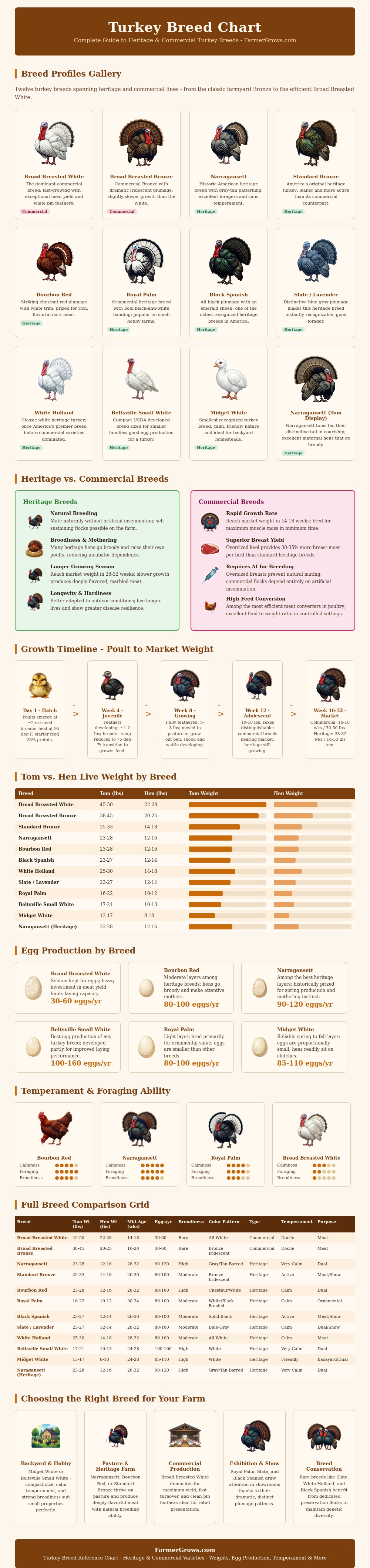
If you’re new to keeping turkeys, you’ll be surprised to find that there’s a lot of diversity among turkey breeds. Some breed have been developed for fast growth and maximum meat production. Others are well-suited to living in pastures, reproducing naturaly, and staying healthy without needing extra food or confinement. Understanding this difference is important, since one strategy may fit better with your desired end-use, timeline, and space requirements.
The chart’s top portion also provide an immediate glimpse into that spectrum of birds: Some are heavy commercial birds, bred to finish fast (and lose there own genetic makeup in the process). Others are heritage types that take longer to grow but retain more of there inherent behavior. Side-by-side comparison is helpful: It’ll allow you to imagine how each bird will really be best served when it come home with you.
Choosing Between Commercial and Heritage Turkeys
One picked primarily for meat production will call for a different approach to feeding and housing. Another might be selected based off its meat potential, its ability to forage, and its ability to lay eggs. Nonetheless, there are still some benefits to heritage breeds that commercial lines has abandoned. Most hens is content to set eggs and raise their own chicks without any help needed. They also remain relatively healthy if left to wander about, and will even mate themselves. Because they don’t need much help, it costs less time and money to maintain a flock that cannot survive on its own.
That’s where speed enters into it for the commercial birds, they come to table-ready size several weeks faster, and provide more breast meat per pound of feed than the heritage breeds. It’s a real trade-off where you lose your independence (you can no longer sustain the line yourself) to gain efficiency.
In the middle section, where we get concrete about time, is a chart of the growth stages. Poults require steady warmth, good feed (high protein), from day old onward. At eight weeks they’re feathered and ready for a bigger pen or pasture. At around sixteen to eighteen weeks, commercial birds is usually finished; heritage birds continue to grow for an additional couple of month.
How much feed do you stock? When will you be able to schedule a butcher date? How does that affect the taste of your meat; and how it cooks?
Egg production is divided similarly. You’ll get nearly a hundred eggs from each hen of some heritage breeds in a year. They’ll also be inclined toward going broody, at least if left unprompted. Many commercial birds don’t lay nearly as much; they’ve been bred not for reproduction but for muscle. The chart makes finding breeds with decent laying capacity obvious if that’s important to your plan.
More than most realize, temperament shows itself in day-to-day bird care. Calmer birds process more easily and are simpler to handle and inspect. Active foragers spend less money on feed because they get out and forage more and fare better on pasture. These characteristics has been given a number rating (the chart) that will allow you to pair them with your desired level of daily interaction.
What type of bird should you choose? That depends on which traits best match what you offer. Do you have a small area and desire to raise birds you can keep close to home? Smaller heritage breeds will suit you. Can you afford to care for them in a controlled environment and want the most meat in the quickest period of time? The commercial lines work well.
Heritage birds raised on pasture typically do best where they can scrounge around for themselves and cope with bad weather. Birds for showing or conservation flocks tend to have bold color patterns that stand out in an exhibition pen. Making the right decision means choosing the one appropriate for your available land, labor, and end use, not necessarily the one that appears most attractiv on paper. After finding a good fit there, caring for turkeys each day will be easier and more predictable.
You should of looked at the chart first to make sure you recieve everything you need.