
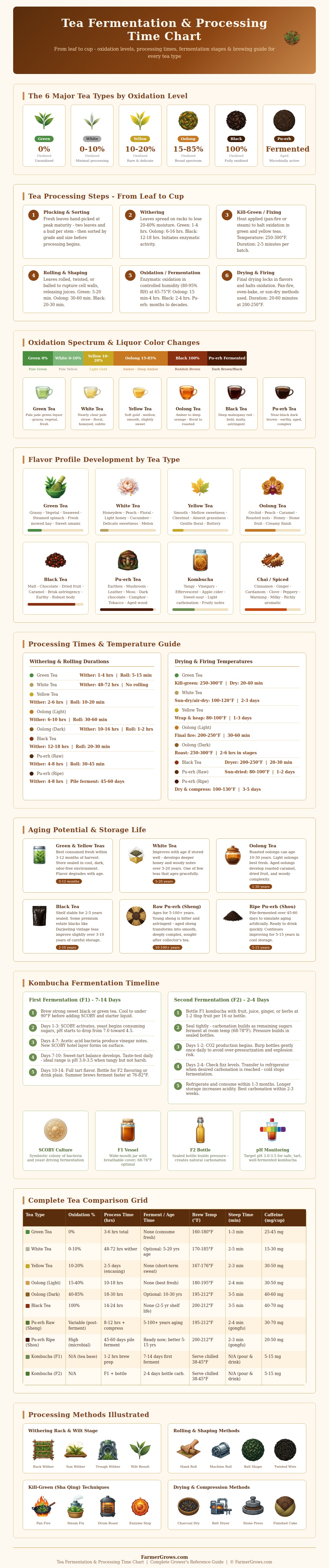
But then you consider all decisions that are made between leaf and cup, and it suddenley becomes clear: tea making isn’t so simple. Whether you’ve got a leather-like taste in your mouth or something grassy depend on how much time the tea spends withering, fermenting, or oxidizing. That spectrum of flavors is what the chart above maps out. It shows where each type of tea fall on the line of oxidation. It also shows how those choices impact color, flavor, and shelf life of finished tea.
Green tea will be most familiar to most folks, so they begin there, but it’s easy to overlook just how short window for making this stuff is. After harvest, those leaves must be immediately heated up to stop oxidation. If you skip that step entirely or wait a few hours to get them going, then the tea begins to edge toward something like an oolong. It becomes flatter-tasting without that bright, vegetal snap that distinguishes good green tea from the rest. And that’s exactly what makes freshness such a big deal with this style of tea. There isn’t much room to fudge on that window.
How Tea Is Made and Tastes Different
At the other end of the effort spectrum is white tea. Sometimes it goes for several days on just a long withering time; there’s barely any touching of leaf at all. Their slight sweetness and gentle character remains intact because they haven’t been treated much. White tea also has that minimal approach in common, which makes it able to age well if kept out of direct sunlight and strong odors. A five-year-old white tea will tend to be more honeyed and rounder then an immature version consumed soon after harvest.
In between green tea and black are all the possibilities of oolong, which can be lightly oxidized or almost completely so. This range allow a single garden to produce both a dark roasted oolong and a lighter, more floral version from same shrubs. As the chart indicates, depending on the oolong style, resting and rolling phases is lengthened or shortened; those decisions show up immediately in finished brew. Darker oolongs can withstand longer steeps with hot water without going bitter, whereas lighter ones will reward shorter, cooler steeping times.
Oxidation goes to the max: Black tea. Because the withering and rolling processes takes longer, they rupture the cells sufficiently for those pesky enzymes to convert all that chlorophyll into good ol’ brown. This results in the characteristic robust, malty beverage known by so many. This is also the reason why resulting tea doesn’t last as long before it begins to go off (as with aging teas). This type of processing was so consistent that tea companies around the world could build a trade based on it. However, there are small differences in timing that distinguishes a mediocre cup from a tea with some substance.
The longest view is Pu-erh. No matter how pile-fermentation (to accelerate aging) or raw (left to age on its own) the tea is prepared, once those leaves are off the farm, microbial action will go on; and not just for years, but decades. Young raw pu-erhs is often described as astringent, sharp; aging mellows them out, adding layers of flavors. It is also the only style described as “microbially active” rather than just “oxidized,” meaning storage conditions matter more for this tea than for any other type.
Although kombucha is technicaly not part of the traditional tea categories… It’s fermented after brewing the tea; its underlying principles are identical: time and temperature. While these variables manifest themselves as color in the liquor for dry-leaf tea, for kombucha they manifest as fizz and acidity.
Knowing how much your specific tea has oxidized helps you decide how to store it; for example, you need to know if green tea should of been stored for months or years. Answer: not more than months). How about white tea? Some white teas, as well as some oolongs, may last years. And pu-erh? Decades require patience.
Taste is the test; the chart provides the map. Adjust one variable at a time. Notice the difference.