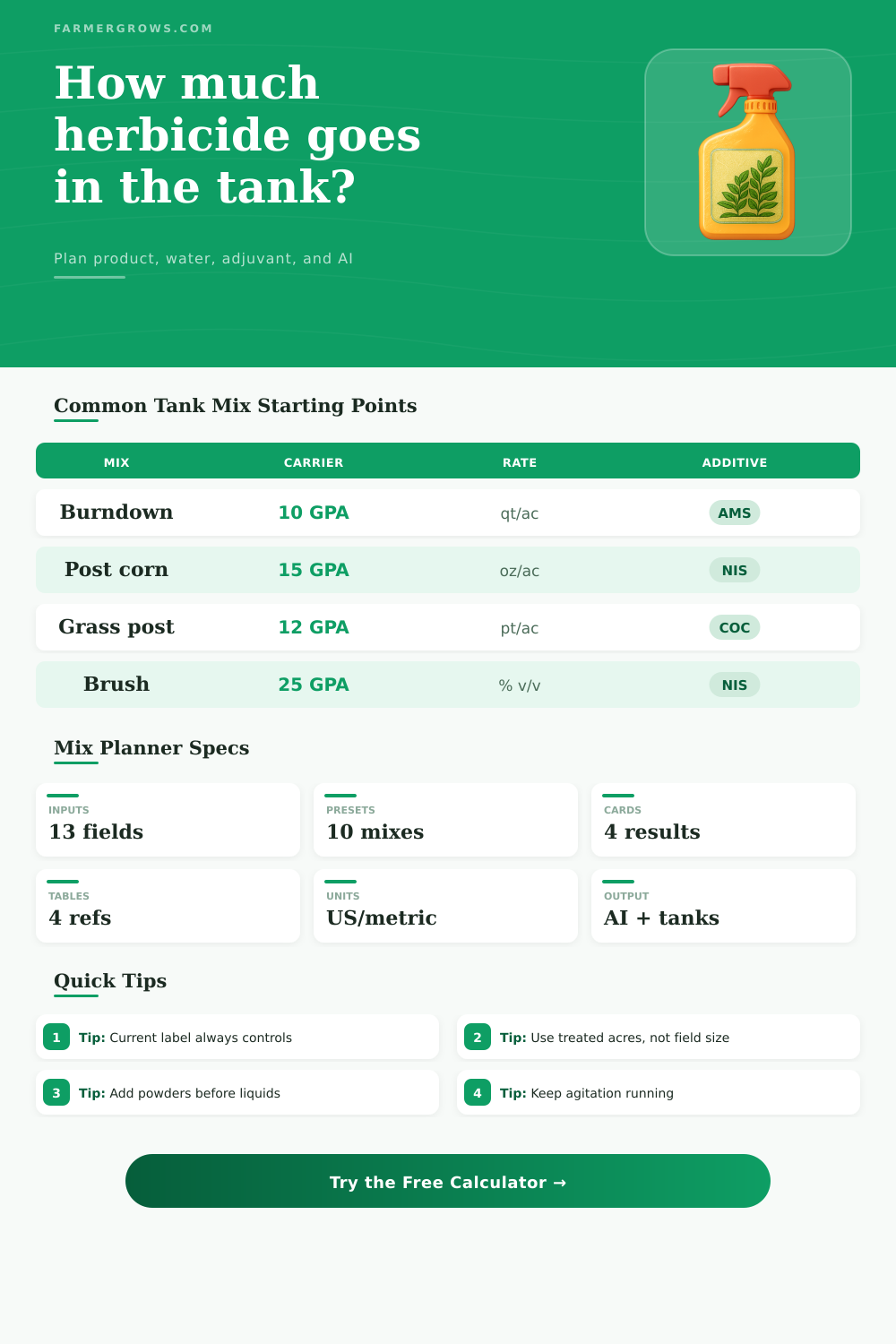
Herbicide Mix Calculator
Estimate spray carrier, product amount, active ingredient, adjuvant, AMS, full tanks, and the partial last tank for common field and spot-spray mixing plans.
Label and safety caveat: This calculator is for planning math only. Always follow the current product label, local regulations, crop restrictions, personal protective equipment requirements, re-entry interval, pre-harvest interval, drift buffers, water-quality directions, and tank-mix compatibility statements. Do not use a preset when its crop, weed stage, geography, or product label does not match your situation.
Best for boom sprayers. Product is based on treated acres and carrier gallons per acre.
Use treated acres only. If bands cover 40% of the field, calculate on that treated fraction.
Common for brush or fence lines. Product is a percent of final spray volume.
Use calibrated walking speed and nozzle output; ounces per gallon only works when label allows it.
Tank Mix Results
Calculated product, carrier, adjuvant, active ingredient, and batch plan.
| Tank size | Carrier rate | Acres per full tank | Metric equivalent |
|---|---|---|---|
| 25 gal ATV sprayer | 20 GPA | 1.25 acres | 94.6 L tank at 187 L/ha |
| 100 gal small boom | 15 GPA | 6.67 acres | 378.5 L tank at 140 L/ha |
| 300 gal pull type | 12 GPA | 25.0 acres | 1,136 L tank at 112 L/ha |
| 500 gal field sprayer | 10 GPA | 50.0 acres | 1,893 L tank at 93.5 L/ha |
| 1,000 gal self-propelled | 15 GPA | 66.7 acres | 3,785 L tank at 140 L/ha |
| Planning value | Conversion | Example result | Use with caution |
|---|---|---|---|
| 1 pt per acre | 16 fl oz per treated acre | 40 acres needs 640 fl oz or 5 gal | Use only when the label rate is pint per acre. |
| 1 qt per acre | 32 fl oz per treated acre | 40 acres needs 1,280 fl oz or 10 gal | Check maximum seasonal and crop-stage limits. |
| 4 lb a.i./gal product | Product gal x 4 = lb active | 10 gal product contains 40 lb a.i. | Acid equivalent may differ from active ingredient. |
| NIS at 0.25% v/v | 0.32 fl oz per gallon spray | 500 gal tank uses 160 fl oz or 5 qt | Some products prohibit surfactant or oil. |
| COC or MSO at 1% v/v | 1.28 fl oz per gallon spray | 500 gal tank uses 640 fl oz or 5 gal | Crop injury risk rises in heat or stress. |
| Dry AMS at 8.5 lb/100 gal | 0.085 lb per gallon spray | 500 gal tank uses 42.5 lb | Dissolve fully before adding herbicide. |
| Order | Addition | What it includes | Practical check |
|---|---|---|---|
| 1 | Water and agitation | Fill tank one-third to one-half with clean water. | Start agitation before any product enters the tank. |
| 2 | Conditioners | AMS, water conditioner, buffering agent if label calls for it. | Allow dry AMS to dissolve before moving on. |
| 3 | Dry formulations | Wettable powders, dry flowables, water-dispersible granules. | Pre-slurry if required and avoid clumps in screens. |
| 4 | Suspensions | Flowables and suspension concentrates. | Shake containers and rinse jugs into the tank. |
| 5 | Solutions and emulsions | Soluble liquids, EC products, oils if allowed. | Watch for heat, crop stress, and compatibility limits. |
| 6 | Surfactants last | NIS, COC, MSO, drift control unless label says otherwise. | Top off with water and keep agitation running. |
| Check | Typical target | Why it matters | Before spraying |
|---|---|---|---|
| Wind speed | Often 3 to 10 mph, label dependent | Calm air can invert; high wind increases drift. | Measure at boom height and observe downwind buffers. |
| Water pH | Many mixes work near pH 5 to 7 | Extreme pH can reduce stability or performance. | Follow label pH and water-conditioning directions. |
| Jar test | Small sample in planned order | Finds settling, gel, flakes, heat, or separation. | Use the same water source and ratios as the tank. |
| Personal protection | Label-specified PPE | Concentrates and aerosols can be hazardous. | Wear PPE before opening containers or rinsing jugs. |
| Cleanout | Label tank-cleaning sequence | Residues can injure the next crop. | Flush boom, screens, end caps, and inductor lines. |
Tank by tank: If the last batch is partial, scale product, AMS, and adjuvant by the actual gallons in that tank. Do not dump a full-tank product amount into a half tank.
Compatibility: When a mix has multiple products, the most restrictive label controls. Run a jar test, keep agitation on, and stop if heat, sludge, separation, or screen plugging appears.
The first thing you do is figure out how many acres will be treated, not whole size of field. Why? Because if it’s a fence line you’re banding or spot-spraying, this will keep your math correct. The second number is what volume of carrier to use. Most labels gives a range. Depending on your sprayer calibration, wind and canopy conditions, etc., you’ll end up somewhere in that range. Enter both those numbers into the calculator and it do the math for you. No more guessing at amount of gallons to mix up.
But there are real tradeoffs in product rate. It’s easy to think a rate of a quart per acre is a given, but you have to convert those quarts to ounces and then multiply by how many acres the tank covers to get math right. Ditto for active ingredient. Checking pounds of active ingredient per gallon ensure that your desired rate aligns with what was expected on label. That’s particularly important when you’re switching from one formulation of a chemical to another. Or when you’ve got two products that appear identical but differ in concentration, that check come in handy.
How to Calculate Your Spray Mix
Then there’s adjuvant. A quarter-percent nonionic surfactant is typical. Some formulations won’t take it. Some specify one percent. Crop oil matters: Oil-based additives change how quickly a product move into the plant. Hot weather and crop stress influence the role of oil-type additives. Hard water require ammonium sulfate as a conditioner, provided it has dissolved prior to addition of herbicide.
Why? This is because the order of mixing are not random. Powders must have time to dissolve. Adding surfactants too early may lock in air bubbles, it could also cause foaming that will hurt agitation. It should of caused issues with the mixing.
There’s also some math involved with your tank size. For example, if I have a 500 gallon tank at 15 gallons an acre, then the tank will cover about 33 acres on one fill up. So if I have a 40-acre field, final load isn’t as big. And you need to scale everything down, the product, the adjuvants, etc. It must fit that partial load. That’s where the calculator comes in. It divides it out for you so you don’t measure a full-tank worth of something into a half-tank worth of volume. This saves product and keeps you from putting down too much product in any given location.
Other factors also matter besides the math core: wind and water pH. The former typically prompts additional precautions with anything over a 10 mph wind at boom height. The latter, very calm conditions may indicate an inversion. And water quality (pH) away from the five-to-eight range can destabilize the active ingredient. That’s why many labels carry water-quality statements, but you won’t find those numbers on the jug.
This is where it gets easy to do as a practical habit. First you measure out treated acres, then go measure your tank size and put in carrier rate. Then the tool cranks out the batch sheet. You take a look at what it says and look back at label one last time before measuring. The calculator handles the math, but whether or not we can even do the plan depends on the label.