Silage Clamp Size Calculator
Size a bunker, bay, or drive-over clamp from forage tonnage, packing density, clamp face geometry, daily feedout, and cover sheet overlap.
Use this as a sizing and planning calculator before final concrete, wall, drainage, and safety design. Actual clamp capacity depends on packing layer depth, forage moisture, crop chop length, wall shape, consolidation, and face management.
Silage Clamp Sizing Results
Results use trapezoid face area: ((floor width + top width) / 2) x packed height, then volume divided by face area.
| Clamp preset | Typical floor width | Typical top width | Packed height | Face area | When it fits |
|---|---|---|---|---|---|
| Small grass bay | 20 to 26 ft | 16 to 24 ft | 7 to 9 ft | 126 to 225 sq ft | Slow feedout, small dairy, sheep, or beef groups |
| Narrow wall clamp | 24 to 30 ft | 24 to 30 ft | 8 to 10 ft | 192 to 300 sq ft | Useful when daily feed is limited and face speed matters |
| Standard dairy bunker | 32 to 40 ft | 28 to 40 ft | 10 to 12 ft | 300 to 480 sq ft | Common maize or grass bay for medium herds |
| Large double bay | 48 to 60 ft | 42 to 60 ft | 12 to 14 ft | 540 to 840 sq ft | High daily use or separate faces for large herds |
| Drive-over wedge pile | 60 to 90 ft | 18 to 34 ft | 8 to 12 ft | 312 to 744 sq ft | No walls, broad floor, sloped sides and ramped ends |
| Profile | Width and height rule | Length formula | Cover note | Management watchout |
|---|---|---|---|---|
| Vertical wall bunker | Top width usually equals floor width | Volume / (width x height) | Line sidewalls, fold top sheet down both sides | Keep removal tool below safe face height |
| Sloped earth clamp | Top width often 1 to 6 ft narrower than base | Volume / (((base + top) / 2) x height) | Allow extra side drop to seal uneven shoulders | Shoulders are harder to pack than the center |
| Drive-over pile | Side slopes often planned near 3 horizontal to 1 vertical | Use trapezoid face, then add ramp length if needed | Order wider sheets or overlap multiple sheets | Wide faces may feed too slowly for small herds |
| Split bay clamp | Use several narrower faces rather than one wide face | Size each bay from its daily ration group | Keep unused bays sealed until opened | Works well when crops or cut dates differ |
| Forage | Usual dry matter | Fresh density target | Dry density check | Clamp sizing note |
|---|---|---|---|---|
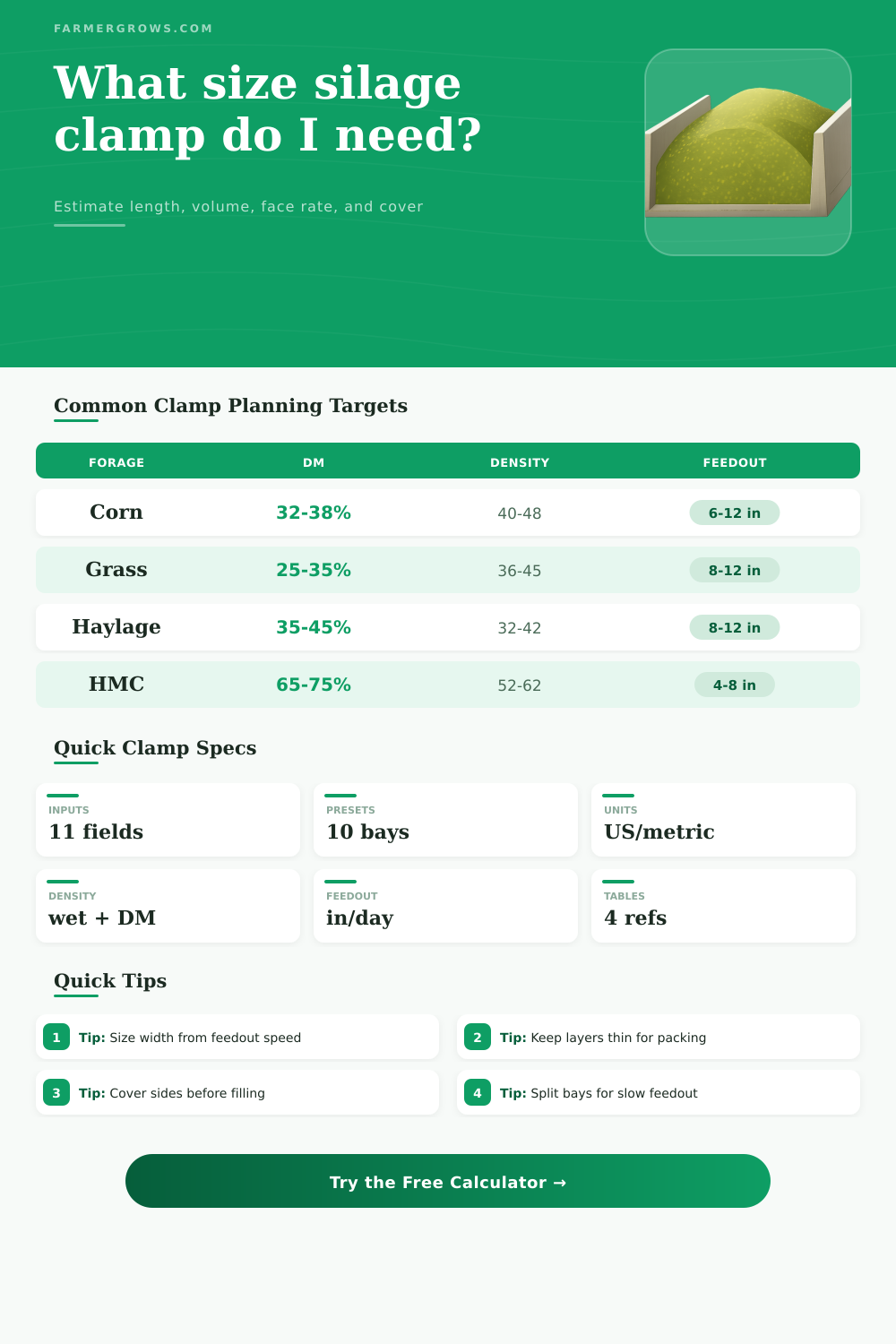
| Corn or maize silage | 30% to 38% | 40 to 48 lb/cu ft | 12 to 16 lb DM/cu ft | High tonnage, often needs long bay or high daily face use |
| Grass silage | 25% to 35% | 36 to 45 lb/cu ft | 10 to 15 lb DM/cu ft | Can be wetter and heavier; watch effluent and compaction |
| Haylage or lucerne | 35% to 50% | 32 to 42 lb/cu ft | 12 to 17 lb DM/cu ft | Drier forage needs extra packing attention and faster feedout |
| Wholecrop cereal | 35% to 45% | 34 to 44 lb/cu ft | 12 to 17 lb DM/cu ft | Kernel processing and chop length affect final density |
| High-moisture corn | 65% to 75% | 52 to 62 lb/cu ft | 34 to 45 lb DM/cu ft | Dense feed; short bay may hold many tons per foot |
| Item | Practical target | Calculation use | Loss guidance | Field note |
|---|---|---|---|---|
| Warm weather face removal | 6 to 12 in/day | Daily volume / face area | Slow faces warm and spoil faster | Use 8 to 12 in/day for riskier forage or hot weather |
| Cool weather face removal | 4 to 6 in/day | Daily volume / face area | Still avoid ragged, loose faces | Smaller herds often need narrower bays |
| Oxygen barrier plus outer sheet | Barrier film under 5 to 8.5 mil poly | Sheet area from top width, length, drop, overlap | Can reduce top-layer dry matter loss versus standard poly | Weight edges with tires, gravel bags, or sidewall strips |
| Sidewall liner | Plastic against concrete before filling | Add side drop or separate liner area | Limits air and water entry at walls | Fold side sheets over the top before the main cover |
| Uncovered or loose cover | Avoid for stored silage | Use higher expected loss if unavoidable | Top 1 to 3 ft carries most visible spoilage risk | Seal immediately after filling and recheck after settling |
Face speed first: If the calculated face removal is below your target, narrow the bay, reduce height, split the crop into multiple bays, or feed from a smaller active face.
Density is earned: Thin filling layers, enough packing tractor weight, fast sealing, sidewall plastic, and a tight cover often matter more than a few extra feet of concrete.
Planning a silage clamp requires you to determine how much space that the forage will take up in three different stages: when the forage is packed, when the forage is covered, and when the forage are fed out. The space requirement for the silage clamp will depend upon the type of crop that will be stored within the silage clamp, the size of the herd to be fed, and the rate at which the worker will move the face of the silage clamp. You must choose the correct size for an silage clamp because choosing the correct size for a silage clamp will save your farm money on both concrete and plastic.
Finally, choosing the correct size for a silage clamp will ensure that the forage is protect from the time that it is packed into the silage clamp until it is finished being fed to the herd. The two measurements of the forage and the methods for use that forage are the two most important factors to consider when planning a silage clamp. Tonnage refers to the total amount of forage that will be included in the silage clamp, but other factor, such as dry matter percentage and packed density are also important factors to consider.
How to plan and size a silage clamp
Dry matter percentage determine how dry the silage will be and how much moisture it will contain; dry crops will contain less moisture than crops like grass. Finally, packed density is important because high-moisture crops like corn will pack differently than dry crops. Tonnage, dry matter percentage, and packed density are three factors that can be used to calculate the total volume of the silage clamp that is require to contain the forage that will be grown on the farm.
Another critical factor in the planning of the silage clamp is the daily feedout rate. Determining the daily feedout rate will help to control the width of the face of the silage clamp. If the face of the silage is moved too slow, the silage can spoil.
If the face of the silage is moved too quickly, it may be necessary to feed from more than one bay of silage at once. By plugging the daily tonnage of the forage into a calculator, the result will be inches of face removal, which can help an owner to determine whether or not the width of the silage clamp will work with the size of the herd that are to be fed. Both the width of the silage clamp and the height of the silage clamp will have an effect upon the length of the silage clamp.
If the width of the silage clamp is increased, the length of the silage clamp will be shortened; however, increasing the width of the silage clamp will also increase the area of the face of the silage. An increased area of the face of the silage will cause the feedout speed to slow. Additionally, if the height of the silage clamp is increased, the length of the silage clamp will also be shortened; however, increasing the height will make it more difficult for the silage clamp to pack efficient and move the face of the silage.
Using a calculator will help an owner to understand the effect of these two variables upon the length of the silage clamp. The cover area for the silage clamp must be calculated in order to order the appropriate amount of plastic for the silage clamp. The cover area include variables like the side drop and the edge overlap of the silage clamp, as these variables will ensure that the plastic will be ordered in sufficient amount to cover the ends and the shoulders of the silage clamp.
If plastic is not ordered in sufficient amounts, air will reach the top layer of the silage clamp, which can lead to the silage spoilage. Spoilaged silage is much more expensive than the cost of plastic. Though the variables and the calculations are important, it is likely that the variables regarding the actual farm that will utilize the silage clamp will be different than those calculated.
For instance, the dry matter percentage of the silage may be higher than calculated, the tonnage may be less because the packing tractor will be less tonnage than expected, or the rate at which the silage clamp is filled will be faster than the rate at which the silage clamp layer can consolidate the silage into the clamp. Though the silage clamp calculator cannot account for all of the variables of the farm, it does provide a starting point for adjusting the width of the silage clamp or splitting the silage clamp into two different areas for feeding. Some of the common mistake that will be made when sizing silage clamps include only calculating the size of the silage clamp for the period of the year when the forage is grown the most, but failing to account for the fact that feedout rates will be slower during the winter months when the herds is lighter.
Additionally, silage clamp designs often assume that the silage will have vertical walls of the silage clamp, but the actual silage will have sloped side, which will reduce the area of the face of the silage clamp. Finally, another common mistake is to forget that if the silage clamp is to be a drive-over silage clamp, it will require extra length for the drive-over ramps for the tractors that will move the silage clamp. These variables should be accounted for in the calculation of the silage clamp, but the numbers can be calculated first so that they are obvious before pouring the concrete for the silage clamp.
The target densities for the silage clamp are important to recognize because the density will have the most significant effect upon the length of the silage clamp. Factors like creating thin layers of silage, making repeated passes with the tractor that will pack the silage, and quickly covering the silage clamp will have a more significant effect upon the length of the silage clamp than adding extra feet of silage clamp wall. Though a silage clamp calculator will allow the farmer to enter the density that they target for the silage clamp, the farmer will have to perform the actual work when the tractor are on the silage clamp.
The goal for the silage clamp is to have a silage clamp that match the feeding rhythm of the herd. If the length of the silage clamp, the rate at which the face of the silage clamp is moved, and the size of the cover area for the silage clamp match the feeding schedule of the farm, the silage will remain cooler and the plastic will remain tight. Finally, if each of these variables match the feeding schedule of the farm, the feedout will be predictable from season to season.