Hay Storage Calculator
Estimate barn floor area, stack dimensions, dry matter retained, storage loss, tarp coverage, and moisture risk for square, large square, round, and wrapped hay bales.
Use practical bale dimensions and moisture readings from your own hay whenever possible. The calculator applies common storage-loss ranges, floor-area buffers, and hay fire thresholds so the result is useful for planning space before the stack is built.
Storage Plan Results
Floor area, stack height, hay retained, and moisture risk are estimated from bale footprint, stacking efficiency, storage method, storage months, and hay moisture.
| Bale type | Common dimensions | Typical weight range | Footprint used | Planning note |
|---|---|---|---|---|
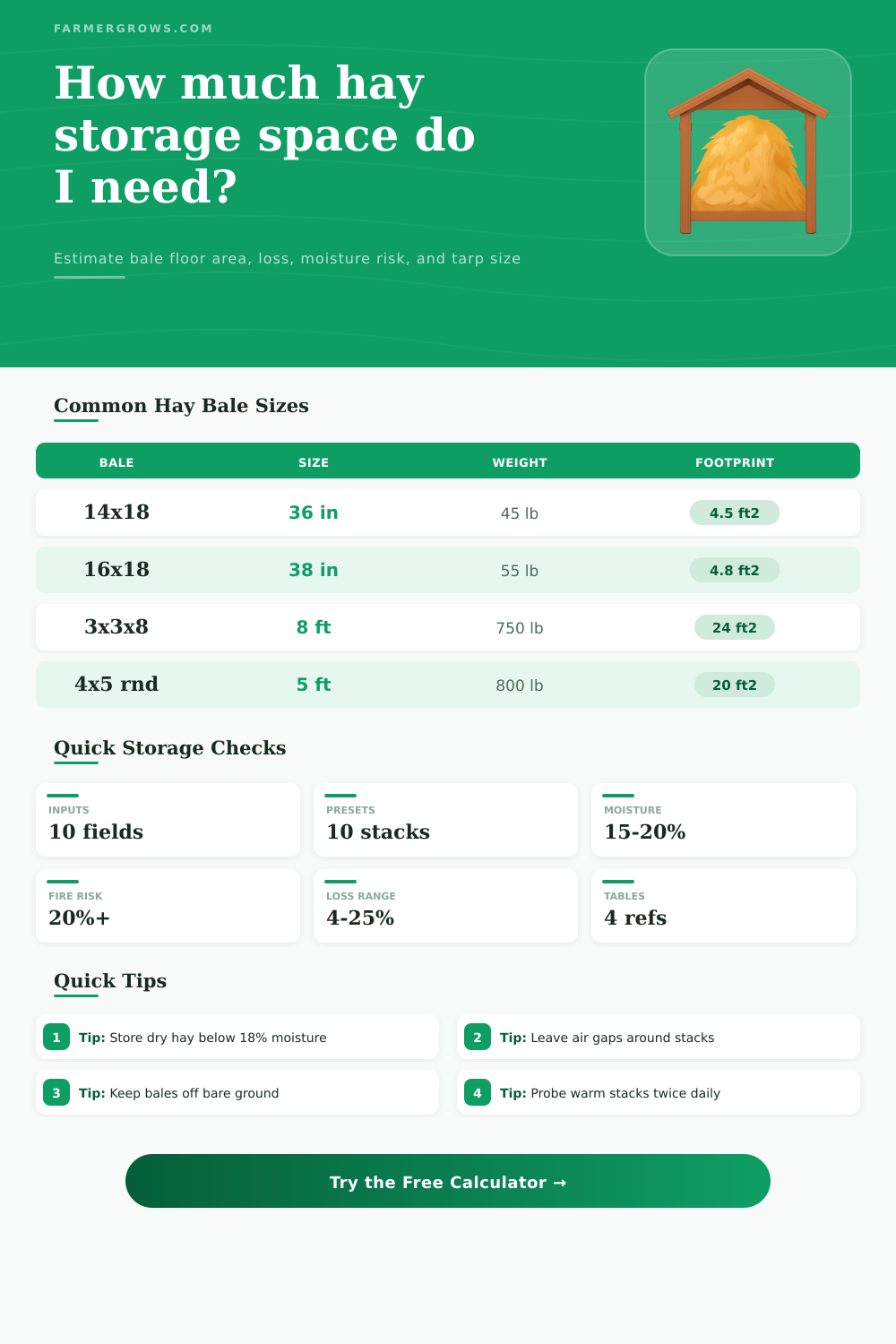
| Small square, 2-string | 14 x 18 x 36 in | 40 to 55 lb | 4.5 sq ft | Often stacked 5 to 8 layers in dry lofts or horse barns |
| Small square, larger chamber | 16 x 18 x 38 in | 50 to 70 lb | 4.75 sq ft | Use actual weight for dense alfalfa or heavy grass hay |
| Three-string bale | 16 x 23 x 44 in | 90 to 120 lb | 7.03 sq ft | Common in western hay markets and sales storage |
| Large square | 3 x 3 x 8 ft | 650 to 850 lb | 24 sq ft | Very efficient in sheds when stacked with a loader |
| Large square | 3 x 4 x 8 ft | 900 to 1,300 lb | 32 sq ft | Plan for equipment reach, stable stacks, and slab capacity |
| Round bale | 4 x 5 ft | 700 to 950 lb | 20 sq ft | Stored end-to-end; outside loss depends heavily on drainage |
| Round bale | 5 x 6 ft | 1,200 to 1,700 lb | 30 sq ft | Higher tonnage per bale but needs larger handling aisles |
| Wrapped baleage | 4 x 4 ft | 900 to 1,300 lb | 16 sq ft | Keep wrap airtight and avoid punctures during storage |
| Hay moisture or stack temperature | Risk level | Recommended action | Why it matters |
|---|---|---|---|
| Dry hay under 15% moisture | Low | Normal storage checks | Usually stable if protected from rain and ground moisture |
| 15% to 18% moisture | Moderate | Allow airflow and monitor new stacks | Mold risk rises as bale density and stack size increase |
| 18% to 20% moisture | Caution | Probe temperature daily for 2 to 3 weeks | Heating is more likely in tight, dense, or poorly ventilated stacks |
| Over 20% moisture in dry hay | High | Separate bales and check temperature often | Heating and quality loss can accelerate quickly |
| Over 25% moisture in dry hay | Danger | Get local fire or extension guidance if heating | Spontaneous combustion risk becomes a serious concern |
| 150°F stack temperature | Warning | Check twice daily and improve ventilation | Temperature is nearing the range where decisions matter |
| 175°F stack temperature | Severe | Call fire department before moving hay | Moving hot hay can introduce oxygen and trigger fire |
| Storage method | Typical 12-month loss | Usual aisle or air allowance | Best-fit bale type | Planning caution |
|---|---|---|---|---|
| Ventilated enclosed barn | 4% to 6% | 12% to 20% | Small square or large square | Do not pack green hay tightly against walls |
| Open-sided hay shed | 6% to 9% | 15% to 25% | Round or large square | Wind-driven rain can damage edge bales |
| Palleted pole barn | 5% to 8% | 14% to 22% | Small square or 3-string | Leave floor ventilation if slab or soil sweats |
| Tight barn, limited airflow | 7% to 12% | 18% to 30% | Dry small squares only | Higher monitoring need above 16% moisture |
| Tarped outdoor stack | 10% to 18% | 20% to 35% | Large square or round | Crown stack and vent tarp sides to reduce condensation |
| Net-wrapped outside | 15% to 25% | 10% to 20% | Round bales | Place on well-drained pad, not low ground |
| Wrapped baleage | 3% to 8% | 8% to 16% | Wrapped rounds | Loss rises fast after wrap punctures |
| Planning item | Rule of thumb | Calculator use | Field check |
|---|---|---|---|
| Small square stack floor | About 4.5 to 4.8 sq ft per bale per layer | Divide by stack layers, then add air and aisle space | Measure actual chamber size and stacking orientation |
| Large square stack floor | 24 to 32 sq ft per bale per layer | Applies high stacking efficiency for straight-sided bales | Check loader lift height and stack stability |
| Round bale floor | Diameter x bale width per bale | Uses lower density to account for round bale voids | Store rows end-to-end with drainage between rows |
| Tarp length | Stack length plus 2 ft tie-down allowance | Adds tie-down slack to calculated stack length | Keep tarp tight enough to shed water but not seal wet hay |
| Tarp width | Stack width plus two side drops | Uses stack height as side drop for a full shed-over cover | Leave bottom edges vented where condensation is likely |
| Barn clear height | Stack layers x bale height plus clearance | Adds your top clearance input to stack height | Confirm lights, trusses, sprinklers, and loader mast clearance |
Moisture first: A perfect floor-area plan cannot rescue hay baled too wet for dry storage. If new hay is above 18% moisture, build smaller stacks, separate suspect lots, and check internal temperature until the heating window passes.
Air and drainage: Leave a real gap along walls, raise hay off damp floors, and crown outdoor stacks. Most storage loss begins where bales touch moisture, not in the dry center of the stack.
Hay storage is a task that require careful planning because hay storage requires that a specific amount of hay be store within a specific amount of space. In some barns, hay bale may dissapear quickly into the storage barn, while in other barns, hay bales may take up most of an available floor space in the barn for the hay loader. The success of hay storage depend upon how well a hay farmer can read the hay stack prior to beginning to build the hay bales into the storage area.
Several different factor will impact how much space is required to store hay bales. Factors like bale shape and bale size will play a critical role in determining how much space will be needed for hay storage. Small square bale can pack tight into smaller areas and can be stacked high, but the small bales will allow for moisture to enter the bales.
How to Plan Hay Storage
Alternatively, large square bales will cover the floor quickly with little effort from the hay loader, but the bales must have a stable footing area, as well as have sufficient space underneath the hay barn for the height of the hay bales. Round bales are efficient in that they leave little area for voids in the storage area, but the voids between rows of round bales will add up to an appreciable amount of wasted space in the storage shed. The hay storage calculator can account for these different factors by entering the dimension for the hay bales that will be stored.
Beyond the type of hay bale that will be stored, different factor impact hay storage. For instance, hay storage sheds that are ventilated will lose less hay to the elements, but will require that hay farmer leave space along the walls of the barn for air movement. Conversely, open shed will protect the hay from the elements, but the exposed edge rows will be subject to rain.
Tarps that cover hay bales will protect beef hay, but the outer layer of hay will lose more moisture when exposed to the outdoor elements. Conversely, hay that is wrapped follow different rules then hay that is stored in other ways. Each storage method will have a different percentage of hay loss, as well as require different space for the aisle between the stored hay bales.
Beyond hay bale type, other factor will impact hay storage. For instance, the moisture level of the hay at the time that it is baled will impact the hay risk level for the winter months. Hay with a moisture content of less than 15% is stable in the storage area.
If the moisture content is 18% or more, the chance of hay heating increase. Finally, if the moisture levels in the hay are high, hay monitoring will change from examining the bales every few days to examining them every 24 hours. Both of these factor can be entered into the hay storage calculator.
Other factors that impact hay storage include height of the hay bales and the height of the roof of the storage shed, as well as the aisles between hay bales. The hay loader will check the height of the hay bales against the height of the storage shed to ensure that he will not hit the barn, and that hay bales will not drip onto the storage area beneath the bales. A buffer area should of been created in addition to the hay bales height requirement.
Additionally, the aisles between hay bales must allow for a hay loader to turn, as well as allow for an individual to monitor the hay without having to move half of the hay stack. The reference tables that are included with the hay storage calculator provide hay farmers with information regarding hay storage methods. These reference tables are not rules that must be followed, but they do provide a starting point for hay farmers with no experience with hay storage to begin to determine what hay storage method works best for their available storage shed.
Given the information on the hay storage calculator, hay farmers will be able to determine if the current storage shed will be able to hold all of the hay that will be grown that season, or if any adjustment must be made to hay purchase, hay stacking or hay covering method. The hay storage calculator can be used prior to hay arrival to establish a hay storage plan that account for the weather, as well as accounts for the hay loader and equipment that is available for hay storage.