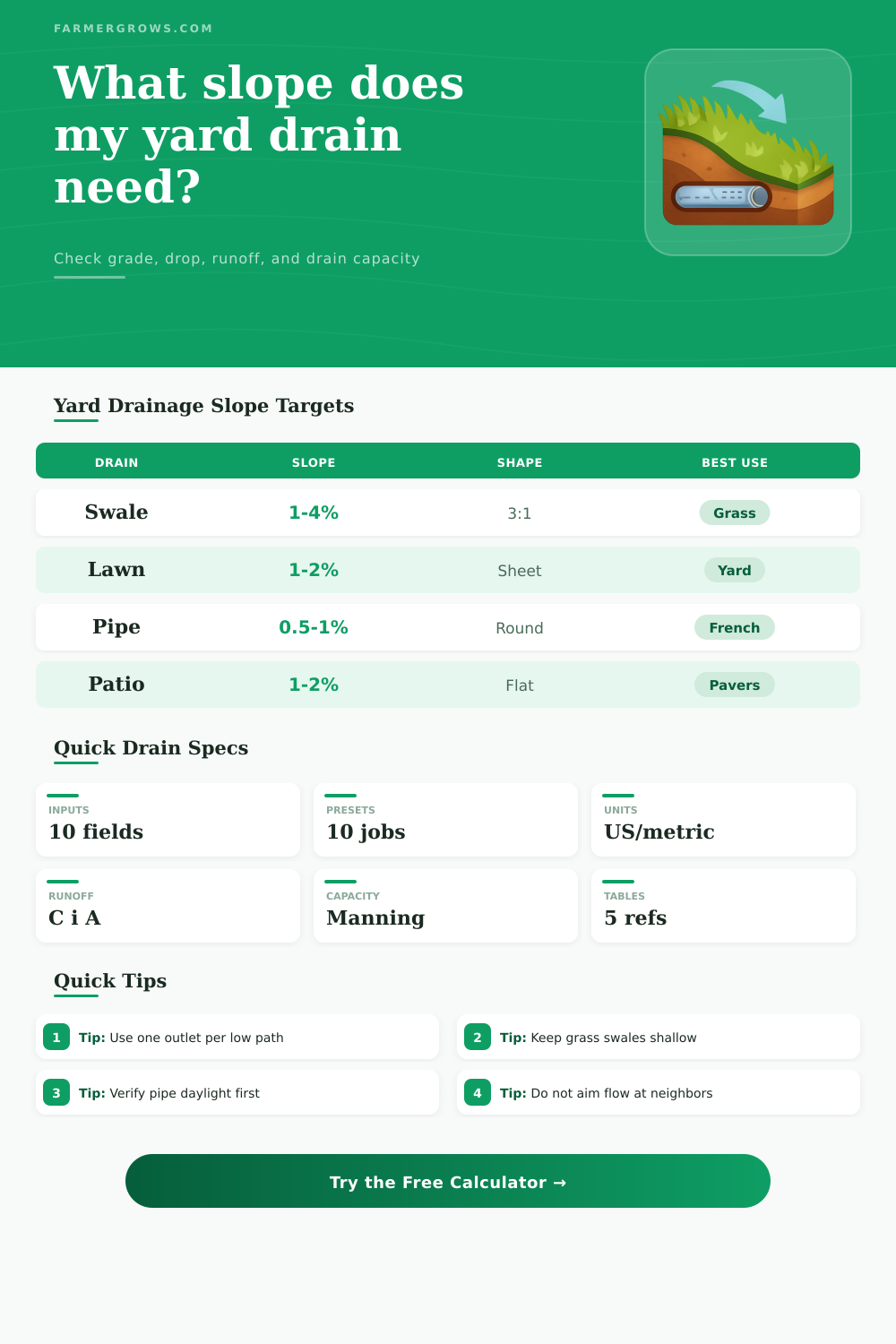
Yard Drainage Slope Calculator
Check an existing grade, design the required drop, estimate storm runoff, and compare pipe or grass swale capacity for wet lawns, side yards, gardens, and farmyard edges.
This calculator is for small yard drainage planning. Always confirm the outlet is legal, daylighted, stable, and does not send concentrated water toward buildings, septic areas, public walks, or neighboring property.
Drainage Grade Results
Results combine measured grade, target drop, Rational Method runoff, and Manning flow capacity for the selected drain path.
| Drainage surface | Practical slope range | Minimum to avoid ponding | Upper caution | Field note |
|---|---|---|---|---|
| Lawn sheet grade | 1% to 2% | About 1% | Over 5% can be hard to mow | Use shallow, broad grade changes instead of sharp cuts. |
| Grass swale | 1% to 4% common | 1% for steady flow | Over 10% needs erosion control | Many landscape guides list swales around 2% to 10% where stable. |
| Patio, walk, pavers | 1% to 2% | 1/8 in per ft | Keep walking comfort in mind | Slope away from buildings and toward a safe collection edge. |
| French drain pipe | 0.5% to 1% | 0.5% with clean outlet | Steeper runs need stable outlet | A 4 in perforated pipe is common for small yard drains. |
| Driveway edge drain | 1% to 5% | 1% for surface flow | Velocity rises on steep paving | Use inlet grates and pipe capacity for concentrated runoff. |
| Surface type | Runoff coefficient used | Typical range | Use when | Adjustment note |
|---|---|---|---|---|
| Sandy lawn | 0.15 | 0.10 to 0.20 | Healthy turf on well-drained soil | Raise if compacted or saturated. |
| Average lawn | 0.30 | 0.20 to 0.35 | Typical residential yard soil | Good default for mixed turf areas. |
| Clay or compacted lawn | 0.40 | 0.35 to 0.50 | Puddling, heavy clay, or worn paths | Use higher values after long storms. |
| Mulched bed | 0.25 | 0.15 to 0.35 | Loose planting beds with cover | Bare soil sheds more water. |
| Gravel drive or path | 0.40 | 0.30 to 0.50 | Compacted stone or farm lanes | Open clean stone can be lower. |
| Roof, concrete, pavers | 0.90 to 0.95 | 0.85 to 1.00 | Hard impervious surfaces | Downspouts create concentrated flow. |
| Swale size | Bottom width | Flow depth | Side slope | Good yard use |
|---|---|---|---|---|
| Small lawn swale | 1 to 2 ft | 2 to 4 in | 4:1 preferred | Subtle side yard drainage where mowing matters. |
| Standard grass swale | 2 to 4 ft | 4 to 8 in | 3:1 or flatter | Backyard and garden edge runoff paths. |
| Farmyard grassed waterway | 4 to 8 ft | 6 to 12 in | 4:1 to 6:1 | Broad flow from sheds, lanes, or paddock edges. |
| Rock-lined swale | 1.5 to 4 ft | 4 to 10 in | 2:1 to 3:1 | Short steeper spots where grass will scour. |
| Rain garden inlet swale | 1 to 3 ft | 2 to 6 in | 3:1 or flatter | Slow delivery into a basin or planted depression. |
| Soil drainage test result | Infiltration class | Planning meaning | Drainage response | Planting note |
|---|---|---|---|---|
| Under 0.25 in/hr | Very slow | Too slow for many rain gardens | Use outleted drains or raised grades | Choose wet-tolerant plants if water remains. |
| Under 1 in/hr | Poor | Standing water likely after storms | Improve soil or add positive drainage | Avoid burying roots in saturated soil. |
| 1 to 3 in/hr | Desirable | Good for most yard plantings | Swales and basins can work well | Mulch helps reduce crusting. |
| Over 4 in/hr | Very fast | Water drains quickly | Slow runoff before it leaves the site | Add organic matter for drought resilience. |
| Pipe or French drain item | Common yard value | Why it matters | Calculator input | Practical check |
|---|---|---|---|---|
| Pipe diameter | 4 in common | Small drains clog and lose capacity faster | Diameter field | Use cleanouts on long runs or bends. |
| Pipe slope | 0.5% to 1% | Maintains flow toward the outlet | Target slope field | Avoid bellies that hold sediment. |
| Trench width | 8 to 12 in | Allows stone envelope around pipe | Reference only | Wrap stone from soil when fines are present. |
| Stone envelope | Washed angular stone | Creates storage and keeps pipe openings clear | Reference only | Do not use dirty stone with clay fines. |
| Outlet protection | Riprap or splash pad | Prevents erosion at concentrated discharge | Capacity result | Never bury an outlet with no daylight. |
Check the outlet first: A perfect 1% trench still fails if the discharge point is flat, blocked, illegal, or aimed at a neighbor. Confirm daylight before digging.
Use capacity with judgment: Manning flow assumes clean geometry. Grass height, leaves, sediment, crushed pipe, frozen soil, and undersized grates can reduce real flow.
When the water sits on the lawn after a storm, the primary cause of the water sitting on the lawn are the slope of the land. A slope may appear flat to the landscape after a sunny day, but it may has traps moisture after it rains. The difference between a dry yard and a soggy yard is often a measurement of less than one inch per foot of land.
Therefore, understanding how the slope of the yard work is a necessity for anyone interested in managing your yard properley. The drainage plan for the land should start with an understanding of where the water will go. When it rains, the water will go to the lowest point in the land that the rain can reach.
How to Fix a Soggy Lawn
That point may be another yard or a foundation of a building that the landowner must consider. Not only must they determine how much water will be moving from one area of the land to another, but they also must ensure that the path for the water will be able to handle the volume of the water moving through that path. The slope can provide two differents elements to a drainage plan.
First, the slope can reveal whether the land naturally moves the water away from the problem area. Second, the slope can indicate how much fall is required in addition to the current slope to ensure proper drainage of the land. The landowner performs these calculations with a calculator that requires the landowner to enter the run length of the land and the drop in elevation of that land.
Most yards has a specific range of slopes for both drainage and staying in bounds of the land. A range for the slope of the land will help to prevent erosion from the land and will keep the grass areas usable for the landowners. The type of surface in the yard can alter how much water can reach the planned drain.
A lawn with sandy soil will allow the water to soak into the ground. Therefore, there will be less runoff from the land. A lawn with clay soil will shed more water then a lawn with sandy soil.
Therefore, if there is clay soil in the yard, it is possible that the swale will get overwhelmed with an additional volume of water. Finally, any areas with roofs or paved areas will send all of the water from the surface to the ground downhill. Based off the volume of water that is expected in the yard and the landowners desire to have the drainage system be visible or not visible, there are three options for drainage systems for lawns.
The landowner can implement a grass swale if the landowner can find a way to create a path for the grass to grow in the area. Another option is a pipe system if the water must travel under a walkway or to remain out of sight. However, both of these systems must have a proper outlet where the water will leave the land as the system will fail if the landowner does not provide one.
Runoff estimates are calculated using the area of the land, the amount of rainfall intensity, and the coefficient of the land. This coefficient is a value that reflects the amount of water that the land will hold in place. A drainage calculator will use these three variables to determine the size of the pipe or the swale that will be constructed.
If the drainage system has a lower capacity than the runoff calculation, then the landowner will have to find other ways to manage the water such as altering the slope of the land or dividing the area of the land. The type of soil in the land will help determine which system is necessary for the drainage plan. Fast-draining soil will allow the land to release the water quickly and may not require a drainage system.
Slow-draining soil will require a drainage system for the land to be able to escape the water that falls on it. One way to determine the type of soil is by the infiltration classes for that land. Many people makes mistakes when planning a drainage system for their lawn.
One of the most common mistakes is to measure the distance of the land from start to finish rather than measuring the land according to how the water will travel on the ground. Using this straight-line distance will provide an underestimation of the distance that the water will have to run. Another mistake is assuming that a steeper slope is better.
However, if the slope is too steep, the grass swale may cut itself too deep in areas during periods of heavy rainfall. The most common mistake is choosing a route for the drainage of the land without considering the outlet for the water. Regardless of how good the drainage route is on the land, it will fail if it does not have an appropriate outlet.
The goal of all of this information regarding drainage systems is to help the landowner understand the tradeoffs in creating a drainage system that will stand the test of time for many seasons. When the grade, the surface, and the outlet of the system are all working together properly, the water will properly move off of the land to the correct location. When the grade, the surface, and the outlet work together properly, the land will remain usable after a downpour.