Rainwater Calculator
Estimate rainwater collection from roofs, barns, sheds, greenhouses, and other catchments, then compare captured gallons or liters against tank size, irrigation demand, and dry-day reserve.
Use this calculator for garden, greenhouse, livestock-yard, orchard, and small farm water planning. Non-potable rainwater systems still need screened inlets, overflow routing, backflow protection, and local code checks.
Rainwater Collection Results
Captured water, tank fill, overflow, and reserve will appear here.
| Catchment surface | Typical coefficient | First flush tendency | Planning note |
|---|---|---|---|
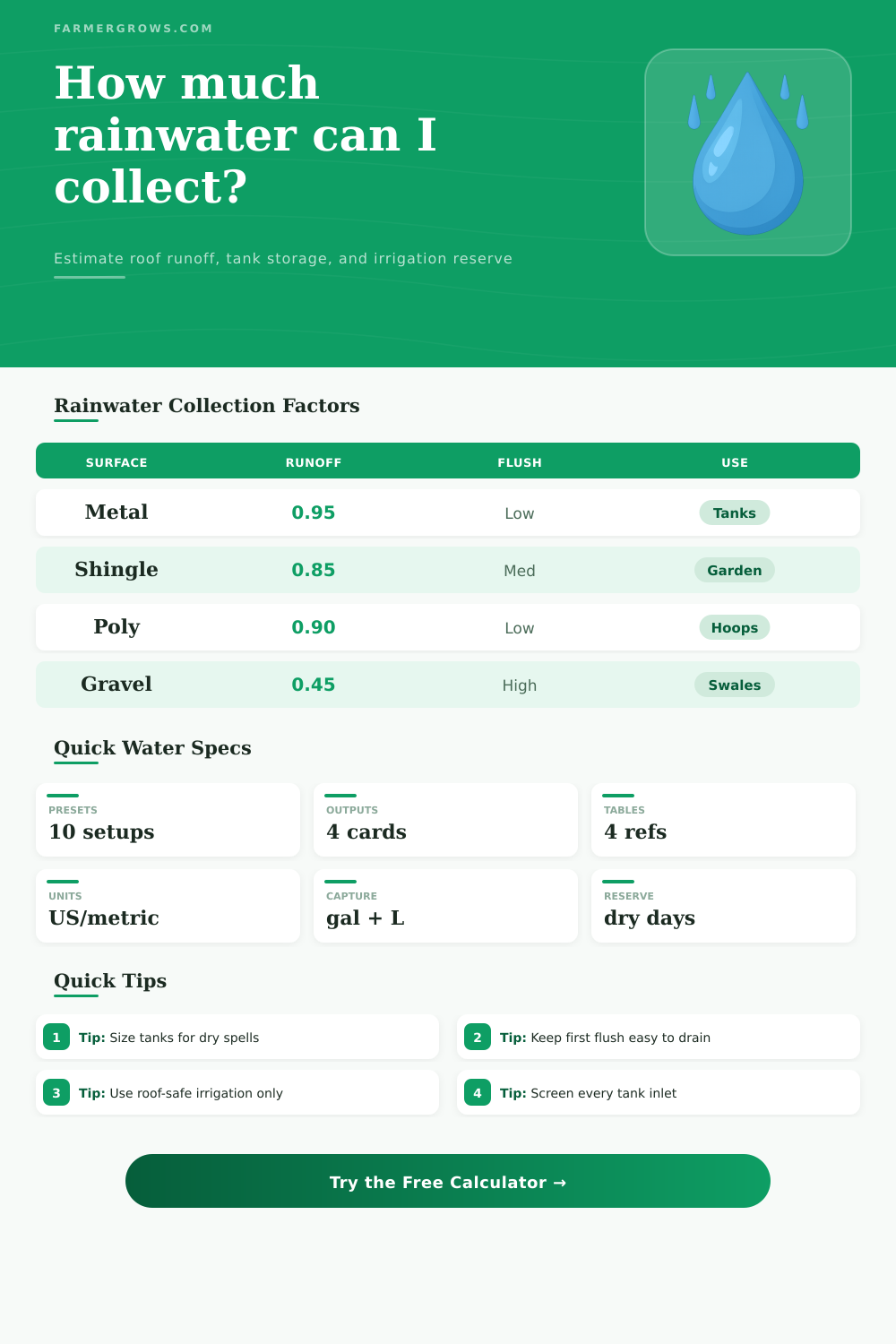
| Painted metal roof | 0.90 to 0.95 | Low to medium | Strong yield if gutters and screens stay clean. |
| Asphalt shingle roof | 0.75 to 0.85 | Medium | Texture holds more water and debris than metal. |
| Tile or concrete roof | 0.80 to 0.90 | Medium | Good catchment, but valleys and laps can slow flow. |
| Poly, glass, or membrane | 0.88 to 0.95 | Low | Common for greenhouses and tunnels with fitted gutters. |
| Ground or gravel catchment | 0.30 to 0.60 | High | Use conservative factors because infiltration changes quickly. |
| Catchment area | 0.5 inch rain | 1 inch rain | 25 mm rain |
|---|---|---|---|
| 250 sq ft / 23.2 sq m | 78 gal / 295 L | 156 gal / 590 L | 154 gal / 583 L |
| 500 sq ft / 46.5 sq m | 156 gal / 590 L | 312 gal / 1,180 L | 309 gal / 1,167 L |
| 1,000 sq ft / 92.9 sq m | 312 gal / 1,180 L | 623 gal / 2,358 L | 617 gal / 2,335 L |
| 2,500 sq ft / 232 sq m | 779 gal / 2,948 L | 1,558 gal / 5,897 L | 1,542 gal / 5,837 L |
| Daily irrigation use | 3 day reserve | 7 day reserve | 14 day reserve |
|---|---|---|---|
| 25 gal/day / 95 L/day | 75 gal / 284 L | 175 gal / 662 L | 350 gal / 1,325 L |
| 75 gal/day / 284 L/day | 225 gal / 852 L | 525 gal / 1,987 L | 1,050 gal / 3,975 L |
| 150 gal/day / 568 L/day | 450 gal / 1,703 L | 1,050 gal / 3,975 L | 2,100 gal / 7,949 L |
| 400 gal/day / 1,514 L/day | 1,200 gal / 4,542 L | 2,800 gal / 10,599 L | 5,600 gal / 21,198 L |
| Use case | Light daily use | Heavy daily use | Notes |
|---|---|---|---|
| Raised beds | 10 to 25 gal | 40 to 80 gal | Mulch and drip tape can reduce demand. |
| Small greenhouse | 30 to 80 gal | 100 to 250 gal | Demand rises sharply in hot sunny weather. |
| Market garden block | 100 to 300 gal | 500 to 1,200 gal | Crop stage and soil water holding drive the range. |
| Washdown or spray water | 25 to 100 gal | 150 to 500 gal | Keep non-potable plumbing labeled and separated. |
Tank sizing: Compare a typical storm capture against the dry-day reserve, not just the biggest rain event. Oversized tanks still need enough roof area and rainfall to refill.
Water quality: Use first flush diversion, leaf screens, mosquito-proof vents, and overflow routing. Treat collected water as non-potable unless the whole system is designed and tested for drinking water.
To plan for the collection of rainwater on a farm, a person must understand the relationships between supply and demand for water. A person must consider the amount of water that falls on a roof of the farm and how much water the farm will need in dry period. If there is a mismatch between these two variables, the rainwater collection system may dry up on the farm.
To avoid this circumstance, it is important to use the calculations to ensure that the system will provide enough water for the farms need. The type of roof that the farmer will use to collect the rainwater will impact how much water is collected. Metal roofs will allow the water to quickly flow into the gutter.
How to Plan Rainwater Collection on a Farm
Asphalt shingles will hold more water because the shingles has a rough surface. Poly film covering the greenhouse might be an efficient way to allow the water to drip into the gutters if the gutters are properly clean and the film is of the proper slope. Each of these different roof type will impact the amount of water that the farm collects.
Additionally, the initial portion of rain may contain sediment that you should account for in the system; the initial portion of rain will not necessarily provide usable water for the farm. One way that the farm can remove the initial portion of rainwater from the system is through the use of a first-flush diversion system. Because the first gallons of rain that fall on the roof will contain the most sediment, these initial gallon can be diverted away from the collection tank.
This system help to keep the sediment from the roof from entering the tank and clog the filters of the tank. The size of this system will depend upon the size of the roof and the amount of sediment that cover the roof. For instance, a small shed will require a different amount of these initial diverted gallons than a large barn roof.
Another important aspect of the system is the size of the collection tank. Many people will want to set the size of the tank based off the size of the largest storm that occur on the farm. However, using this method to size the tank will not account for dry periods on the farm.
Instead, you should size the tank according to the number of dry days that you wish to cover with the collected water and one additional safety margin for dry periods. If the water supply is seasonal and you are to meet the demand for water at the farm, the tank will need to be able to hold all of the water that will be required during the dry periods between seasonal rains. The irrigation demand for the farm will change depending upon the amount of rain that falls and the types of plants that you are to cultivate on the farm.
Raised bed with mulch will require less water than areas without mulch. Areas with greenhouses will require a significant amount of water because the air in the greenhouse can heat up very quick. Additionally, the livestock on the farm will require some water for washing and spraying the animals.
Each of these irrigation demand will need to be measured so that each can be compared to the amount of water that the roof will provide. In addition to the requirements for the tanks, roofs, and irrigation demands, the system will need to include provisions for the overflow of the collected water. An overflow pipe should be installed for the tank so that excess water does not drip onto the foundation of a farm building or spill onto a farm lane.
The overflow pipe should help direct the excess water away from the farm structures and the area where animals live. Additionally, you should install screens on each of the intake for the tank to prevent mosquitoes and debris from entering the tank. While these components may seem unnecessary according to the calculations of supply and demand, these components will help the tank to remain reliable over the years.
Finally, using a calculator to determine the supply and demand for water will help a person understand the limitation of the rainwater collection system. A large roof may not provide as much water as is calculated due to the initial portion of rain and the efficiency of the gutter. A large collection tank may not have enough capacity to store the water that is needed if dry periods last for several days.
Using these calculations will allow a farmer to understand these limitations and to decide how much money they should of spent on purchasing the necesary material to establish the rainwater collection system.