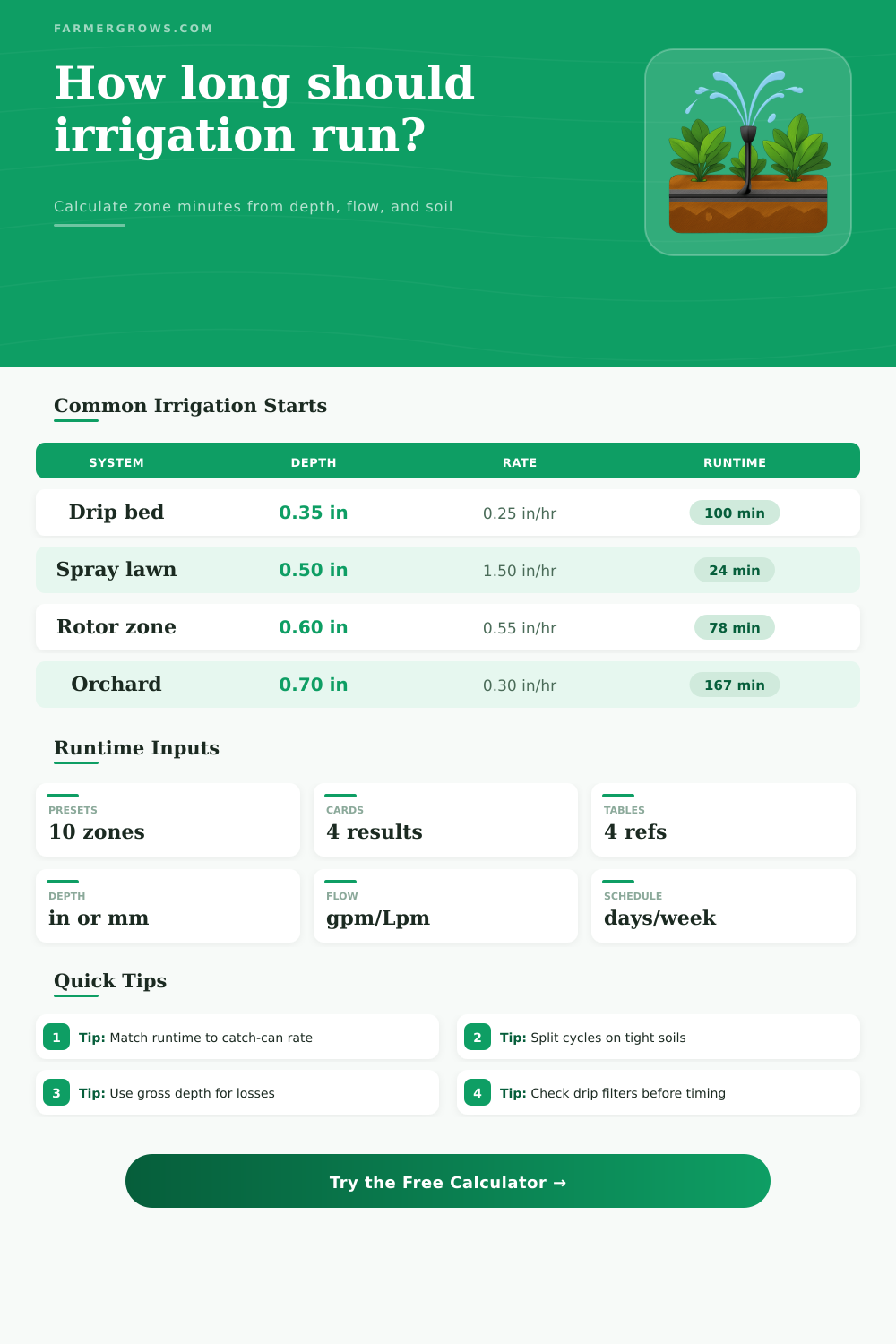
Irrigation Run Time Calculator
Estimate runtime minutes per zone from target water depth, precipitation rate, drip or sprinkler flow, field area, system efficiency, soil intake, and cycle soak limits.
Use measured catch-can precipitation for sprinklers when possible. For drip zones, use total zone flow and wetted area so the calculator can derive an application rate before scheduling cycles.
Runtime Result
Runtime is based on gross depth after efficiency, selected method rate, and cycle limits for intake and controller scheduling.
| Crop or landscape | Typical target per irrigation | Days per week | Runtime note |
|---|---|---|---|
| Seedlings and shallow greens | 0.15 to 0.30 in | 4 to 7 | Shorter frequent cycles keep the seed zone moist |
| Vegetable beds in active growth | 0.35 to 0.60 in | 2 to 4 | Adjust by evapotranspiration and mulch cover |
| Fruit trees and orchard blocks | 0.50 to 0.90 in | 1 to 3 | Deep irrigation works when wetted area is realistic |
| Turf or pasture maintenance | 0.40 to 0.75 in | 2 to 3 | Split cycles if spray or rotor output exceeds intake |
| Greenhouse benches | 0.10 to 0.30 in | 3 to 7 | Use container media moisture, not field depth alone |
| Sprinkler type | Common precipitation rate | 30 min depth | Use case |
|---|---|---|---|
| Fixed spray heads | 1.2 to 2.0 in/hr | 0.60 to 1.00 in | Small lawns, beds, and tight shapes |
| Rotors | 0.35 to 0.75 in/hr | 0.18 to 0.38 in | Larger turf, pasture lanes, and open blocks |
| Impact sprinklers | 0.25 to 0.60 in/hr | 0.13 to 0.30 in | Portable sets and field edges |
| Micro-sprinklers | 0.20 to 0.50 in/hr | 0.10 to 0.25 in | Orchards, nursery stock, and under canopy zones |
| Misters | 0.50 to 1.50 in/hr | 0.25 to 0.75 in | Propagation benches and short pulse irrigation |
| Drip setup | Typical flow reference | Area basis | Runtime caution |
|---|---|---|---|
| Low-flow drip tape | 0.20 to 0.35 gpm per 100 ft | Bed width x tape length | Longer runs need pressure checks at the far end |
| Medium drip tape | 0.45 to 0.65 gpm per 100 ft | Crop row wetted strip | Do not use whole field area if aisles stay dry |
| Dripline emitters | 0.4 to 1.0 gph each | Emitter count x spacing area | Convert emitter count into total zone gpm |
| Tree bubblers | 0.25 to 2.0 gpm each | Canopy or basin area | Deep basins may need several soak cycles |
| Greenhouse drip stakes | 0.5 to 2.0 gph each | Container count x top area | Use leach fraction separately if needed |
| Soil texture | Approx. intake rate | Suggested cycle cap | Soak guidance |
|---|---|---|---|
| Sand or loamy sand | 0.75 to 2.00 in/hr | 45 to 90 min | Shorter intervals may reduce deep loss |
| Sandy loam | 0.50 to 1.00 in/hr | 35 to 60 min | Usually absorbs rotor and drip rates well |
| Loam | 0.25 to 0.60 in/hr | 25 to 45 min | Watch slopes and compacted headlands |
| Clay loam | 0.15 to 0.35 in/hr | 12 to 30 min | Cycle soak is often needed for sprinklers |
| Heavy clay | 0.05 to 0.20 in/hr | 5 to 20 min | Use pulses and inspect for runoff early |
Check the rate: A catch-can test is the fastest way to catch nozzle wear, wind drift, pressure mismatch, and sprinkler overlap errors before changing the controller.
Split the run: When precipitation rate is higher than soil intake, use multiple cycles with soak time so water moves into the root zone instead of leaving the bed or row.
A run time calculator will help you to determine how long to run your irrigation system. A run time calculator is useful because it can change the target depth to the number of minutes that each zone should run. Furthermore, the run time calculator consider the characteristics of each emitter, the characteristics of the soil, and the limitations of the irrigation controller.
Thus, using a run time calculator will allow you to have more accurate control over your irrigation system then simply visually observing if the ground becomes wet. The first step in determining the run time of your irrigation system is to calculate the net water depth that you wish to provide to your root zone. Factors to consider in calculating the depth of water to your root zone is the growth stage of your crop, how much rain has fallen recently, and the amount of water that your plants require before you begin irrigation.
How to Use a Run Time Calculator for Irrigation
The net water depth that is calculated is not the same as the gross water depth that must be irrigated. The net depth must be increased to account for the distribution efficiency of the irrigation system. For instance, sprinkler systems may have a distribution efficiency of 70% due to wind drift, but a drip irrigation system may have a distribution efficiency of 90%.
The distribution efficiency will impact the amount of water that you calculate must be added to each zone, thus impacting the runtime that the zone should have. A run time calculator consider a number of methods to calculate the precipitation rate. One method calculates the precipitation rate based off the measurements of precipitation collected in catch cans throughout the fields.
The other method calculates the precipitation rate based on the total flow of each zone divided by the area that get wet. Another method to calculate the precipitation rate is to use the slower of these two calculated rates. Using these different methods allow for the efficiency of each sprinkler system to be compared to the rated efficiency of the emitters.
Another consideration in setting up an irrigation system is the intake rate of the soil. Water sitting on the surface of the soil does not reach the roots of the plant. If the rate at which the irrigation system waters the soil is faster than the soil intake rate, the water will run off the surface of the soil.
For these situation, the run time calculator will dictate the number of cycles during which the irrigation system will run and the amount of time during which the soil will soak in the water. Using these cycles allow for the irrigation system to remain in operation for a longer period of time but with less runoff of water from the fields. Reference tables provides the intake rates of different textures of soil, as well as the suggested caps for each cycle.
One last consideration before beginning to irrigate your fields is to consider the weekly irrigation schedule. While each zone may take only 40 minutes of irrigation to provide the necessary amount of water to each field, the amount of zones that you have under one irrigation controller may indicate that the total time required for the controller to deliver the needed water is likely outside of the time allotted for irrigation. Therefore, you can calculate how many minutes each zone should run by multiplying the number of days per week that the fields are irrigated by the number of zone.
This calculation will indicate if the fields requires more water than can be provided by the water supply. One of the benefits of implementing a run time calculator is the ability to view how changing one variable will impact the entire irrigation schedule. For instance, if you increase the distribution efficiency of your system (by fixing some of the clogged emitters), the gross water depth will be reduced, leading to a reduction in the runtime of each zone.
Similarly, if you increase the soil intake rate (by adding soil amendments), the number of irrigation cycles will be reduced. These types of calculations would of been difficult for a person to make if they managed a large number of irrigation zones, but are made possible through the use of a run time calculator. A run time calculator accounts for common mistake that are made during the calculation of run time.
For instance, using the total area of the field rather than the wetted area for drip irrigation will lead to an underestimation of the amount of time that the irrigation system should run. Another common mistake is to ignore the overlaps of zones set up by rotor irrigation systems, which may lead to underestimation of the runtime of those zones. By using a run time calculator, individuals is prevented from making these mistakes because they must manually enter each variable into the calculator before starting the timer for the irrigation system.
Furthermore, having a cycle plan created according to the run time calculator allows for a person to make adjustments to the system in response to changing environmental factor.